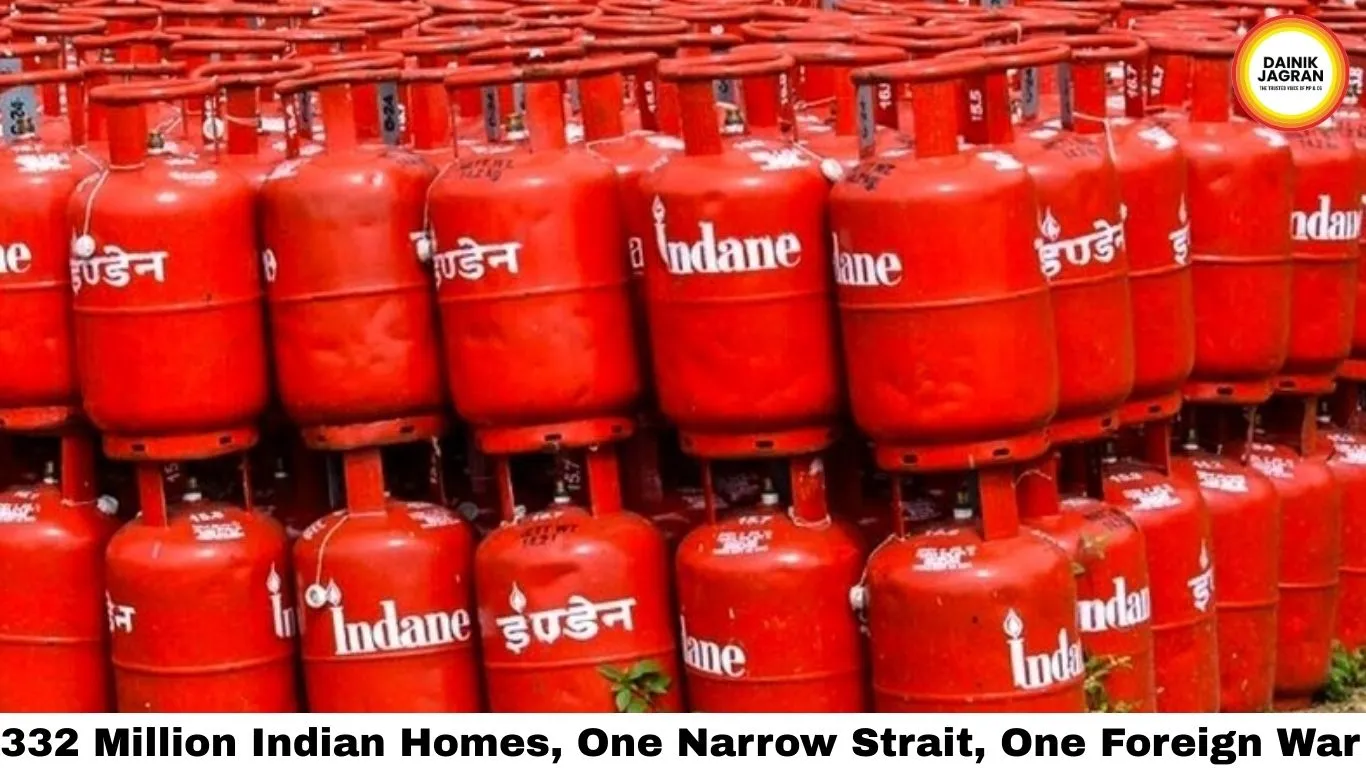
332 Million Indian Homes, One Narrow Strait, One Foreign War — India's LPG Crisis Is the Worst Energy Emergency Since Independence and the Government Is Still Pretending It Isn't
Digital Desk
One Chokepoint. One Billion Three Hundred Million People. Zero Strategic Buffer.
There is a single question at the heart of India's 2026 LPG crisis — a question so fundamental, so long-deferred, and so devastatingly answered by the events of the past fifteen days that the country's entire energy establishment should be sitting with it in uncomfortable silence rather than issuing reassuring press releases.
How did a nation of 1.4 billion people — the world's fourth largest economy, a nuclear power, a country that prides itself on strategic autonomy — allow itself to become so catastrophically dependent on a single maritime chokepoint for the fuel it uses to cook its daily meals?
India's LPG imports account for around 60 per cent of domestic consumption, and about 90 per cent of those imports normally move through the Strait of Hormuz. Thus, roughly 54 per cent of normal LPG availability is directly exposed if the corridor remains shut.
As of January 2026, India has around 332.1 million active domestic LPG connections and 104.29 million Pradhan Mantri Ujjwala Yojana connections — a welfare programme that brought clean cooking fuel to India's poorest households.
Those 104.29 million PMUY connections are the most politically and morally important number in this entire crisis. They represent India's poorest women — the beneficiaries of a flagship government scheme explicitly designed to liberate them from the smoke, the kerosene, and the indoor air pollution of traditional cooking. The Ujjwala Yojana was India's most celebrated welfare initiative of the last decade. And right now, those 104 million households are waiting in queues, paying black market prices, or going back to the firewood they were supposed to have left behind forever.
A foreign war they had no part in, conducted through a strait they have never seen, has reached directly into their kitchens and extinguished the flame that a government scheme lit for them.
The Numbers India's Government Does Not Want You to Calculate
The government of India has maintained, with remarkable consistency throughout this crisis, that there is no LPG shortage. The government maintains that there is no shortage of LPG in the country.
Here is what the government's own data says simultaneously:
In January 2026, India produced 1.158 million tonnes of LPG. Imports stood at 2.192 million tonnes in the same month — meaning imports exceeded domestic production by nearly double.
Qatar accounted for approximately 34 per cent of India's LPG imports. UAE supplied nearly 26 per cent. Kuwait contributed around 8.3 per cent. Saudi Arabia was a major supplier contributing 11 per cent in earlier years. Most of these suppliers export through the Strait of Hormuz — closed since March 1, 2026.
The Strait of Hormuz closed on March 1. India's top four LPG suppliers — Qatar, UAE, Kuwait, Saudi Arabia — all export through the Strait of Hormuz. Together they account for approximately 80 per cent of India's LPG imports. And the government says there is no shortage.
Long queues have been seen outside cooking gas distribution centres across India. Scuffles, protests and panic buying have broken out. The government has asked consumers to avoid panic buying.
Social media is flooded with people standing in long queues across Delhi, Uttar Pradesh, Punjab, Maharashtra and other states DNA India — queues that the government, in its official communications, continues to attribute to panic rather than to the arithmetic of a supply chain that has had its principal artery severed by a war.
When the government says "no shortage" and the queues say otherwise — it is the queues that are telling the truth.
What the Crisis Looks Like, State by State, City by City
This is not a crisis that exists only in data points and government statements. It is a crisis with a face, a voice, and a daily human texture that is playing out from Kashmir to Kanyakumari.
In Bengaluru, hotel associations reported that only 10 per cent of establishments received their gas supplies on March 10. In Mumbai, commercial LPG refill delays ranged from two to eight days.
Nearly 10,000 establishments will shut down in Tamil Nadu alone, according to M. Ravi, president of the Chennai Hotel Association. Mumbai-based AHAR has warned that members are on the "verge of closure."
In Bengaluru, Veerendra Kamat, secretary of the Bengaluru Hotels Association, said most gas companies have stopped supplying commercial cylinders. Restaurants are cutting menus, reducing portions, stretching existing stocks as far as they will go.
The National Restaurant Association of India stated that 75 per cent of India's food service industry depends on LPG — and that a prolonged shortage could cost the economy between ₹1,200 and ₹1,300 crore per day.
₹1,200 to ₹1,300 crore. Per day. From the restaurant sector alone. Not from lost oil revenues, not from industrial disruption, not from the broader macroeconomic cascades of a ₹100-a-barrel oil price — just from the restaurants, dhabas, canteens, street stalls and wedding caterers who cannot cook because the gas has stopped coming.
War-risk insurance premiums for vessels operating in the Gulf have surged in some cases by more than 1,000 per cent, prompting insurers to cancel cover for ships entirely. No insurance means no shipping. No shipping means no LPG. No LPG means no cooking. India TV News The chain of consequences from a war in West Asia to a closed dhaba in Chennai is short, direct, and devastating.
The Government Responds — Better Late Than Never, But Far Too Late
To its credit, the Modi government has not been entirely passive. The sequence of interventions since March 8 represents the most significant emergency energy policy activation India has seen in decades.
On March 8, 2026, the government invoked the Essential Commodities Act through a gazette notification — the Natural Gas Supply Regulation Order 2026 — directing all refineries to maximise LPG yields and channel the entire output of C3 and C4 hydrocarbon streams exclusively to the three Oil Marketing Companies for domestic cooking gas.
The order established a four-tier priority system: Tier 1 — full requirements for domestic PNG, CNG for transport, and LPG production. Tier 2 — fertiliser plants at 70 per cent of requirements. Tier 3 — manufacturing consumers on the national gas grid, capped at 80 per cent. Tier 4 — industrial and commercial CGD consumers, capped at 80 per cent.
Petroleum Minister Hardeep Singh Puri told Parliament that LPG production has been increased by 30 per cent through refinery directives, and further procurement is actively underway.
The government also permitted the temporary use of alternative fuels — biomass, RDF pellets, kerosene and coal — for the hospitality and restaurant sector for one month. An additional 48,000 kilolitres of kerosene will be released to state governments over and above quarterly allocations. DNA India
And in a development that represents India's most significant diplomatic victory of the crisis: Iran recently allowed a couple of ships carrying LPG for India to pass through the Strait of Hormuz — a diplomatic breakthrough facilitated through multiple conversations between External Affairs Minister S. Jaishankar and Iranian Foreign Minister Abbas Araqchi.
Eight LPG tankers are currently positioned just outside the Strait of Hormuz. The government is in contact with Iran to facilitate their movement. Iranian authorities are cooperating in this process — partly because approximately 250 Iranian sailors are currently in India, awaiting repatriation. Wikipedia
The 250 Iranian sailors stranded in India are — in the most unexpected and human way imaginable — India's most valuable diplomatic asset in this crisis. A country whose ships we are asking to let through our most critical supply route has 250 of its own sailors in our care. Jaishankar's diplomacy has converted that humanitarian circumstance into a navigational opening. That is not luck — it is the craft of an experienced foreign minister working every available lever simultaneously.
The Brutal Arithmetic of Why a 30% Production Increase Is Not Enough
The government's 30 per cent domestic production increase sounds reassuring. The mathematics of what it actually means are considerably less so.
Market analysts say that even if refineries manage to increase LPG output by 10 to 20 per cent above current domestic production, domestic supply would only rise to roughly 47 to 50 per cent of total demand — leaving a significant gap that must still be filled through imports. DNA India
India produces 40 per cent of its LPG domestically. A 30 per cent increase in that production yields an additional 12 per cent of total demand. Which means that even at maximum refinery output, India still needs to import approximately 48 per cent of its total LPG requirement — from supply chains that are either blocked, insured at 1,000 per cent premiums, or rerouting through longer, more expensive alternatives.
India has already arranged a 2.2 MTPA US LPG deal for 2026 — equivalent to about 10 per cent of annual imports. Diversification is underway, increasing LPG sourcing from the US, Norway, Canada and Russia. Business Standard Alternative supply is being assembled — but it cannot be assembled at the speed of a war-driven closure of the world's most critical energy corridor.
The gap between available supply and national demand is real. The queues are the evidence. The ₹1,300 crore daily restaurant economy loss is the cost. The firewood and coal smoke rising from restaurants and dhabas across the country is the visible, environmental, health-damaging proof.
Operation Sankalp: India's Naval Commitment to Its Own Fuel Lines
In a development that has received insufficient media attention relative to its strategic significance, India has activated a naval operation specifically dedicated to protecting its energy supply chains.
India activated Operation Sankalp — a naval operation to protect energy shipments in the Arabian Sea and the Gulf of Oman. New Kerala Indian Navy vessels are now positioned to provide escort and security to LPG and crude tankers attempting to transit the Strait of Hormuz or navigate around it.
This is not a symbolic gesture. It is the activation of hard power in direct service of domestic energy security — an acknowledgement that India's dependence on imported fuel has reached a threshold where the Navy must be deployed not in pursuit of strategic geopolitical objectives but simply to ensure that the country's kitchens can function.
That sentence deserves to be read slowly. India is deploying its Navy to ensure its kitchens can function. That is the real, material, everyday consequence of two decades of energy import dependence combined with zero strategic LPG reserves and the complete absence of a domestic buffer capable of absorbing an external shock of this magnitude.
The Five Failures That Built This Crisis — And Must Never Be Allowed to Repeat It
The 2026 LPG crisis is not a natural disaster. It is the entirely predictable, extensively documented, repeatedly warned-about consequence of specific policy failures that accumulated over decades. Here are the five that matter most:
The first and most fundamental is the absence of strategic LPG reserves. India holds roughly 100 million barrels of crude oil in refinery and commercial reserves — providing some buffer. But there are no equivalent strategic LPG reserves. Business Standard India built strategic petroleum reserves for crude oil. It never built equivalent reserves for the fuel that 332 million households use to cook their meals. The result is that a fortnight of supply disruption — not months, not years, a fortnight — has produced queues, shutdowns and a declared national emergency.
The second is the catastrophic concentration of import sources. Qatar alone accounted for 34 per cent of India's LPG imports. New Kerala Three suppliers — Qatar, UAE and Kuwait — together accounted for nearly 70 per cent. All through the same strait. Diversification was discussed in policy documents for a decade. It was not executed with the urgency the risk demanded.
The third is the failure to expand PNG networks fast enough. Piped Natural Gas can help in urban areas, though it also partly depends on imported gas. India has 143.60 GW of cumulative solar capacity, and 195 compressed biogas plants being set up across the country. Business Standard The infrastructure for diversified cooking energy existed in blueprint form. The political will to fund and accelerate it did not match the scale of the vulnerability it was meant to address.
The fourth is the subsidy architecture that made LPG politically untouchable. The price of cooking gas is, as one analysis noted, a hotly debated issue during elections — with five Indian states due to go to the polls in the first half of 2026. National Herald India Any serious reform of India's LPG import dependence required political decisions — on pricing, on investment, on infrastructure — that were perpetually deferred because LPG cylinders are votes. The crisis is, in part, the cost of that deferral.
The fifth is the absence of a genuine demand-side response before the crisis hit. The government is now asking people to shift to PNG, use induction stoves and avoid panic buying. These are conversations that should have been happening, with government investment and public campaigns, for the past five years.
The People Paying the Price That Policy Makers Deferred
Every policy failure has a human face. India's LPG crisis of 2026 has 332 million of them.
Long queues have formed outside gas distribution centres. Scuffles have broken out. Protests have erupted. Governments have asked office workers to work from home, shut universities and started rationing fuel as restaurants close.
A woman in Chandigarh named Sonu told a reporter simply: "Thank God, I got my LPG yesterday." That sentence — raw, relieved, spoken by a woman who experienced the procurement of her family's cooking fuel as cause for gratitude rather than expectation — is the most honest summary of what India's 2026 LPG crisis has done to ordinary life.
When getting your gas cylinder becomes a cause for thankfulness rather than a routine transaction, something has broken. Not in the individual. In the system that was supposed to guarantee her access to a fuel she was promised — on television, in government schemes, in the language of a welfare state — would always be available.
The Diplomatic Breakthrough That Offers a Thread of Hope
In the midst of the crisis, India's most consequential intervention has been diplomatic rather than military or logistical.
India is engaged in high-level diplomatic discussions to ensure safe passage for LPG shipments — including multiple telephonic conversations between External Affairs Minister S. Jaishankar and Iranian Foreign Minister Abbas Araqchi. India is also considering naval escorts to ensure the safe return of its fuel tankers.
Iran granted safe passage to two gas tankers through the Strait of Hormuz — India's biggest diplomatic win of the crisis. Eight more tankers are positioned outside the strait awaiting clearance.
This is Jaishankar's foreign policy philosophy — strategic autonomy, multi-alignment, relationships maintained across every axis of global power — delivering its most concrete, most tangible, most kitchen-level result. India's decades-long cultivation of a relationship with Iran that was independent of American pressure has created a channel of communication that no other major democracy can currently access. And through that channel, gas tankers are moving.
It is not enough. It is not fast enough. It does not resolve the structural vulnerabilities that this crisis has exposed. But it is real — and it is the product of foreign policy decisions that were made long before anyone knew this war was coming.
Conclusion: The Fire That Must Not Go Out — And the Lessons That Cannot Be Forgotten
A country of India's scale cannot allow clean-cooking resilience to depend excessively on a single imported fuel passing through a single strategic chokepoint. This does not imply a rapid retreat from LPG, which remains central to household cooking. It does suggest a broader portfolio — piped natural gas in urban areas, electric cooking, and bioenergy over the medium term. On the supply side, India's 143.60 GW of solar capacity and the 195 compressed biogas plants being set up offer a path toward genuine energy diversification.
The Strait of Hormuz will not remain closed forever. Iran's new Supreme Leader has called it a "tool to pressure the enemy" — suggesting he intends to reopen it as a bargaining chip rather than close it permanently. National Herald India The eight LPG tankers waiting outside will eventually move. The queues will eventually shorten. The dhabas will eventually reopen.
But when they do — when the gas flows again and the flame returns to 332 million Indian stoves — the government of India must not allow the relief of the moment to erase the lessons of the crisis. Because the next war, the next closure, the next geopolitical shock to a supply chain built on assumptions of permanent stability will arrive — and it will arrive without warning, as this one did, into the kitchens of the poorest households in the country.
The short to medium term economic response rests on three instruments: prioritisation, diversification, and logistics strengthening. Business Standard Those three words — prioritisation, diversification, logistics — must be written on the wall of every energy ministry office in India. Not as a crisis response. As a permanent operating principle.
The LPG Control Order of 2026 is India's emergency response to a fire that is already burning. What India now needs — urgently, structurally, permanently — is the architecture to ensure that the next match cannot start this fire again.
332 million homes. One narrow strait. One foreign war that had nothing to do with India.
Never again.
.jpg)