India’s Gen Z Voters Could Redefine Politics Before the 2029 Election
Saumya Gupta
India’s youngest electorate is large, digitally connected and increasingly willing to mobilise around jobs, examinations and accountability. But political influence will depend on voter registration, turnout and whether online anger becomes sustained electoral participation.
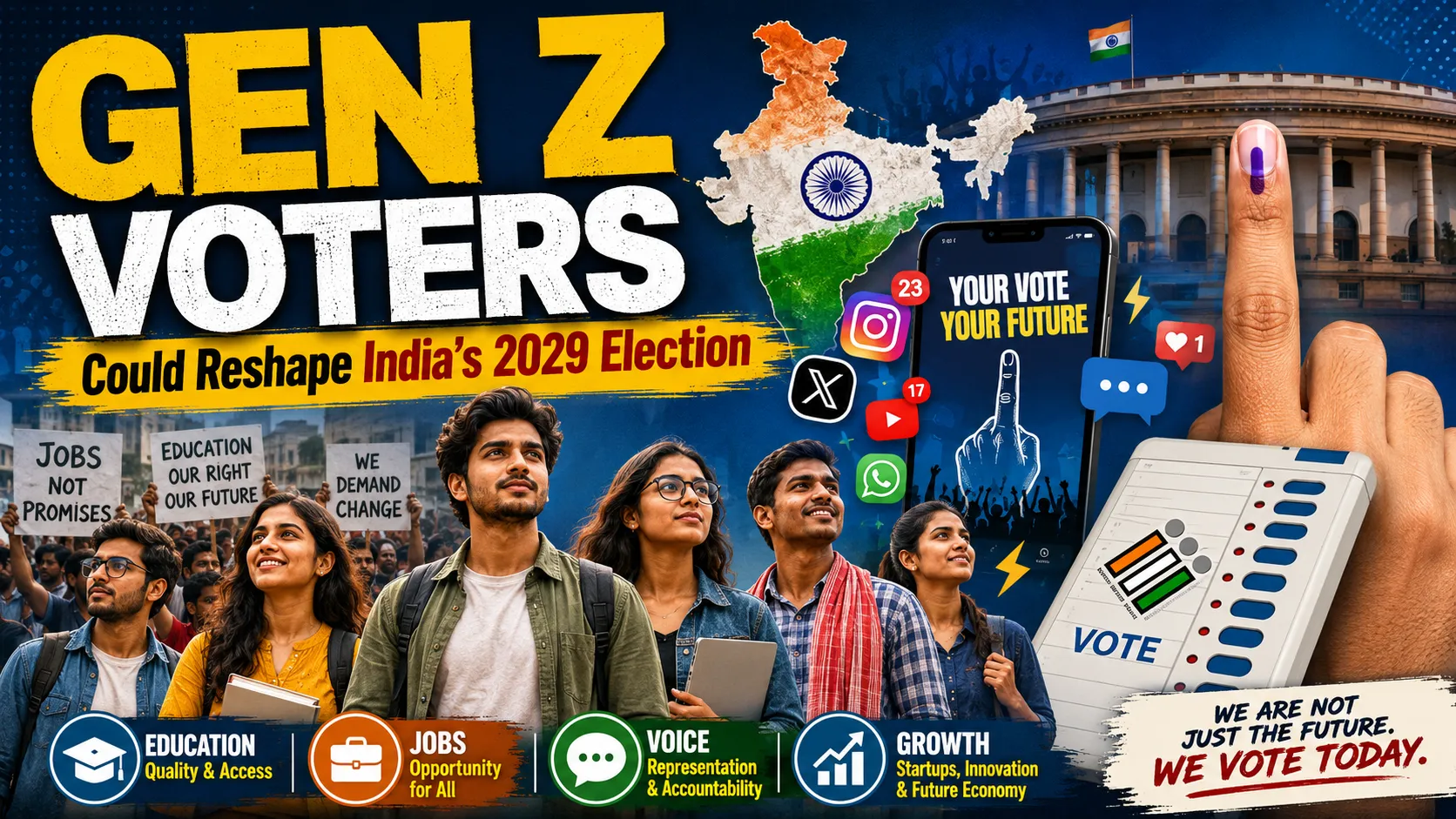
India’s Gen Z is emerging as a political force that parties can no longer treat merely as a social-media audience. By the 2029 Lok Sabha election, nearly everyone born in the first decade of this century will be eligible to vote, placing a vast generation of young adults at the centre of India’s electoral contest.
Definitions of Gen Z vary, but it generally covers people born from the late 1990s to the early 2010s. India already has more than 382 million people aged between 10 and 24, according to the United Nations Population Fund. Not all are voters, and it would be misleading to describe the entire group as an electoral bloc today. The demographic scale, however, is unmistakable.
The Election Commission recorded more than 96.88 crore registered electors ahead of the 2024 Lok Sabha election. Its electoral atlas separately identifies voters aged 18 to 29 as the youngest major age cohort, though their proportion varies considerably across states and Union Territories.
Not One Voting Bloc
The phrase “Gen Z vote” can create the false impression that young Indians think alike. They do not.
An engineering graduate seeking a government job in Bhopal may have different priorities from a gig worker in Bengaluru, a tribal student in Bastar, a first-time woman voter in rural Madhya Pradesh or a young entrepreneur in Mumbai.
Caste, religion, gender, income, language, education and location continue to shape voting behaviour. Family preferences and local political networks also remain influential, particularly outside large cities.
Gen Z’s importance therefore does not come from uniformity. It comes from scale and from the possibility that a few shared concerns could influence close contests across many constituencies.
Jobs Are The Fault Line
Employment is likely to remain the most powerful issue.
A recent Reuters assessment of India’s youth crisis placed youth unemployment at 9.9%, more than three times the overall rate. It also highlighted a deeper frustration: even educated young people often struggle to convert qualifications into secure, salaried work.
The concern is not simply whether jobs exist. Young voters increasingly judge the quality of work—salary, security, career growth and whether their education has any connection to available opportunities.
Government vacancies, delayed recruitment, cancelled examinations and paper leaks sharpen this anxiety. A candidate may spend years preparing for one examination, only to face postponement, litigation or allegations of fraud.
That makes examination integrity an economic issue, not merely an education issue.
NEET Changed The Mood
The NEET paper leak controversy demonstrated how quickly a student grievance can become a national political challenge.
What began as anger over an examination expanded into a wider debate about institutional credibility, unemployment and the treatment of protesters. Youth-led mobilisation eventually forced policy concessions and the resignation of Union Education Minister Dharmendra Pradhan, according to multiple reports.
The episode challenged the assumption that young Indians are politically apathetic. It showed that satire, short-form videos and decentralised digital networks can bring together people who do not belong to traditional student unions or political parties.
However, protest strength does not automatically translate into votes. Electoral influence requires registration, turnout, constituency-level organisation and a clear choice among candidates.
Politics Moves To Phones
Gen Z encounters politics differently from earlier generations.
Political messages now travel through reels, memes, YouTube explainers, messaging groups, influencers and short clips extracted from speeches. This creates faster engagement but also a more fragmented information environment.
Research on Indian social media has documented coordinated political amplification, including campaigns that slightly alter the same message and distribute it across accounts and platforms. Other studies have shown how organised WhatsApp networks were used to influence political trends during earlier Indian elections.
Young voters may be skilled internet users, but that does not automatically make them resistant to manipulated content. Deepfakes, misleading edits and emotionally charged misinformation will become a larger election risk by 2029.
Parties that rely only on viral content may win attention without building trust.
MP-CG Stakes Are High
The Gen Z shift will matter greatly in Madhya Pradesh and Chhattisgarh, where education, recruitment and migration remain major youth concerns.
In both states, large numbers of students prepare for medical, engineering, teaching, police and administrative examinations. Young people from smaller towns often move to Bhopal, Indore, Raipur, Delhi, Kota or other educational centres, placing financial pressure on families.
In tribal and rural districts, the concerns can be different: access to colleges, internet connectivity, transport, language barriers and the absence of formal employment close to home.
A political party that speaks only about start-ups and artificial intelligence may fail to connect with a young voter waiting for a delayed constable recruitment result. Equally, a party promising only government jobs cannot address the aspirations of a generation entering private employment, freelancing and entrepreneurship.
What Parties Must Change
Political parties will need to move beyond symbolic youth outreach.
They must publish credible recruitment calendars, protect examination systems, expand apprenticeships and explain how economic growth will produce stable employment. They will also need candidates who can answer difficult questions directly rather than relying on slogans or staged social-media interactions.
Policies on affordable education, housing, public transport, mental wellbeing, digital rights and climate resilience may gain greater electoral weight.
The strongest youth message will not necessarily come from the party with the largest digital campaign. It may come from the party that can show measurable delivery.
Power Depends On Turnout
Gen Z could become one of India’s most influential political generations by 2029, but demographics alone do not guarantee power.
Millions of eligible young people must first register correctly, remain on electoral rolls and vote. They must also distinguish between political participation and online performance.
For parties, the warning is clear: young citizens cannot be treated only as beneficiaries, volunteers or social-media followers. They are increasingly demanding accountability as voters.
For India’s Gen Z voters, the next step is equally important. Protest can force attention, but sustained electoral participation will determine whether that attention changes public policy.
Key Numbers
| Indicator | Available estimate |
|---|---|
| India’s total population in 2025 | 1.4639 billion |
| Indians aged 10–24 | More than 382 million |
| Registered electors before 2024 Lok Sabha polls | 96.88 crore |
| Reported youth unemployment rate in 2026 | 9.9% |
| Next scheduled Lok Sabha election | 2029 |
The age groups above do not exactly match the definition of Gen Z. They indicate the demographic and electoral scale rather than the precise number of Gen Z voters.
--------
🚨 Beat the News Rush – Join Now!
Get breaking alerts, hot exclusives, and game-changing stories instantly on your phone. No delays, no fluff – just the edge you need. ⚡
Tap to join:
🟢 WhatsApp Channel: Dainik Jagran MP CG
Crave more?
🅕 Facebook: Dainik Jagran MP CG English
🅧 Twitter (X): Dainik Jagran MP CG
🅘 Instagram: Dainik Jagran MP CG
Share the fire – keep your crew ahead! 🗞️🔥
India’s Gen Z Voters Could Redefine Politics Before the 2029 Election
Saumya Gupta
India’s Gen Z is emerging as a political force that parties can no longer treat merely as a social-media audience. By the 2029 Lok Sabha election, nearly everyone born in the first decade of this century will be eligible to vote, placing a vast generation of young adults at the centre of India’s electoral contest.
Definitions of Gen Z vary, but it generally covers people born from the late 1990s to the early 2010s. India already has more than 382 million people aged between 10 and 24, according to the United Nations Population Fund. Not all are voters, and it would be misleading to describe the entire group as an electoral bloc today. The demographic scale, however, is unmistakable.
The Election Commission recorded more than 96.88 crore registered electors ahead of the 2024 Lok Sabha election. Its electoral atlas separately identifies voters aged 18 to 29 as the youngest major age cohort, though their proportion varies considerably across states and Union Territories.
Not One Voting Bloc
The phrase “Gen Z vote” can create the false impression that young Indians think alike. They do not.
An engineering graduate seeking a government job in Bhopal may have different priorities from a gig worker in Bengaluru, a tribal student in Bastar, a first-time woman voter in rural Madhya Pradesh or a young entrepreneur in Mumbai.
Caste, religion, gender, income, language, education and location continue to shape voting behaviour. Family preferences and local political networks also remain influential, particularly outside large cities.
Gen Z’s importance therefore does not come from uniformity. It comes from scale and from the possibility that a few shared concerns could influence close contests across many constituencies.
Jobs Are The Fault Line
Employment is likely to remain the most powerful issue.
A recent Reuters assessment of India’s youth crisis placed youth unemployment at 9.9%, more than three times the overall rate. It also highlighted a deeper frustration: even educated young people often struggle to convert qualifications into secure, salaried work.
The concern is not simply whether jobs exist. Young voters increasingly judge the quality of work—salary, security, career growth and whether their education has any connection to available opportunities.
Government vacancies, delayed recruitment, cancelled examinations and paper leaks sharpen this anxiety. A candidate may spend years preparing for one examination, only to face postponement, litigation or allegations of fraud.
That makes examination integrity an economic issue, not merely an education issue.
NEET Changed The Mood
The NEET paper leak controversy demonstrated how quickly a student grievance can become a national political challenge.
What began as anger over an examination expanded into a wider debate about institutional credibility, unemployment and the treatment of protesters. Youth-led mobilisation eventually forced policy concessions and the resignation of Union Education Minister Dharmendra Pradhan, according to multiple reports.
The episode challenged the assumption that young Indians are politically apathetic. It showed that satire, short-form videos and decentralised digital networks can bring together people who do not belong to traditional student unions or political parties.
However, protest strength does not automatically translate into votes. Electoral influence requires registration, turnout, constituency-level organisation and a clear choice among candidates.
Politics Moves To Phones
Gen Z encounters politics differently from earlier generations.
Political messages now travel through reels, memes, YouTube explainers, messaging groups, influencers and short clips extracted from speeches. This creates faster engagement but also a more fragmented information environment.
Research on Indian social media has documented coordinated political amplification, including campaigns that slightly alter the same message and distribute it across accounts and platforms. Other studies have shown how organised WhatsApp networks were used to influence political trends during earlier Indian elections.
Young voters may be skilled internet users, but that does not automatically make them resistant to manipulated content. Deepfakes, misleading edits and emotionally charged misinformation will become a larger election risk by 2029.
Parties that rely only on viral content may win attention without building trust.
MP-CG Stakes Are High
The Gen Z shift will matter greatly in Madhya Pradesh and Chhattisgarh, where education, recruitment and migration remain major youth concerns.
In both states, large numbers of students prepare for medical, engineering, teaching, police and administrative examinations. Young people from smaller towns often move to Bhopal, Indore, Raipur, Delhi, Kota or other educational centres, placing financial pressure on families.
In tribal and rural districts, the concerns can be different: access to colleges, internet connectivity, transport, language barriers and the absence of formal employment close to home.
A political party that speaks only about start-ups and artificial intelligence may fail to connect with a young voter waiting for a delayed constable recruitment result. Equally, a party promising only government jobs cannot address the aspirations of a generation entering private employment, freelancing and entrepreneurship.
What Parties Must Change
Political parties will need to move beyond symbolic youth outreach.
They must publish credible recruitment calendars, protect examination systems, expand apprenticeships and explain how economic growth will produce stable employment. They will also need candidates who can answer difficult questions directly rather than relying on slogans or staged social-media interactions.
Policies on affordable education, housing, public transport, mental wellbeing, digital rights and climate resilience may gain greater electoral weight.
The strongest youth message will not necessarily come from the party with the largest digital campaign. It may come from the party that can show measurable delivery.
Power Depends On Turnout
Gen Z could become one of India’s most influential political generations by 2029, but demographics alone do not guarantee power.
Millions of eligible young people must first register correctly, remain on electoral rolls and vote. They must also distinguish between political participation and online performance.
For parties, the warning is clear: young citizens cannot be treated only as beneficiaries, volunteers or social-media followers. They are increasingly demanding accountability as voters.
For India’s Gen Z voters, the next step is equally important. Protest can force attention, but sustained electoral participation will determine whether that attention changes public policy.
Key Numbers
| Indicator | Available estimate |
|---|---|
| India’s total population in 2025 | 1.4639 billion |
| Indians aged 10–24 | More than 382 million |
| Registered electors before 2024 Lok Sabha polls | 96.88 crore |
| Reported youth unemployment rate in 2026 | 9.9% |
| Next scheduled Lok Sabha election | 2029 |
The age groups above do not exactly match the definition of Gen Z. They indicate the demographic and electoral scale rather than the precise number of Gen Z voters.