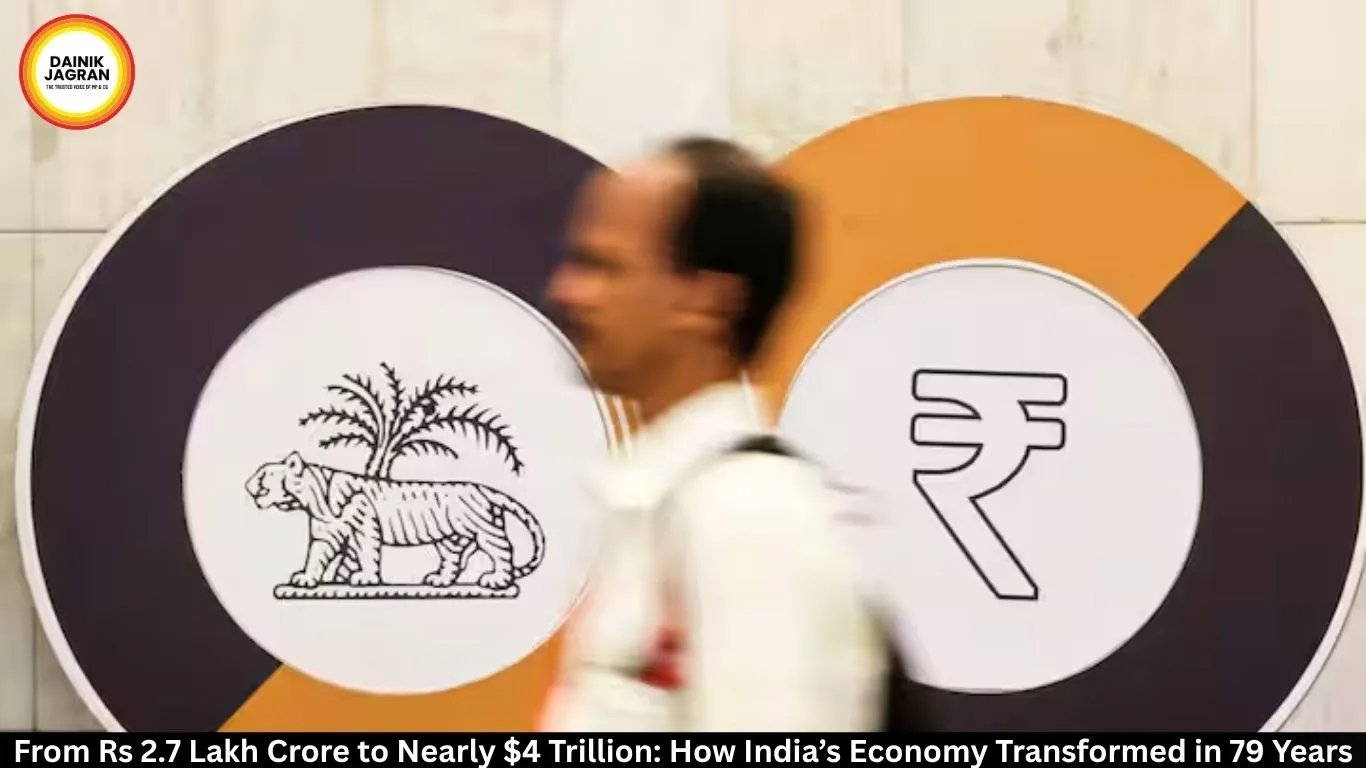
India Economy Transformation: From Rs 2.7 Lakh Crore to Nearly $4 Trillion

Digital desk

India Economy Transformation: From Rs 2.7 Lakh Crore to Nearly $4 Trillion

India's economy has transformed dramatically in 79 years, expanding from a weak post-Independence base to nearly $4 trillion through reforms, digitalisation, trade and infrastructure growth.

From a largely agrarian economy struggling with poverty, low literacy and weak infrastructure in 1947 to a nearly $4 trillion economy powered by services, technology, digital payments and a growing manufacturing base, India has undergone a dramatic economic transformation over the past 79 years.

When the country gained independence on August 15, 1947, its economy was still shaped by the impact of colonial rule. Industrial capacity was limited, electricity access was poor and foreign exchange resources were largely held in sterling balances. Today, India has become one of the world's largest economies, with a rapidly expanding digital ecosystem and significantly stronger external finances.

Economy Nears $4 Trillion

According to World Bank estimates cited in recent data, India's nominal GDP reached around .96 trillion in 2025, compared with .91 trillion in 2024. GDP per capita stood at approximately ,702.5.

Also Read... Beyond Strategic Petroleum Reserves: Why India Needs Real Energy Resilience

India's latest official estimates also put real GDP growth at 7.7 per cent in FY2025-26, underlining the country's relatively strong expansion despite global economic uncertainties.

Also Read... UPI Will Remain Free, Sitharaman Says as Parliament Passes Tax Amendment Bill

Historical comparisons, however, need caution. The frequently cited figure of around Rs 2.7-2.9 lakh crore for India's economy at Independence comes from historical reconstructions and is not directly comparable with today's GDP because national accounting methods, prices and exchange rates have changed considerably.

Also Read... India at 80: Young North, Ageing South and the Race to Create Jobs

Liberalisation Changed Course

India's economic policy in the early decades after Independence was dominated by state-led industrialisation, import substitution and extensive government controls.

The 1991 balance-of-payments crisis became a major turning point. Economic reforms reduced licensing restrictions, opened several sectors to private investment and increased India's integration with the global economy.

The decades that followed witnessed rapid expansion in information technology, telecommunications, financial services and other sectors. India's services industry gradually became one of the country's biggest engines of growth and foreign exchange earnings.

Forex Reserves Cross $700 Billion

India's external financial position has also changed substantially.

The country entered Independence with limited access to freely usable foreign currency and remained closely linked to the sterling system. That situation was starkly different from the position in August 2026, when India's foreign exchange reserves crossed $700 billion.

RBI data showed reserves at around $707 billion in the week ended August 7, 2026, providing the country with a sizeable buffer against external shocks.

The contrast is particularly significant when compared with the 1991 crisis, when India faced severe pressure on its balance of payments and was forced to seek emergency external assistance.

Trade Basket Expands

India's merchandise exports were worth only around Rs 403 crore in 1947-48. The country's export basket has since expanded far beyond agricultural commodities and traditional textiles.

Engineering products, petroleum products, pharmaceuticals, chemicals, automobiles, electronics and other manufactured goods now form an important part of India's merchandise exports, while IT and professional services have emerged as major export earners.

In July 2026, merchandise exports reportedly touched a record $44.24 billion. However, imports rose faster, taking the merchandise trade deficit to around $31.98 billion.

The figures highlight both India's growing presence in global trade and the continuing challenge of improving manufacturing competitiveness.

Literacy and Life Expectancy Rise

Economic development has been accompanied by major social changes.

India's literacy rate was only 18.33 per cent in 1951, with female literacy at 8.86 per cent. Recent estimates put literacy among people aged seven and above at around 80.9 per cent.

Life expectancy has also increased sharply. From roughly 31-32 years around Independence, it has risen to around 72 years, reflecting improvements in healthcare, vaccination, sanitation, nutrition and disease control.

Yet regional differences in education and healthcare remain significant.

Digital Revolution Reshapes Economy

Perhaps no transformation has been as rapid as India's digital expansion.

India had no internet users in 1947. By March 2026, TRAI data showed more than 1.09 billion internet subscribers, including over 1.06 billion broadband connections.

The launch of UPI in 2016 accelerated the digital payments revolution. During FY2025-26, UPI processed more than 24,000 crore transactions, worth over Rs 314 lakh crore.

Alongside Aadhaar, Jan Dhan accounts and widespread mobile connectivity, UPI has become a key component of India's digital public infrastructure.

Electricity Capacity Soars

India's power infrastructure has also expanded dramatically. Electricity-generating capacity stood at only 1,362 MWaround Independence.

By March 2025, installed generation capacity had reached nearly 557 GW. Per-capita electricity consumption has also risen sharply, reflecting the expansion of households, industries, transport and digital infrastructure.

A Larger, Younger Economy

India's population has increased from around 36 crore in 1951 to nearly 146 crore, according to recent estimates.

The size of the population provides a major economic opportunity through consumption and labour supply. But the demographic advantage will depend heavily on employment, skills, productivity, healthcare and education.

Manufacturing has therefore returned to the centre of economic policy, with initiatives such as production-linked incentives aimed at attracting investment and integrating India into global supply chains.

The Road to 2047

India's transformation since Independence is substantial, but the next phase presents a different set of challenges.

Creating enough quality jobs, improving productivity, reducing regional disparities, strengthening manufacturing, managing urbanisation and addressing climate-related risks will be crucial.

The country's ambition of becoming a developed economy by 2047 will require sustained growth as well as broader improvements in human capital and living standards.

From a constrained post-colonial economy to a globally integrated, digitally connected and increasingly diversified economic powerhouse, India's journey over 79 years has been significant.

The bigger question now is not simply how large the Indian economy can become, but whether its next phase of growth can translate into higher incomes, better jobs and more inclusive prosperity for its vast population.
 

english.dainikjagranmpcg.com
15 Aug 2026 By Abhishek Joshi

India Economy Transformation: From Rs 2.7 Lakh Crore to Nearly $4 Trillion

Digital desk

From a largely agrarian economy struggling with poverty, low literacy and weak infrastructure in 1947 to a nearly $4 trillion economy powered by services, technology, digital payments and a growing manufacturing base, India has undergone a dramatic economic transformation over the past 79 years.

When the country gained independence on August 15, 1947, its economy was still shaped by the impact of colonial rule. Industrial capacity was limited, electricity access was poor and foreign exchange resources were largely held in sterling balances. Today, India has become one of the world's largest economies, with a rapidly expanding digital ecosystem and significantly stronger external finances.

Economy Nears $4 Trillion

According to World Bank estimates cited in recent data, India's nominal GDP reached around $3.96 trillion in 2025, compared with $3.91 trillion in 2024. GDP per capita stood at approximately $2,702.5.

India's latest official estimates also put real GDP growth at 7.7 per cent in FY2025-26, underlining the country's relatively strong expansion despite global economic uncertainties.

Historical comparisons, however, need caution. The frequently cited figure of around Rs 2.7-2.9 lakh crore for India's economy at Independence comes from historical reconstructions and is not directly comparable with today's GDP because national accounting methods, prices and exchange rates have changed considerably.

Liberalisation Changed Course

India's economic policy in the early decades after Independence was dominated by state-led industrialisation, import substitution and extensive government controls.

The 1991 balance-of-payments crisis became a major turning point. Economic reforms reduced licensing restrictions, opened several sectors to private investment and increased India's integration with the global economy.

The decades that followed witnessed rapid expansion in information technology, telecommunications, financial services and other sectors. India's services industry gradually became one of the country's biggest engines of growth and foreign exchange earnings.

Forex Reserves Cross $700 Billion

India's external financial position has also changed substantially.

The country entered Independence with limited access to freely usable foreign currency and remained closely linked to the sterling system. That situation was starkly different from the position in August 2026, when India's foreign exchange reserves crossed $700 billion.

RBI data showed reserves at around $707 billion in the week ended August 7, 2026, providing the country with a sizeable buffer against external shocks.

The contrast is particularly significant when compared with the 1991 crisis, when India faced severe pressure on its balance of payments and was forced to seek emergency external assistance.

Trade Basket Expands

India's merchandise exports were worth only around Rs 403 crore in 1947-48. The country's export basket has since expanded far beyond agricultural commodities and traditional textiles.

Engineering products, petroleum products, pharmaceuticals, chemicals, automobiles, electronics and other manufactured goods now form an important part of India's merchandise exports, while IT and professional services have emerged as major export earners.

In July 2026, merchandise exports reportedly touched a record $44.24 billion. However, imports rose faster, taking the merchandise trade deficit to around $31.98 billion.

The figures highlight both India's growing presence in global trade and the continuing challenge of improving manufacturing competitiveness.

Literacy and Life Expectancy Rise

Economic development has been accompanied by major social changes.

India's literacy rate was only 18.33 per cent in 1951, with female literacy at 8.86 per cent. Recent estimates put literacy among people aged seven and above at around 80.9 per cent.

Life expectancy has also increased sharply. From roughly 31-32 years around Independence, it has risen to around 72 years, reflecting improvements in healthcare, vaccination, sanitation, nutrition and disease control.

Yet regional differences in education and healthcare remain significant.

Digital Revolution Reshapes Economy

Perhaps no transformation has been as rapid as India's digital expansion.

India had no internet users in 1947. By March 2026, TRAI data showed more than 1.09 billion internet subscribers, including over 1.06 billion broadband connections.

The launch of UPI in 2016 accelerated the digital payments revolution. During FY2025-26, UPI processed more than 24,000 crore transactions, worth over Rs 314 lakh crore.

Alongside Aadhaar, Jan Dhan accounts and widespread mobile connectivity, UPI has become a key component of India's digital public infrastructure.

Electricity Capacity Soars

India's power infrastructure has also expanded dramatically. Electricity-generating capacity stood at only 1,362 MWaround Independence.

By March 2025, installed generation capacity had reached nearly 557 GW. Per-capita electricity consumption has also risen sharply, reflecting the expansion of households, industries, transport and digital infrastructure.

A Larger, Younger Economy

India's population has increased from around 36 crore in 1951 to nearly 146 crore, according to recent estimates.

The size of the population provides a major economic opportunity through consumption and labour supply. But the demographic advantage will depend heavily on employment, skills, productivity, healthcare and education.

Manufacturing has therefore returned to the centre of economic policy, with initiatives such as production-linked incentives aimed at attracting investment and integrating India into global supply chains.

The Road to 2047

India's transformation since Independence is substantial, but the next phase presents a different set of challenges.

Creating enough quality jobs, improving productivity, reducing regional disparities, strengthening manufacturing, managing urbanisation and addressing climate-related risks will be crucial.

The country's ambition of becoming a developed economy by 2047 will require sustained growth as well as broader improvements in human capital and living standards.

From a constrained post-colonial economy to a globally integrated, digitally connected and increasingly diversified economic powerhouse, India's journey over 79 years has been significant.

The bigger question now is not simply how large the Indian economy can become, but whether its next phase of growth can translate into higher incomes, better jobs and more inclusive prosperity for its vast population.


https://english.dainikjagranmpcg.com/national/india-economy-transformation-from-rs-27-lakh-crore-to-nearly/article-26177

--------

🚨 Beat the News Rush – Join Now!

Get breaking alerts, hot exclusives, and game-changing stories instantly on your phone. No delays, no fluff – just the edge you need. ⚡

Tap to join: 

🟢 WhatsApp Channel: Dainik Jagran MP CG

Crave more?

🅕 Facebook: Dainik Jagran MP CG English

🅧 Twitter (X): Dainik Jagran MP CG

🅘 Instagram: Dainik Jagran MP CG

Share the fire – keep your crew ahead! 🗞️🔥

Trending News