India has called on the United Nations Security Council (UNSC) to make mitigating the humanitarian consequences of armed conflicts an immediate priority, warning that disruptions caused by wars are increasingly threatening global food security.
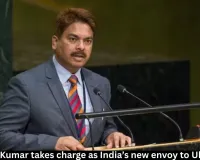
Speaking at a UNSC open debate titled “Food Under Fire: The Security Council’s Role in Mitigating Global and Local Food Crises” on Tuesday, India's Permanent Representative to the UN, P. Harish, said conflicts were creating consequences that extend well beyond the areas where fighting is taking place.
Conflicts Threaten Food Security
Harish said disruptions to energy markets, fertiliser supplies, maritime transport, humanitarian logistics and agricultural trade were allowing regional conflicts to create wider pressure on food supplies.
“Today’s conflicts increasingly generate ripple effects far beyond the immediate theatre of hostilities,” he said.
India's intervention comes amid concerns over disruptions to major trade and shipping routes, which can affect the movement and cost of food, fertilisers and other essential commodities globally.
India Seeks Humanitarian Access
Harish said the Security Council's immediate focus should be on reducing the humanitarian impact of conflicts.
According to India's position, this requires safe, rapid and unimpeded humanitarian access, along with support for de-confliction arrangements that can allow humanitarian operations to continue during hostilities.
India also urged the Council to ensure that measures such as sanctions do not unintentionally obstruct humanitarian assistance or legitimate food and agricultural trade.
The Indian envoy noted that developing countries with high dependence on imports are particularly vulnerable when international supply chains are disrupted.
India's Food Security Approach
While calling for action by the Security Council, Harish also stressed that building resilient and food-secure societies remains primarily the responsibility of national governments, supported by the UN development system and specialised agencies.
He highlighted India's domestic food-security measures, including the National Food Security Act, which provides statutory entitlement to subsidised food grains.
Harish also pointed to direct benefit transfers under PM-KISAN, saying support to more than 110 million farming households has strengthened the economic resilience of small and marginal farmers.
India's promotion of millets, including its role in the International Year of Millets in 2023, was also cited as an example of efforts to promote climate-resilient and nutrient-rich crops.
UN Highlights Major Conflict Zones
UN Secretary-General Antonio Guterres, speaking at the same debate, highlighted the impact of conflicts and disruptions in several strategically important regions.
He pointed to the Black Sea, where the Russia-Ukraine conflict has affected grain and energy exports, as well as the Strait of Hormuz, where restrictions and disruptions have contributed to higher commodity prices and reduced availability.
Guterres also referred to attacks on commercial vessels in the Red Sea, warning that they were putting additional pressure on supply chains carrying food and other commodities.
Proposal for Hormuz Corridor
Guterres said the UN has proposed a protected corridor to facilitate the movement of fertilisers and food grains through the Strait of Hormuz.
The proposed mechanism would initially focus on fertilisers and related raw materials and could later be expanded to other products. A task force led by the UN Office for Project Services has reportedly developed a framework to register and verify vessels carrying fertiliser and associated products.
Guterres said the success of the proposal would depend on cooperation and political will from the parties involved.
Maritime Disruptions Add Pressure
The World Food Programme's Acting Director Carl Skau also warned that serious disruptions to maritime trade could push tens of millions more people into food insecurity.
The discussions at the UNSC underline India's broader concern that conflicts are no longer confined to their immediate geographic impact. Disruptions to shipping, energy, fertiliser and agricultural trade can spread economic and humanitarian pressures across borders.
India's call for immediate humanitarian action therefore places food security alongside humanitarian access as an important consideration in the Security Council's response to conflicts.

.jpg)







12.jpg)
