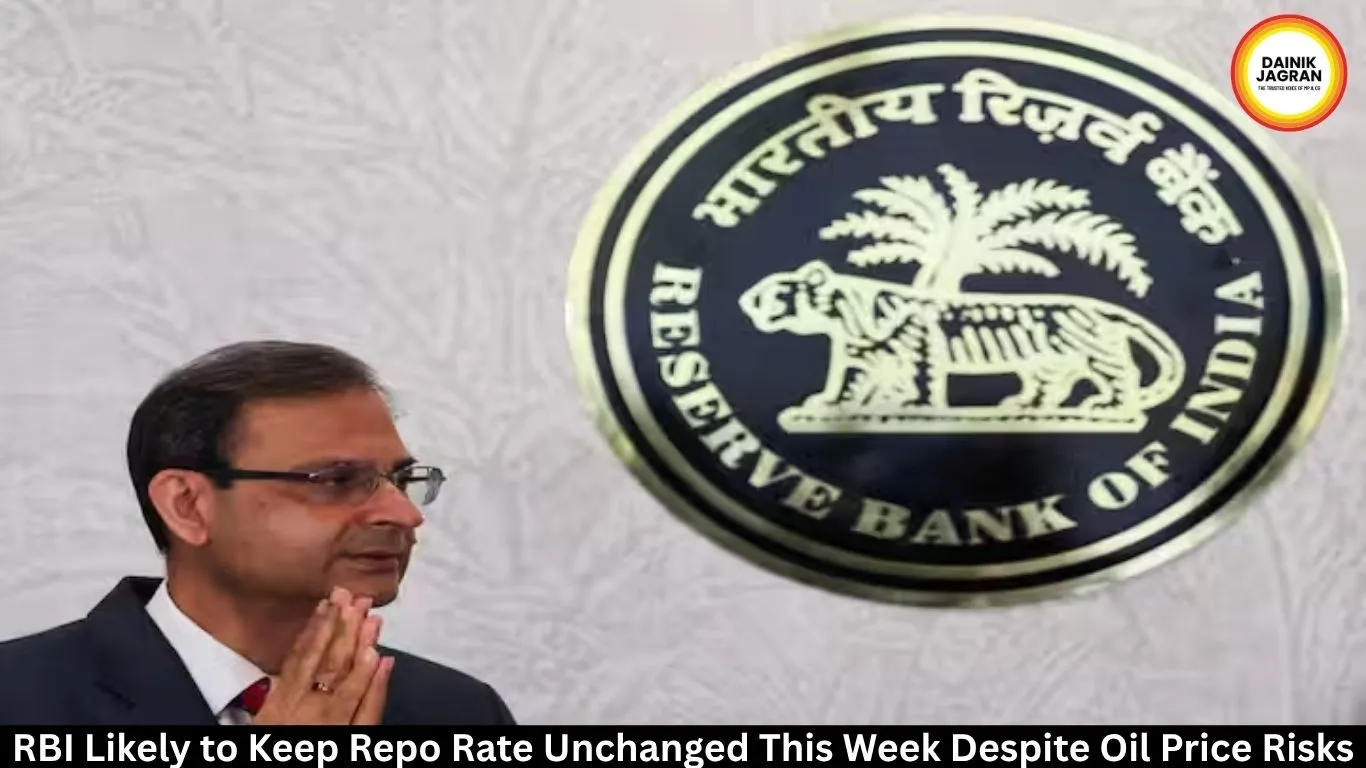
RBI Expected to Hold Repo Rate Steady Despite Rising Oil Prices
Digital desk
The RBI is likely to keep the repo rate unchanged this week as inflation remains within its comfort zone despite higher crude oil prices and global uncertainty, while signalling a more hawkish outlook.
The Reserve Bank of India (RBI) is widely expected to leave the benchmark repo rate unchanged at its Monetary Policy Committee (MPC) meeting this week, as inflation remains within the central bank's prescribed tolerance range despite rising global oil prices triggered by the Iran conflict.
According to a Reuters survey, 68 of 72 economists expect the MPC to maintain the current policy rate. While the RBI is unlikely to tighten monetary policy immediately, analysts believe it may adopt a more hawkish tone by highlighting emerging inflation risks and reiterating that future decisions will remain data-dependent.
Inflation Still Within Target Band
India's retail inflation rose to 4.38 per cent in June, crossing the RBI's medium-term target of 4 per cent for the first time in 17 months. However, it remains well within the central bank's statutory tolerance band of 2 to 6 per cent, allowing policymakers room to pause.
Core inflation, which excludes volatile food and fuel prices, has also remained close to 4 per cent, suggesting that underlying price pressures are still manageable.
Economists say the current inflation trajectory does not yet warrant an immediate increase in interest rates.
Oil Prices Pose Fresh Challenge
The recent surge in crude oil prices following geopolitical tensions in West Asia has added uncertainty to the inflation outlook.
Although higher fuel costs typically feed into transportation, manufacturing and consumer prices, RBI Governor Sanjay Malhotra recently indicated that the pass-through from fuel prices to broader inflation has so far remained limited.
However, inflation expectations among households have started to rise, according to the RBI's latest survey, raising concerns that sustained high energy prices could eventually push overall inflation higher.
Wholesale inflation has also accelerated, reaching 9.87 per cent in June, adding another element of caution for policymakers.
RBI May Adopt Hawkish Tone
While the central bank is expected to keep rates unchanged, market participants believe the MPC could signal greater vigilance over inflation risks.
Analysts expect the policy statement to acknowledge global uncertainties, elevated commodity prices and currency pressures while emphasising that future action will depend on incoming economic data.
Such a stance would allow the RBI to balance inflation management with support for economic growth.
Different Approach from Global Central Banks
The RBI's expected pause contrasts with the actions of several major central banks that have tightened monetary policy in response to rising energy costs.
Countries including Europe, Australia, Indonesia, the Philippines, Singapore, South Korea and South Africa have raised interest rates in recent weeks.
Meanwhile, the US Federal Reserve and the Bank of Japan have opted to keep policy rates unchanged as they continue to assess the economic impact of global geopolitical tensions.
Focus on Stability
Apart from inflation, the RBI is also monitoring the rupee and capital flows.
Recent policy measures aimed at supporting the Indian currency have helped attract foreign investment, reducing immediate pressure on the exchange rate despite volatile global markets.
For now, economists expect the central bank to prioritise financial stability while closely watching inflation trends before considering any future policy tightening.

--------
🚨 Beat the News Rush – Join Now!
Get breaking alerts, hot exclusives, and game-changing stories instantly on your phone. No delays, no fluff – just the edge you need. ⚡
Tap to join:
🟢 WhatsApp Channel: Dainik Jagran MP CG
Crave more?
🅕 Facebook: Dainik Jagran MP CG English
🅧 Twitter (X): Dainik Jagran MP CG
🅘 Instagram: Dainik Jagran MP CG
Share the fire – keep your crew ahead! 🗞️🔥
RBI Expected to Hold Repo Rate Steady Despite Rising Oil Prices
Digital desk
The Reserve Bank of India (RBI) is widely expected to leave the benchmark repo rate unchanged at its Monetary Policy Committee (MPC) meeting this week, as inflation remains within the central bank's prescribed tolerance range despite rising global oil prices triggered by the Iran conflict.
According to a Reuters survey, 68 of 72 economists expect the MPC to maintain the current policy rate. While the RBI is unlikely to tighten monetary policy immediately, analysts believe it may adopt a more hawkish tone by highlighting emerging inflation risks and reiterating that future decisions will remain data-dependent.
Inflation Still Within Target Band
India's retail inflation rose to 4.38 per cent in June, crossing the RBI's medium-term target of 4 per cent for the first time in 17 months. However, it remains well within the central bank's statutory tolerance band of 2 to 6 per cent, allowing policymakers room to pause.
Core inflation, which excludes volatile food and fuel prices, has also remained close to 4 per cent, suggesting that underlying price pressures are still manageable.
Economists say the current inflation trajectory does not yet warrant an immediate increase in interest rates.
Oil Prices Pose Fresh Challenge
The recent surge in crude oil prices following geopolitical tensions in West Asia has added uncertainty to the inflation outlook.
Although higher fuel costs typically feed into transportation, manufacturing and consumer prices, RBI Governor Sanjay Malhotra recently indicated that the pass-through from fuel prices to broader inflation has so far remained limited.
However, inflation expectations among households have started to rise, according to the RBI's latest survey, raising concerns that sustained high energy prices could eventually push overall inflation higher.
Wholesale inflation has also accelerated, reaching 9.87 per cent in June, adding another element of caution for policymakers.
RBI May Adopt Hawkish Tone
While the central bank is expected to keep rates unchanged, market participants believe the MPC could signal greater vigilance over inflation risks.
Analysts expect the policy statement to acknowledge global uncertainties, elevated commodity prices and currency pressures while emphasising that future action will depend on incoming economic data.
Such a stance would allow the RBI to balance inflation management with support for economic growth.
Different Approach from Global Central Banks
The RBI's expected pause contrasts with the actions of several major central banks that have tightened monetary policy in response to rising energy costs.
Countries including Europe, Australia, Indonesia, the Philippines, Singapore, South Korea and South Africa have raised interest rates in recent weeks.
Meanwhile, the US Federal Reserve and the Bank of Japan have opted to keep policy rates unchanged as they continue to assess the economic impact of global geopolitical tensions.
Focus on Stability
Apart from inflation, the RBI is also monitoring the rupee and capital flows.
Recent policy measures aimed at supporting the Indian currency have helped attract foreign investment, reducing immediate pressure on the exchange rate despite volatile global markets.
For now, economists expect the central bank to prioritise financial stability while closely watching inflation trends before considering any future policy tightening.