Degrees Without Dignity: Understanding India's Hidden Educated Unemployment Crisis
Digital Desk
India's rising educated unemployment reflects a widening gap between higher education and employment opportunities. Here's why degrees alone are no longer enough and what reforms are needed.
India's higher education system has expanded at an unprecedented pace over the past two decades. Universities have multiplied, private colleges have flourished, and every year millions of students graduate with degrees in engineering, management, arts, commerce and science. Yet behind this impressive growth lies an uncomfortable reality—earning a degree no longer guarantees meaningful employment.
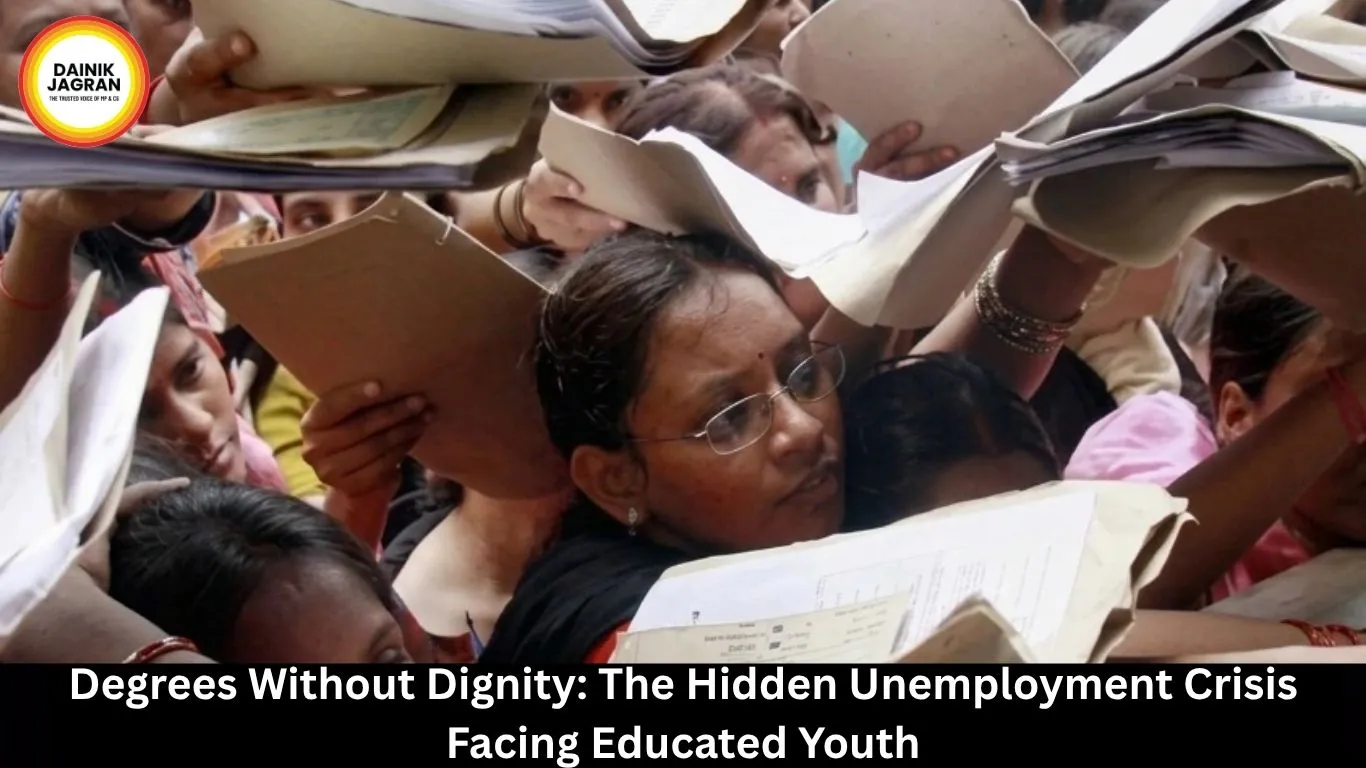
For many young Indians, unemployment is no longer defined by the absence of education. Instead, it is increasingly becoming a crisis of educated aspirations. Across cities and towns, graduates spend months—or even years—preparing for government examinations, applying for limited vacancies, accepting jobs far below their qualifications or leaving the workforce altogether. The result is not merely economic hardship but a growing sense of frustration, uncertainty and declining confidence in the promise of higher education.
The challenge extends beyond unemployment to underemployment. Thousands of engineering graduates work in sectors unrelated to their field of study. Postgraduates often compete for clerical or entry-level positions requiring far lower qualifications. Competitive examinations for a few hundred government posts routinely attract lakhs of applicants, many holding master's degrees, professional certifications and years of preparation. Such trends reveal a widening gap between educational attainment and labour market demand.
One of the core issues is the disconnect between academic curricula and industry expectations. While institutions continue to produce graduates in large numbers, employers frequently report shortages of candidates with practical, technical and problem-solving skills. Rapid advances in artificial intelligence, automation and digital technologies are reshaping workplaces faster than many educational institutions can adapt. Consequently, graduates may leave college with theoretical knowledge but without the skills required for emerging industries.
The problem is particularly acute in rural and semi-urban India, where quality employment opportunities remain limited. Many educated young people migrate to metropolitan cities hoping for better prospects, only to encounter intense competition, rising living costs and uncertain career paths. Others return home after unsuccessful job searches, adding to the silent burden of educated unemployment that often remains invisible in official statistics.
Mental health is another dimension that deserves greater attention. Continuous examination cycles, repeated recruitment delays, cancelled tests and prolonged uncertainty have taken a psychological toll on millions of aspirants. For many families, higher education represents years of financial sacrifice. When expected employment fails to materialise, disappointment affects not only individuals but entire households.
Addressing the crisis requires more than announcing new vacancies. India needs stronger collaboration between universities, industries and policymakers to ensure that education remains relevant to changing economic realities. Curricula must evolve alongside technological advancements. Apprenticeships, internships and vocational training should become integral components of higher education rather than optional additions. Entrepreneurship must be encouraged not merely through slogans but through easier access to finance, mentorship and market linkages.
Equally important is improving the transparency and efficiency of public recruitment. Timely examinations, faster recruitment processes and stronger safeguards against paper leaks can restore confidence among job seekers. Delays and irregularities not only postpone careers but also erode trust in public institutions.
The private sector also has a significant role to play. Investment in labour-intensive manufacturing, green technologies, healthcare, logistics and digital services can create employment opportunities for graduates from diverse educational backgrounds. At the same time, continuous upskilling and lifelong learning should become a normal part of professional careers, enabling workers to adapt to rapidly changing economic conditions.
India's demographic dividend remains one of its greatest strengths. With one of the world's youngest populations, the country possesses immense human capital capable of driving innovation and economic growth. However, this advantage can quickly become a liability if education continues to produce degrees without corresponding opportunities.
A university degree should represent more than a certificate of academic completion. It should provide young people with the confidence, skills and dignity to build meaningful careers. Bridging the gap between education and employment is therefore not only an economic necessity but also a social imperative. Until that happens, the country's unemployment challenge will remain hidden behind rising graduation numbers—leaving millions of educated young Indians searching not just for jobs, but for the dignity that meaningful work provides.
--------
🚨 Beat the News Rush – Join Now!
Get breaking alerts, hot exclusives, and game-changing stories instantly on your phone. No delays, no fluff – just the edge you need. ⚡
Tap to join:
🟢 WhatsApp Channel: Dainik Jagran MP CG
Crave more?
🅕 Facebook: Dainik Jagran MP CG English
🅧 Twitter (X): Dainik Jagran MP CG
🅘 Instagram: Dainik Jagran MP CG
Share the fire – keep your crew ahead! 🗞️🔥
Degrees Without Dignity: Understanding India's Hidden Educated Unemployment Crisis
Digital Desk
India's higher education system has expanded at an unprecedented pace over the past two decades. Universities have multiplied, private colleges have flourished, and every year millions of students graduate with degrees in engineering, management, arts, commerce and science. Yet behind this impressive growth lies an uncomfortable reality—earning a degree no longer guarantees meaningful employment.
For many young Indians, unemployment is no longer defined by the absence of education. Instead, it is increasingly becoming a crisis of educated aspirations. Across cities and towns, graduates spend months—or even years—preparing for government examinations, applying for limited vacancies, accepting jobs far below their qualifications or leaving the workforce altogether. The result is not merely economic hardship but a growing sense of frustration, uncertainty and declining confidence in the promise of higher education.
The challenge extends beyond unemployment to underemployment. Thousands of engineering graduates work in sectors unrelated to their field of study. Postgraduates often compete for clerical or entry-level positions requiring far lower qualifications. Competitive examinations for a few hundred government posts routinely attract lakhs of applicants, many holding master's degrees, professional certifications and years of preparation. Such trends reveal a widening gap between educational attainment and labour market demand.
One of the core issues is the disconnect between academic curricula and industry expectations. While institutions continue to produce graduates in large numbers, employers frequently report shortages of candidates with practical, technical and problem-solving skills. Rapid advances in artificial intelligence, automation and digital technologies are reshaping workplaces faster than many educational institutions can adapt. Consequently, graduates may leave college with theoretical knowledge but without the skills required for emerging industries.
The problem is particularly acute in rural and semi-urban India, where quality employment opportunities remain limited. Many educated young people migrate to metropolitan cities hoping for better prospects, only to encounter intense competition, rising living costs and uncertain career paths. Others return home after unsuccessful job searches, adding to the silent burden of educated unemployment that often remains invisible in official statistics.
Mental health is another dimension that deserves greater attention. Continuous examination cycles, repeated recruitment delays, cancelled tests and prolonged uncertainty have taken a psychological toll on millions of aspirants. For many families, higher education represents years of financial sacrifice. When expected employment fails to materialise, disappointment affects not only individuals but entire households.
Addressing the crisis requires more than announcing new vacancies. India needs stronger collaboration between universities, industries and policymakers to ensure that education remains relevant to changing economic realities. Curricula must evolve alongside technological advancements. Apprenticeships, internships and vocational training should become integral components of higher education rather than optional additions. Entrepreneurship must be encouraged not merely through slogans but through easier access to finance, mentorship and market linkages.
Equally important is improving the transparency and efficiency of public recruitment. Timely examinations, faster recruitment processes and stronger safeguards against paper leaks can restore confidence among job seekers. Delays and irregularities not only postpone careers but also erode trust in public institutions.
The private sector also has a significant role to play. Investment in labour-intensive manufacturing, green technologies, healthcare, logistics and digital services can create employment opportunities for graduates from diverse educational backgrounds. At the same time, continuous upskilling and lifelong learning should become a normal part of professional careers, enabling workers to adapt to rapidly changing economic conditions.
India's demographic dividend remains one of its greatest strengths. With one of the world's youngest populations, the country possesses immense human capital capable of driving innovation and economic growth. However, this advantage can quickly become a liability if education continues to produce degrees without corresponding opportunities.
A university degree should represent more than a certificate of academic completion. It should provide young people with the confidence, skills and dignity to build meaningful careers. Bridging the gap between education and employment is therefore not only an economic necessity but also a social imperative. Until that happens, the country's unemployment challenge will remain hidden behind rising graduation numbers—leaving millions of educated young Indians searching not just for jobs, but for the dignity that meaningful work provides.