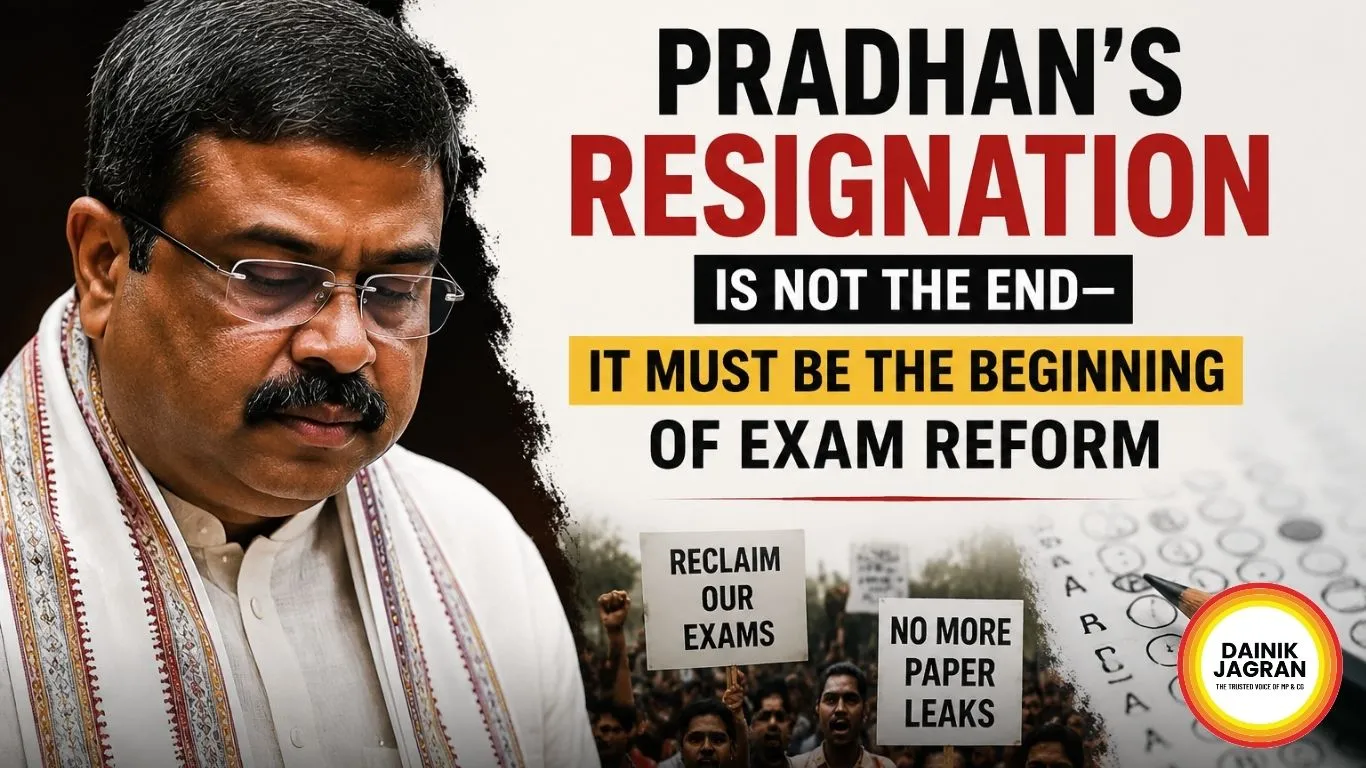
Dharmendra Pradhan's Resignation Is Not the End—It Must Be the Beginning of India's Exam Reform

Ananya Srivastava

Dharmendra Pradhan's Resignation Is Not the End—It Must Be the Beginning of India's Exam Reform

Dharmendra Pradhan's resignation has addressed a major political demand, but it does not resolve the deeper crisis exposed by repeated examination paper leaks. The government's next steps and the strategy adopted by the Cockroach Janata Party (CJP) will determine whether this moment leads to lasting education reforms or remains just another political milestone.

The resignation of Union Education Minister Dharmendra Pradhan marks one of the most significant political developments to emerge from the nationwide protests over the alleged NEET paper leak. It demonstrates that sustained public pressure can influence political decision-making. Yet, if the government believes that replacing one minister will end the controversy, it risks overlooking the fundamental issue that sparked the movement in the first place.

The crisis has never been solely about an individual. It is about public confidence in India's examination system. Millions of students spend years preparing for competitive exams, often sacrificing financial stability, personal time, and emotional well-being. When allegations of paper leaks and administrative failures emerge repeatedly, trust in the entire system begins to erode.

Resignations may satisfy immediate political demands, but they cannot restore credibility on their own.

The Government Must Shift From Damage Control to Structural Reform

The Centre now faces an opportunity to move beyond political firefighting and introduce meaningful reforms.

The first priority should be an independent investigation into examination irregularities, with complete transparency in its findings. Accountability should extend beyond political leadership to officials, agencies, and networks found responsible for compromising examination integrity.

Second, the examination ecosystem requires modernization. Greater use of encrypted digital question paper distribution, AI-driven monitoring, enhanced cybersecurity, and stricter oversight of testing centres can significantly reduce the risk of leaks.

Third, the government should establish a permanent national examination security framework instead of relying on temporary measures after every controversy. Independent audits, periodic security assessments, and clear accountability mechanisms would help rebuild public confidence.

Finally, communication with students must improve. During crises, uncertainty often fuels anger more than the incident itself. Transparent updates and timely decisions can prevent misinformation and reduce anxiety among candidates.

What Should Be CJP's Next Move?

For the Cockroach Janata Party (CJP), Dharmendra Pradhan's resignation represents a major political achievement. However, every protest movement reaches a defining moment after securing its first major demand.

If CJP continues solely with symbolic demonstrations, public support could gradually decline. Instead, the organization now has an opportunity to transition from protest politics to policy advocacy.

Rather than focusing exclusively on further resignations, CJP could present a comprehensive education reform charter outlining concrete proposals for examination security, student welfare, recruitment transparency, grievance redressal, and institutional accountability.

Maintaining peaceful dialogue with the government while insisting on measurable reforms may prove more effective than indefinite confrontation. Public movements often gain lasting legitimacy when they evolve from resistance into constructive participation in policymaking.

Students Must Remain the Focus

Perhaps the biggest lesson from this episode is that students should never become collateral damage in political contests.

Every stakeholder—the government, opposition parties, civil society, and protest groups—must ensure that education reforms remain the central objective. Political victories may dominate headlines for a few days, but restoring trust in India's examination system will determine whether this movement leaves a lasting legacy.

The Road Ahead

Dharmendra Pradhan's resignation may have closed one chapter, but it has opened a much larger conversation about accountability, transparency, and institutional reform.

The government's credibility will now depend not on who replaces the minister, but on whether it can create an examination system that students trust. Likewise, CJP's future influence will depend on whether it transforms public anger into practical policy solutions.

If both sides seize this moment responsibly, India's education system could emerge stronger. If not, the resignation will be remembered as a political event rather than a turning point in education reform.
--------

🚨 Beat the News Rush – Join Now!

Get breaking alerts, hot exclusives, and game-changing stories instantly on your phone. No delays, no fluff – just the edge you need. ⚡

Tap to join: 

🟢 WhatsApp Channel: Dainik Jagran MP CG

Crave more?

🅕 Facebook: Dainik Jagran MP CG English

🅧 Twitter (X): Dainik Jagran MP CG

🅘 Instagram: Dainik Jagran MP CG

Share the fire – keep your crew ahead! 🗞️🔥

english.dainikjagranmpcg.com
25 Jul 2026 By Rishita

Dharmendra Pradhan's Resignation Is Not the End—It Must Be the Beginning of India's Exam Reform

Ananya Srivastava

The resignation of Union Education Minister Dharmendra Pradhan marks one of the most significant political developments to emerge from the nationwide protests over the alleged NEET paper leak. It demonstrates that sustained public pressure can influence political decision-making. Yet, if the government believes that replacing one minister will end the controversy, it risks overlooking the fundamental issue that sparked the movement in the first place.

The crisis has never been solely about an individual. It is about public confidence in India's examination system. Millions of students spend years preparing for competitive exams, often sacrificing financial stability, personal time, and emotional well-being. When allegations of paper leaks and administrative failures emerge repeatedly, trust in the entire system begins to erode.

Resignations may satisfy immediate political demands, but they cannot restore credibility on their own.

The Government Must Shift From Damage Control to Structural Reform

The Centre now faces an opportunity to move beyond political firefighting and introduce meaningful reforms.

The first priority should be an independent investigation into examination irregularities, with complete transparency in its findings. Accountability should extend beyond political leadership to officials, agencies, and networks found responsible for compromising examination integrity.

Second, the examination ecosystem requires modernization. Greater use of encrypted digital question paper distribution, AI-driven monitoring, enhanced cybersecurity, and stricter oversight of testing centres can significantly reduce the risk of leaks.

Third, the government should establish a permanent national examination security framework instead of relying on temporary measures after every controversy. Independent audits, periodic security assessments, and clear accountability mechanisms would help rebuild public confidence.

Finally, communication with students must improve. During crises, uncertainty often fuels anger more than the incident itself. Transparent updates and timely decisions can prevent misinformation and reduce anxiety among candidates.

What Should Be CJP's Next Move?

For the Cockroach Janata Party (CJP), Dharmendra Pradhan's resignation represents a major political achievement. However, every protest movement reaches a defining moment after securing its first major demand.

If CJP continues solely with symbolic demonstrations, public support could gradually decline. Instead, the organization now has an opportunity to transition from protest politics to policy advocacy.

Rather than focusing exclusively on further resignations, CJP could present a comprehensive education reform charter outlining concrete proposals for examination security, student welfare, recruitment transparency, grievance redressal, and institutional accountability.

Maintaining peaceful dialogue with the government while insisting on measurable reforms may prove more effective than indefinite confrontation. Public movements often gain lasting legitimacy when they evolve from resistance into constructive participation in policymaking.

Students Must Remain the Focus

Perhaps the biggest lesson from this episode is that students should never become collateral damage in political contests.

Every stakeholder—the government, opposition parties, civil society, and protest groups—must ensure that education reforms remain the central objective. Political victories may dominate headlines for a few days, but restoring trust in India's examination system will determine whether this movement leaves a lasting legacy.

The Road Ahead

Dharmendra Pradhan's resignation may have closed one chapter, but it has opened a much larger conversation about accountability, transparency, and institutional reform.

The government's credibility will now depend not on who replaces the minister, but on whether it can create an examination system that students trust. Likewise, CJP's future influence will depend on whether it transforms public anger into practical policy solutions.

If both sides seize this moment responsibly, India's education system could emerge stronger. If not, the resignation will be remembered as a political event rather than a turning point in education reform.
https://english.dainikjagranmpcg.com/opinion/dharmendra-pradhans-resignation-is-not-the-end%E2%80%94it-must-be-the/article-23581

Trending News