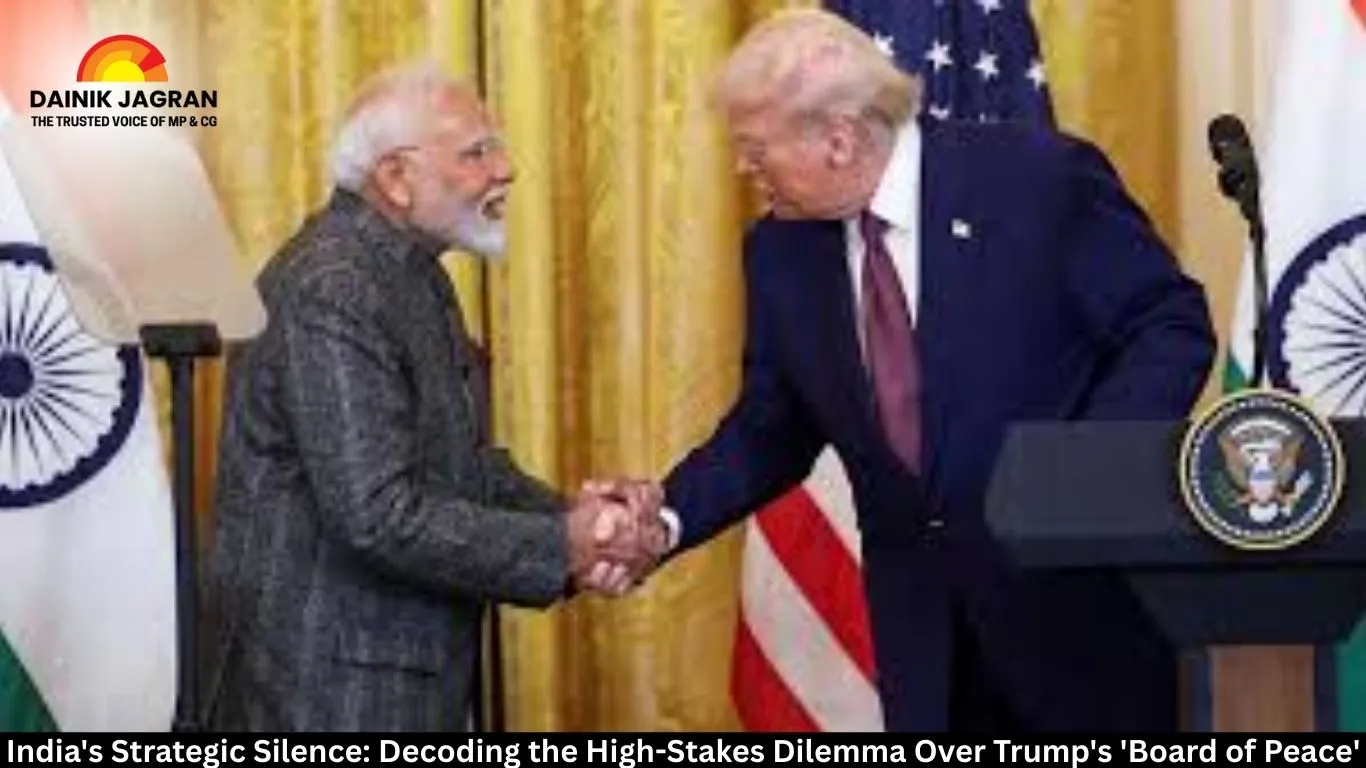
India's Strategic Silence: Decoding the High-Stakes Dilemma Over Trump's 'Board of Peace'
Digital Desk
In a move that has sent ripples through the corridors of global power, US President Donald Trump used the Davos platform to launch a controversial new "Board of Peace" . Promoted as a tool to resolve conflicts and oversee reconstruction, starting with GGaza, the board is being viewed by many analysts as a direct challenge to the post-World War II, UN-centric world order . While nations like Pakistan, Israel, and several Gulf states have signed on, a crucial player remains conspicuously silent: India .
The invitation from President Trump to Prime Minister Narendra Modi presents New Delhi with one of its most delicate diplomatic puzzles in recent years. Joining could offer a seat at a new table of influence but risks alienating traditional partners and undermining the multilateral system India has long supported. Staying out could invite further economic pressure from a protectionist US administration. India's calculated silence thus far speaks volumes about its high-stakes dilemma.
What Is Trump's Board of Peace?
Announced at the World Economic Forum in Davos, the Board of Peace is framed as the body to implement the second phase of Trump's 20-point plan for Gaza, which includes reconstruction and long-term governance . However, its ambitions appear far broader. The board's leaked charter reveals an organization with a global peace mandate, a lifetime chairman in Trump himself, and a staggering $1 billion fee for permanent membership .
The executive board is composed entirely of Trump confidants and allies, including his son-in-law Jared Kushner, former UK Prime Minister Tony Blair, and US Secretary of State Marco Rubio . This structure has led critics to label it a "passion project" designed less for inclusive global problem-solving and more for consolidating a new axis of influence under Trump's personal stewardship.
A World Divided: Who's In, Who's Out
The board's membership reveals a stark geopolitical split:
· The Joiners: Approximately 20 countries, including Pakistan, Israel, Saudi Arabia, UAE, Turkey, and Azerbaijan, have joined the initiative .
· The Holdouts: Major European powers like the UK, France, Germany, and Sweden have pointedly refused, expressing concerns over the board's legal scope and its implications for the existing international order . Canada, Russia, China, and the European Union have also not committed .
This division places India in a tough spot. Aligning with the "Joiners"—a group that includes its rival Pakistan—could be domestically unpopular and signal a retreat from its principled stance on multilateralism. However, siding with the "Holdouts" risks provoking a US administration that has already shown a willingness to use trade as a weapon.
India's Calculated "Wait and Watch"
India's non-committal response is a classic diplomatic maneuver, but it is fraught with risk. Experts cite several factors behind India's hesitation:
· Defending Multilateralism: As a founding member of the UN and a traditional champion of a rules-based order, India is ideologically cautious about initiatives that might weaken established institutions
· The Pakistan Problem: Pakistan's enthusiastic membership complicates India's decision. Analysts fear the board could become a platform for internationalizing the Kashmir issue on terms unfavorable to New Delhi.
· Uncertain Longevity: The board is seen as intrinsically linked to Trump's persona and current term. Its viability and relevance beyond his presidency are major questions for Indian strategists thinking in long-term horizons.
The Shadow of Trade and Tariff Wars
The diplomatic calculation cannot be separated from hard economic reality. The Trump administration has already imposed a 50% tariff on all Indian imports, citing trade imbalances and India's continued purchase of Russian oil . The threat of even more punitive measures looms large.
· India's exports worth approximately $87 billion annually are vulnerable to these tariffs, impacting key sectors like electronics, pharmaceuticals, and textiles .
· Furthermore, South Africa is now considering similar 50% tariffs on vehicles imported from India and China, signaling that US actions may embolden other nations .
In this context, India's silence on the Board of Peace is also seen as an effort to avoid giving Trump any pretext to escalate trade hostilities further. The hope in New Delhi is that a neutral stance might keep the door open for back-channel negotiations on tariffs.
A Precarious Balancing Act
India finds itself navigating a perfect storm of diplomatic innovation and economic coercion. Trump's Board of Peace is more than a peace proposal; it is a litmus test for loyalty in a fragmenting world. For India, the choice is not merely about joining a new group but about defining its strategic path in an era where traditional alliances are being stress-tested.
The "wait and watch" approach offers temporary shelter but is not a long-term strategy. As pressure builds from both Washington and its own economic corridors, New Delhi will soon have to make a decisive move. That decision will reveal whether India believes its future lies in reshaping the old world order or cautiously engaging with the contours of a new, uncertain one. The world is watching.