


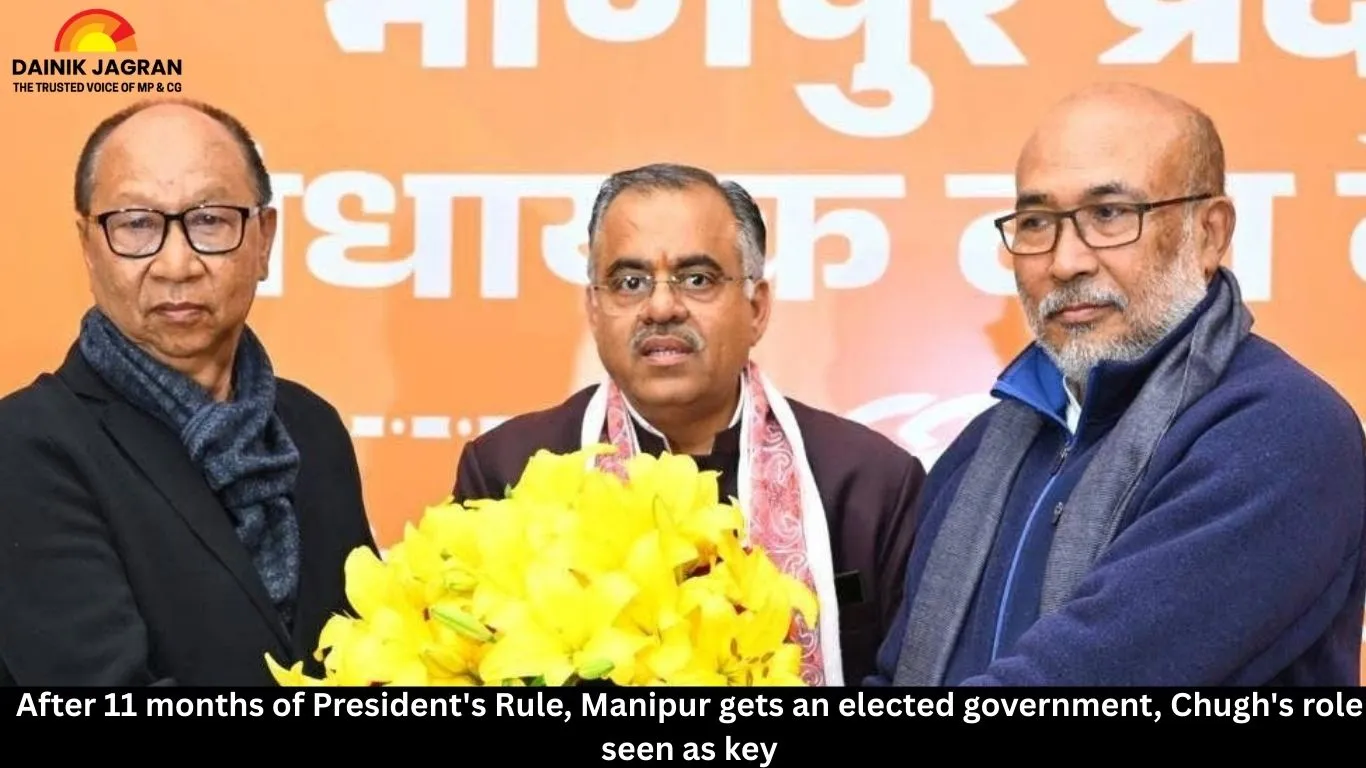
After 11 months of President's Rule, Manipur gets an elected government, Chugh's role seen as key
Digital Desk
Appointed as Central Observer by the BJP Parliamentary Board, Chugh was given charge of the party’s internal process at a time when ethnic tensions, fragile alliances, and administrative paralysis had pushed the northeastern state into prolonged instability. Party sources said his brief was to hold the BJP and its allies together and ensure a smooth transfer of power.
On February 3, he presided over a closed-door meeting in New Delhi where legislators unanimously chose Yumnam Khemchand Singh as the leader of the BJP Legislative Party, a show of unity the party had struggled to produce for months and one that cleared the path toward government formation.
In the weeks before that meeting, Chugh had been working the phones and the corridors, coordinating between the central leadership in Delhi and the BJP’s 37 MLAs in Manipur, along with its NDA partners. Party insiders said his involvement was decisive in steadying nerves after the resignation of former Chief Minister N. Biren Singh in 2025, which had triggered the imposition of President’s Rule.
On February 4, Chugh accompanied Khemchand Singh to Lok Bhavan, where they met Governor Ajay Kumar Bhalla and formally staked their claim to form a government. The move restored elected administration to the state just days before President’s Rule would have completed a full year.
The return to normalcy came after months of unrest rooted in the events of May 2023, when protests by the Meitei community over demands for Scheduled Tribe status spilled into violent clashes with Kuki groups. Hundreds were killed. Thousands were displaced. Public trust in the state’s institutions, already thin, eroded further.
Chugh’s ability to navigate that environment drew on decades of organisational work within the party. He began in Punjab through student politics and the Bharatiya Janata Yuva Morcha, building a grassroots base over the years. His long association with the RSS, colleagues say, shaped both his political outlook and his working methods.
In 2009, he was appointed Vice Chairman of the Punjab Youth Development Board and appointed Minister of State in the Punjab Government, a post he held until 2011. The following year, he continued in the same capacity as Chief Parliamentary Secretary. During that period, he worked on youth employment, skill development, and career counselling, gaining experience in governance that would prove useful in later assignments.
After moving into the BJP’s national structure in 2014, Chugh was posted to some of the party’s more sensitive assignments, including Jammu and Kashmir and Ladakh. He was elevated to National General Secretary in 2020 and has since handled organisational work across states, including Telangana, the Andaman and Nicobar Islands, and others. He has also been involved in party-building through the Yuva Morcha and SC Morcha, as well as in internal election management.
In Manipur, he worked with senior leaders, including Sambit Patra and state BJP President Adhikarimayum Sharda Devi, to finalise the shape of the new cabinet. The government that emerged included a notable first: the appointment of Nemcha Kipgen as the state’s first woman Deputy Chief Minister.
Political observers see the episode as a reflection of how the BJP prefers to handle crises: by deploying experienced organisational men over public-facing figures and prioritising internal cohesion above all else. The Manipur assignment adds to Chugh’s track record as someone the party turns to when the ground is unstable, and the margins for error are small.
More than three decades after he first got involved in student politics in Punjab, his influence remains largely invisible from the outside, the kind that moves through party structures rather than public platforms and tends to show up only when things are on the verge of falling apart.

.jpg)
.jpg)




