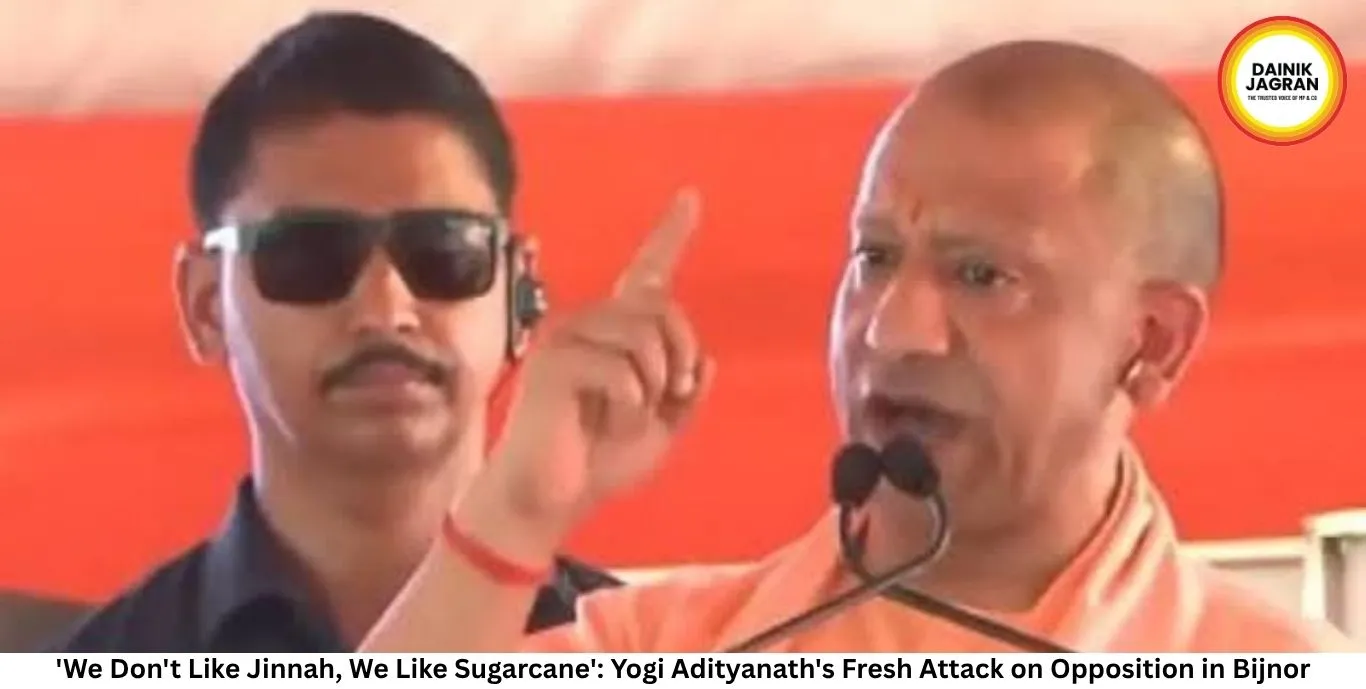
'We Don't Like Jinnah, We Like Sugarcane': Yogi Adityanath's Fresh Attack on Opposition in Bijnor
Digital desk
Uttar Pradesh Chief Minister Yogi Adityanath took his "Jinnah" jibe at the opposition to a new district on Saturday, telling a gathering in Bijnor that his government's priorities were sugarcane, not the ideology he accuses rival parties of following.
Speaking in Bijnor, Adityanath said that before 2017, chief ministers avoided visiting the district, treating it as inauspicious. He turned that framing around, arguing that it was those earlier leaders who were themselves the inauspicious ones, since a place blessed by the presence of the Ganga and linked to Lord Krishna's visit to Mahatma Vidur's home could never truly deserve such a reputation. He said Bijnor had since built a new identity around development, crediting what he called the "Double Engine Government" with transforming Uttar Pradesh from a long-struggling "BIMARU" state into one of India's leading ones.
He then turned sharply toward his political rivals, saying that those who wanted Bijnor to remain riot-prone, crime-ridden and under mafia control were the same people who, in his words, "believe in division and admire Jinnah." He summed up the contrast with a line that's since become the headline of his visit: "We do not like Jinnah; we like sugarcane" — pointing to his government's record of raising sugarcane prices and clearing the state of what he described as crime, riots, curfews and mafia influence as evidence of that priority.
The remarks echo a nearly identical attack he made a day earlier during a visit to Shamli, where he accused "worshippers of Jinnah" of deliberately altering the region's demography, pointing to past migration from Kairana and Kandhla as evidence. In Bijnor, he extended the same warning to local residents, cautioning that followers of what he called Jinnah's ideology would divide people along regional and caste lines whenever given the opportunity, and would resort to corruption in development work if allowed back into power.
On the sugarcane sector specifically, Adityanath recalled asking Suresh Rana, when he first took charge as sugarcane development minister in 2017, whether the state's mills would simply continue being sold off — to which Rana had reportedly assured him the mills would instead be reclaimed and restarted. The Chief Minister said 122 sugar mills are now operational, with farmers being paid on time and sugarcane prices at ₹400 per quintal, and cited Uttar Pradesh's position as the country's top producer of sugarcane, sugar and ethanol as proof of the sector's turnaround.
The visit was tied to the inauguration and foundation-laying of 89 development projects worth more than ₹581 crore across the Shamli, Thana Bhawan and Kairana assembly constituencies, continuing a pattern of framing infrastructure announcements alongside sharp political messaging as Uttar Pradesh heads toward its 2027 Assembly elections.
Neither the Samajwadi Party nor the Congress had issued a public response to Adityanath's remarks at the time of publishing.
--------
🚨 Beat the News Rush – Join Now!
Get breaking alerts, hot exclusives, and game-changing stories instantly on your phone. No delays, no fluff – just the edge you need. ⚡
Tap to join:
🟢 WhatsApp Channel: Dainik Jagran MP CG
Crave more?
🅕 Facebook: Dainik Jagran MP CG English
🅧 Twitter (X): Dainik Jagran MP CG
🅘 Instagram: Dainik Jagran MP CG
Share the fire – keep your crew ahead! 🗞️🔥
'We Don't Like Jinnah, We Like Sugarcane': Yogi Adityanath's Fresh Attack on Opposition in Bijnor
Digital desk
Speaking in Bijnor, Adityanath said that before 2017, chief ministers avoided visiting the district, treating it as inauspicious. He turned that framing around, arguing that it was those earlier leaders who were themselves the inauspicious ones, since a place blessed by the presence of the Ganga and linked to Lord Krishna's visit to Mahatma Vidur's home could never truly deserve such a reputation. He said Bijnor had since built a new identity around development, crediting what he called the "Double Engine Government" with transforming Uttar Pradesh from a long-struggling "BIMARU" state into one of India's leading ones.
He then turned sharply toward his political rivals, saying that those who wanted Bijnor to remain riot-prone, crime-ridden and under mafia control were the same people who, in his words, "believe in division and admire Jinnah." He summed up the contrast with a line that's since become the headline of his visit: "We do not like Jinnah; we like sugarcane" — pointing to his government's record of raising sugarcane prices and clearing the state of what he described as crime, riots, curfews and mafia influence as evidence of that priority.
The remarks echo a nearly identical attack he made a day earlier during a visit to Shamli, where he accused "worshippers of Jinnah" of deliberately altering the region's demography, pointing to past migration from Kairana and Kandhla as evidence. In Bijnor, he extended the same warning to local residents, cautioning that followers of what he called Jinnah's ideology would divide people along regional and caste lines whenever given the opportunity, and would resort to corruption in development work if allowed back into power.
On the sugarcane sector specifically, Adityanath recalled asking Suresh Rana, when he first took charge as sugarcane development minister in 2017, whether the state's mills would simply continue being sold off — to which Rana had reportedly assured him the mills would instead be reclaimed and restarted. The Chief Minister said 122 sugar mills are now operational, with farmers being paid on time and sugarcane prices at ₹400 per quintal, and cited Uttar Pradesh's position as the country's top producer of sugarcane, sugar and ethanol as proof of the sector's turnaround.
The visit was tied to the inauguration and foundation-laying of 89 development projects worth more than ₹581 crore across the Shamli, Thana Bhawan and Kairana assembly constituencies, continuing a pattern of framing infrastructure announcements alongside sharp political messaging as Uttar Pradesh heads toward its 2027 Assembly elections.
Neither the Samajwadi Party nor the Congress had issued a public response to Adityanath's remarks at the time of publishing.