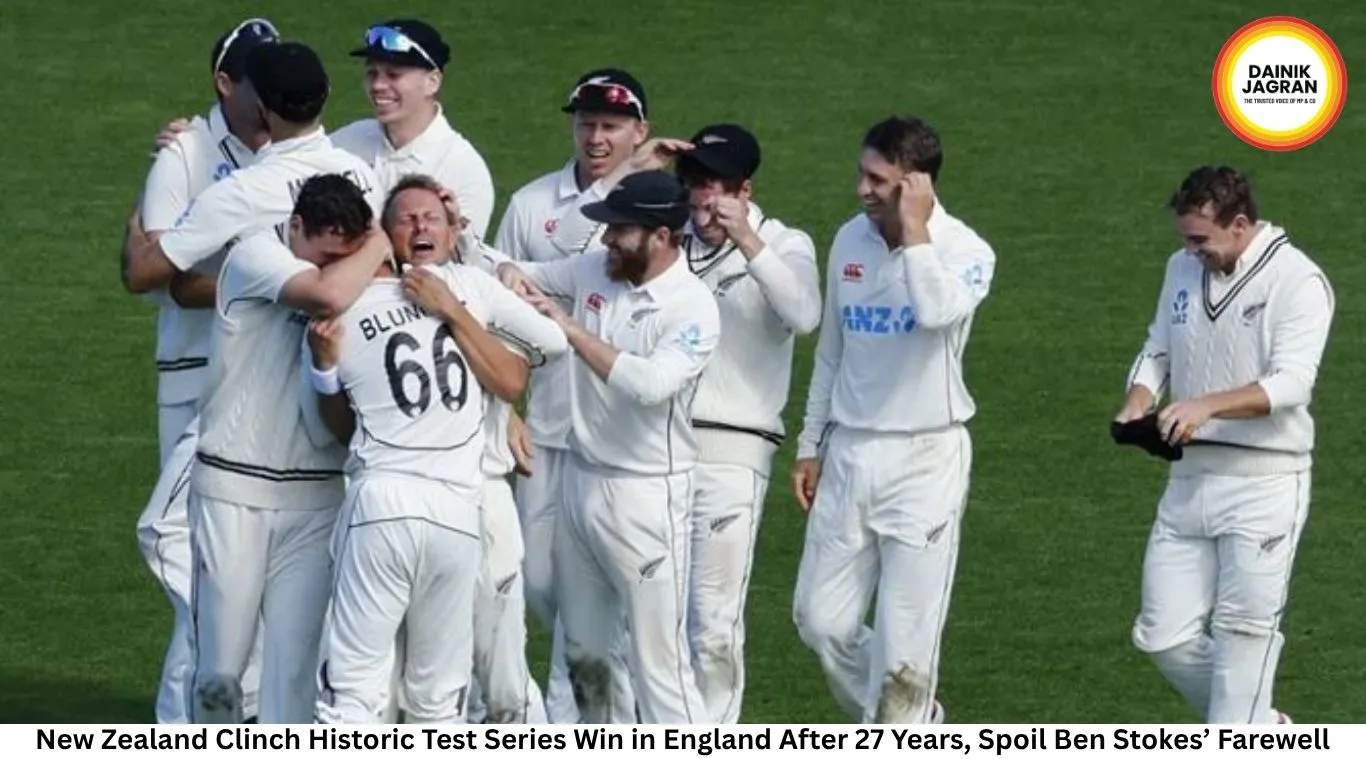
New Zealand Clinch Historic Test Series Win in England After 27 Years, Spoil Ben Stokes’ Farewell
Digital desk
New Zealand ended a 27-year wait for a Test series victory in England after defeating the hosts by 160 runs in the third and final Test at Trent Bridge, sealing a 2-1 series triumph and denying Ben Stokes a winning farewell in his final international match.
Chasing a challenging target of 373 on the fifth day, England were bowled out for 212, handing New Zealand one of their most memorable overseas Test victories in recent decades. The result marked only the fourth Test series win for the Black Caps in England and their first since 1999.
The achievement was made even more impressive by the manner in which New Zealand recovered after losing the opening Test. The visitors bounced back to win the final two matches and secure the series, becoming only the second New Zealand side to achieve such a comeback in England.
For England, the defeat carried added significance. It was their first home Test series loss of three matches or more since 2012 and added to a difficult run of results under the leadership era associated with the aggressive “Bazball” approach.
Much of the attention during the Test centered on Ben Stokes, who announced his retirement from international cricket during the match. The England captain hoped to end his distinguished career with a series victory, but New Zealand’s disciplined performance ensured a different outcome.
Stokes attempted to spark England’s chase with an aggressive innings, scoring 30 runs from just 20 deliveries. However, he was unable to convert the start into a match-defining knock and departed with England still facing a daunting task.
The final day began with England on 103 for 4, requiring a significant effort to overhaul the target. Instead, New Zealand seized control during the opening session.
Nathan Smith removed Emilio Gay early, before a brilliant direct hit from Henry Nicholls resulted in the run-out of Joe Root. The dismissal proved a major turning point, as England’s hopes of a comeback began to fade.
New Zealand maintained relentless pressure throughout the session. Mitchell Santner trapped Gus Atkinson lbw, while another direct-hit run-out accounted for Josh Tongue. The visitors eventually wrapped up the innings when Santner dismissed Jamie Smith, who had offered resistance with a fighting 60.
Smith’s innings briefly kept England in contention. He shared a valuable 75-run partnership with Atkinson, but regular wickets at the other end prevented England from building sustained momentum.
The foundation for New Zealand’s victory had been laid much earlier in the match through a dominant first-innings batting display.
Captain Tom Latham and Devon Conway produced a commanding opening partnership of 317 runs, putting England’s bowling attack under sustained pressure. Latham scored 151, while Conway contributed 157 as New Zealand posted 438 in their first innings.
England responded with 354, leaving the visitors with an 84-run advantage.
In the second innings, Daryl Mitchell played a decisive role. Battling through physical discomfort and absorbing several blows from England’s fast bowlers, he remained unbeaten on 100. His century, combined with Rachin Ravindra’s 94, helped New Zealand declare at 288 for 9 and set England a target of 373.
The victory was particularly notable given New Zealand’s injury concerns. The tourists were forced to manage multiple setbacks during the match, including injuries to Matt Henry, Blair Tickner and Will O’Rourke. Despite those challenges, the team delivered a composed and resilient performance.
After the match, Mitchell described the series victory as a special achievement, saying the team had arrived in England with the goal of winning the series and was delighted to accomplish it.
For Stokes, the result was not the ending he had envisioned. Nevertheless, the England captain said he remained proud of his career and his time leading the national side.
As one chapter closes for England with Stokes’ retirement, New Zealand leaves England with a historic series triumph that will be remembered as one of the team's finest overseas achievements.

--------
🚨 Beat the News Rush – Join Now!
Get breaking alerts, hot exclusives, and game-changing stories instantly on your phone. No delays, no fluff – just the edge you need. ⚡
Tap to join:
🟢 WhatsApp Channel: Dainik Jagran MP CG
Crave more?
🅕 Facebook: Dainik Jagran MP CG English
🅧 Twitter (X): Dainik Jagran MP CG
🅘 Instagram: Dainik Jagran MP CG
Share the fire – keep your crew ahead! 🗞️🔥
New Zealand Clinch Historic Test Series Win in England After 27 Years, Spoil Ben Stokes’ Farewell
Digital desk
Chasing a challenging target of 373 on the fifth day, England were bowled out for 212, handing New Zealand one of their most memorable overseas Test victories in recent decades. The result marked only the fourth Test series win for the Black Caps in England and their first since 1999.
The achievement was made even more impressive by the manner in which New Zealand recovered after losing the opening Test. The visitors bounced back to win the final two matches and secure the series, becoming only the second New Zealand side to achieve such a comeback in England.
For England, the defeat carried added significance. It was their first home Test series loss of three matches or more since 2012 and added to a difficult run of results under the leadership era associated with the aggressive “Bazball” approach.
Much of the attention during the Test centered on Ben Stokes, who announced his retirement from international cricket during the match. The England captain hoped to end his distinguished career with a series victory, but New Zealand’s disciplined performance ensured a different outcome.
Stokes attempted to spark England’s chase with an aggressive innings, scoring 30 runs from just 20 deliveries. However, he was unable to convert the start into a match-defining knock and departed with England still facing a daunting task.
The final day began with England on 103 for 4, requiring a significant effort to overhaul the target. Instead, New Zealand seized control during the opening session.
Nathan Smith removed Emilio Gay early, before a brilliant direct hit from Henry Nicholls resulted in the run-out of Joe Root. The dismissal proved a major turning point, as England’s hopes of a comeback began to fade.
New Zealand maintained relentless pressure throughout the session. Mitchell Santner trapped Gus Atkinson lbw, while another direct-hit run-out accounted for Josh Tongue. The visitors eventually wrapped up the innings when Santner dismissed Jamie Smith, who had offered resistance with a fighting 60.
Smith’s innings briefly kept England in contention. He shared a valuable 75-run partnership with Atkinson, but regular wickets at the other end prevented England from building sustained momentum.
The foundation for New Zealand’s victory had been laid much earlier in the match through a dominant first-innings batting display.
Captain Tom Latham and Devon Conway produced a commanding opening partnership of 317 runs, putting England’s bowling attack under sustained pressure. Latham scored 151, while Conway contributed 157 as New Zealand posted 438 in their first innings.
England responded with 354, leaving the visitors with an 84-run advantage.
In the second innings, Daryl Mitchell played a decisive role. Battling through physical discomfort and absorbing several blows from England’s fast bowlers, he remained unbeaten on 100. His century, combined with Rachin Ravindra’s 94, helped New Zealand declare at 288 for 9 and set England a target of 373.
The victory was particularly notable given New Zealand’s injury concerns. The tourists were forced to manage multiple setbacks during the match, including injuries to Matt Henry, Blair Tickner and Will O’Rourke. Despite those challenges, the team delivered a composed and resilient performance.
After the match, Mitchell described the series victory as a special achievement, saying the team had arrived in England with the goal of winning the series and was delighted to accomplish it.
For Stokes, the result was not the ending he had envisioned. Nevertheless, the England captain said he remained proud of his career and his time leading the national side.
As one chapter closes for England with Stokes’ retirement, New Zealand leaves England with a historic series triumph that will be remembered as one of the team's finest overseas achievements.