


Jharkhand Smugglers Behind Chhattisgarh's Border Poppy Crisis: Ambikapur's Drug Network Exposes the State's Opium Emergency
Digital Desk
From Dhaan Ka Katora to Afeem Ka Khet
Chhattisgarh built its identity with pride — the dhaan ka katora, India's rice bowl. Lush paddy fields, dense forests, tribal communities living in harmony with the land. That identity is now under assault. In March 2026, the state finds itself in the grip of a spreading opium emergency — and at its eastern frontier, along the Jharkhand border near Ambikapur, investigators have uncovered a disturbing cross-state network that rents tribal farmland to grow poppies under cover of forest and geography.
Preliminary investigation revealed that the cultivation was being carried out by people from Jharkhand, who had rented the land from local farmers. Villagers told police they knew opium was being grown but were unaware it was illegal — and came forward only after seeing a similar case from Durg district in the news.
That admission — we knew, but we didn't know it was wrong — captures the full scale of the challenge law enforcement now faces in Chhattisgarh's tribal belt.
What Police Found Near the Jharkhand Border
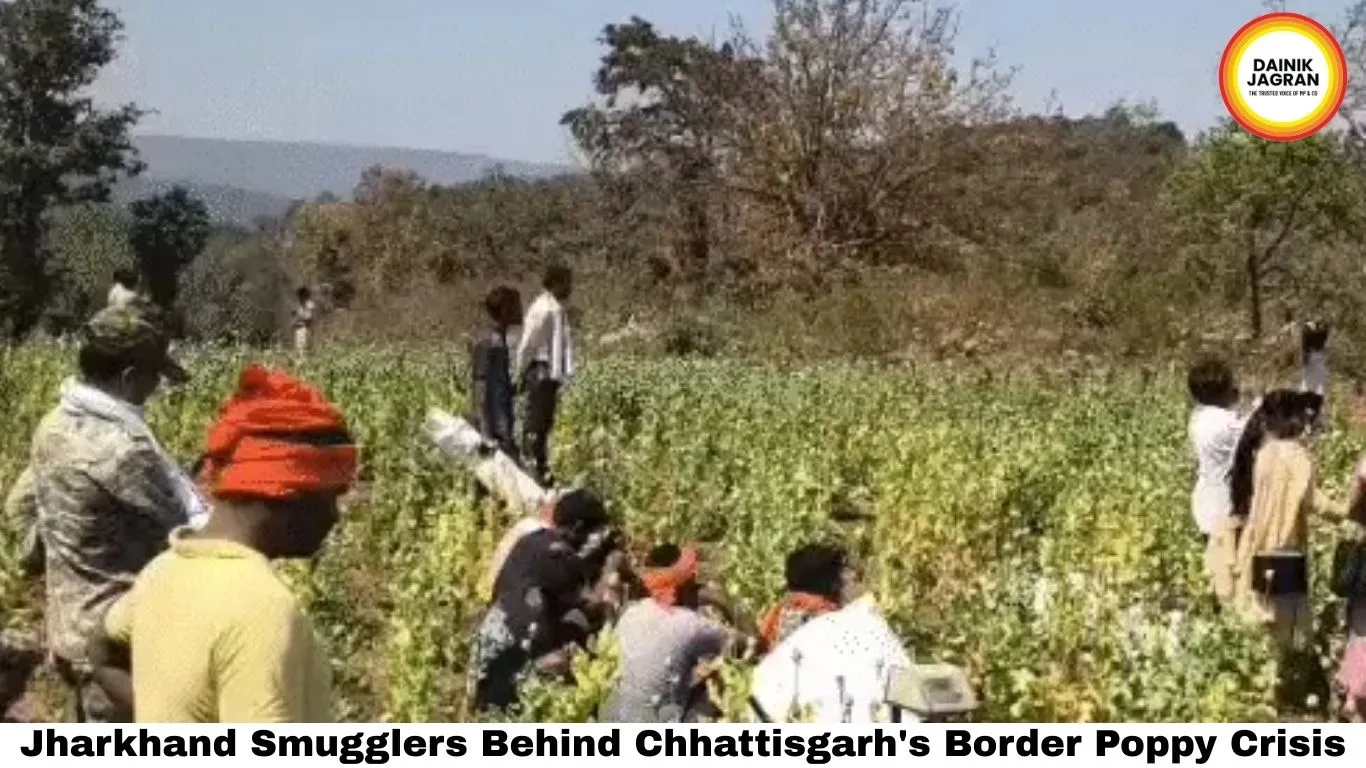
On March 10, 2026, acting on a tip-off, a joint team of police and district administration reached the Sarna Toli area under Tripuri Gram Panchayat in Kusmi block — one of the most remote and forested corners of Chhattisgarh, bordering Jharkhand. Initial investigation confirmed that illegal opium was being cultivated on more than two acres of land. The area was immediately taken into custody and the relevant narcotics agencies were alerted.
The Balrampur Collector Rajendra Katara and the Superintendent of Police personally reached the site — and were visibly stunned by the thriving opium crop they found. The fields were placed under overnight police surveillance before the formal seizure and destruction of the crop was carried out, with samples taken as evidence. The seizure totalled 18 quintals — approximately 1,800 kg — of opium plants with an estimated market value of ₹1.75 crore. A large quantity of dried poppy pods — some already incised for opium extraction — was recovered. Business Standard
The presence of incised pods is operationally significant: this was not a crop in early growth. It was a crop already being harvested for raw opium. The network was not planning — it was producing.
The Jharkhand Connection: An Established Drug Corridor
The involvement of Jharkhand-based operators in this case is not a random detail — it is the defining feature of the entire network, and one that explains why border districts like Balrampur and Ambikapur's Kusmi block have become vulnerable targets.
Jharkhand's districts of Khunti, Hazaribagh, Latehar, Palamu and Chatra have long been fertile ground for the opium mafia — who, with the help of villagers, historically grew opium crops in Naxal-affected areas where state presence was thin. In the last recorded data, opium was destroyed across 2,545 acres in Jharkhand in 2023 alone.
Jharkhand-based smugglers have adopted sophisticated strategies — converting opium into powder form and transporting it in small packets to cities including Ranchi, Hazaribagh, Chatra and urban centres in Uttar Pradesh, Punjab, Rajasthan, West Bengal and Nepal. Investigations after multiple arrests revealed that the Jharkhand smuggling network extends to Nepal and several Indian states — making it not only a production hub but a major transit and distribution centre for narcotics.
When enforcement pressure increased inside Jharkhand, the natural response for these operators was to move cultivation across the border — into Chhattisgarh's forested, lightly policed tribal belt. Renting land from local tribal farmers on informal sharecropping-style arrangements gave the network a layer of local cover, making it harder for authorities to identify the real operators behind the crop.
Durg to Balrampur: A State-Wide Pattern Emerges
The Ambikapur-Kusmi bust is not an isolated incident. It is the third major seizure in Chhattisgarh within the space of a single week — and together, these cases reveal a pattern that extends from the state's western industrial belt to its eastern tribal frontier.
On March 6, 2026, Durg police raided a farm in Samoda village and found 4 to 5 acres of opium cultivation hidden behind maize plants — the first opium case ever registered in Durg district. The arrested individual told police he had taken the land from Vinayak Tamrakar on a sharecropping arrangement.
The crop was spread over about 5 acres and 62 decimals of land in Samoda and Jhenjhri villages. Nearly 62,000 kilograms of opium plants were removed from the field, with an estimated value of approximately ₹7.88 crore. Police also seized 10 grams of opium, 200 grams of poppy seeds, a cutting tool used for extracting opium, seven sacks of poppy husk, a tractor and a JCB machine.
The Durg case carries a political dimension that has made it even more explosive. A sarpanch has formally accused the district chief of the BJP's Kisan Morcha of being connected to the illegal opium farming — introducing a significant political dimension that the state's opposition has seized upon with devastating speed.
The Rajasthan Seed Trail: How the Network Operates
One of the most revealing aspects of the Chhattisgarh poppy crisis is how the supply chain crosses multiple state borders before a single plant enters the ground.
A Rajasthan-based seed supplier has been arrested in connection with the wider Chhattisgarh opium network — revealing that the operation stretches from Rajasthan's legal poppy-growing belt, where seeds are diverted illegally, across Jharkhand's transport corridor, and into Chhattisgarh's tribal farmland. Operators from Jharkhand. Land from Chhattisgarh's tribal farmers. A distribution network that runs to Nepal and multiple Indian states. This is not cottage crime — it is organised, multi-state narco-agriculture.
The Political Fallout: Both Sides Under Fire
The opium crisis has predictably ignited political warfare in Raipur.
Former Chief Minister Bhupesh Baghel visited the Durg site along with local Congress leaders to inspect the area and highlight the issue. His social media posts carrying photographs of poppy plants in a BJP leader's farm spread across YouTube and WhatsApp with devastating speed — framing the BJP-led Vishnu Deo Sai government as protectors of drug farmers.
The BJP has fired back — pointing to the liquor scam allegations against the Baghel government and arguing that Congress has no moral authority to lecture on organised crime in the state. Both sides are using the drug crisis as political ammunition.
But for the tribal farmers of Kusmi block who rented their land to Jharkhand strangers — and for the young people of Balrampur, Ambikapur and Durg who may eventually consume drugs produced in fields a few kilometres from their homes — the political back-and-forth is not just irrelevant. It is an insult.
What Must Happen Now: Five Demands for Real Action
Unless the full financial and logistical network — the Jharkhand operators, the Rajasthan seed suppliers, the local facilitators, and any political connections — is prosecuted to its conclusion under the NDPS Act, this story will not end in Balrampur. It will simply move to the next remote forest district.
Here is what genuine accountability demands:
- A joint Chhattisgarh-Jharkhand special investigation team must be formed immediately, with NDPS Act authority to pursue operators across both states without jurisdictional barriers.
- The Rajasthan seed supplier connection must be fully investigated, with a backward chain audit of all licensed poppy seed sales in Rajasthan that could have been diverted to illegal cultivation.
- Tribal farmers who rented their land under informal arrangements must receive legal protection — their cooperation as witnesses is essential, and they must not be criminalised for the actions of outsiders who exploited their land and their trust.
- Any political figure — from any party — whose land, finances or connections are found linked to the drug cultivation network must be prosecuted under both the NDPS Act and the Prevention of Money Laundering Act, with no exceptions based on party affiliation.
- Border surveillance between Chhattisgarh and Jharkhand, particularly in forested areas around Kusmi, Ambikapur and Balrampur, must be immediately upgraded — with drone surveillance, forest department coordination and regular ground patrols of remote farmland.
Conclusion: Chhattisgarh Cannot Afford to Lose Its Fields to Opium
Jharkhand DGP Anurag Gupta, when cracking down on his own state's opium fields, said in clear terms that he would not spare any police officer found in collusion with the opium mafia. That zero-tolerance standard must now be adopted by Chhattisgarh's administration as well — from the SP's office to the forest department to the district collector's chamber.
Chhattisgarh's tribal farmers did not invite this crisis. They were targeted — by sophisticated operators who identified their land, their poverty, their geographic isolation, and their unfamiliarity with narcotics law as tools of exploitation. The state owes them protection, not prosecution.
The opium plants have been uprooted. The Jharkhand operators are being hunted. The Rajasthan seed trail is being followed. Good. But if the network is not dismantled completely — if the political connections are quietly buried, the operators given bail, and the farmland simply left to the next round of illegal cultivation — then Chhattisgarh will not just lose its identity as the rice bowl of India.
It will have allowed itself to become something far darker.
The paddy fields of Chhattisgarh belong to its farmers. Not to smugglers from across the border. Not to politicians with dangerous connections. And certainly not to opium.
.jpg)




