

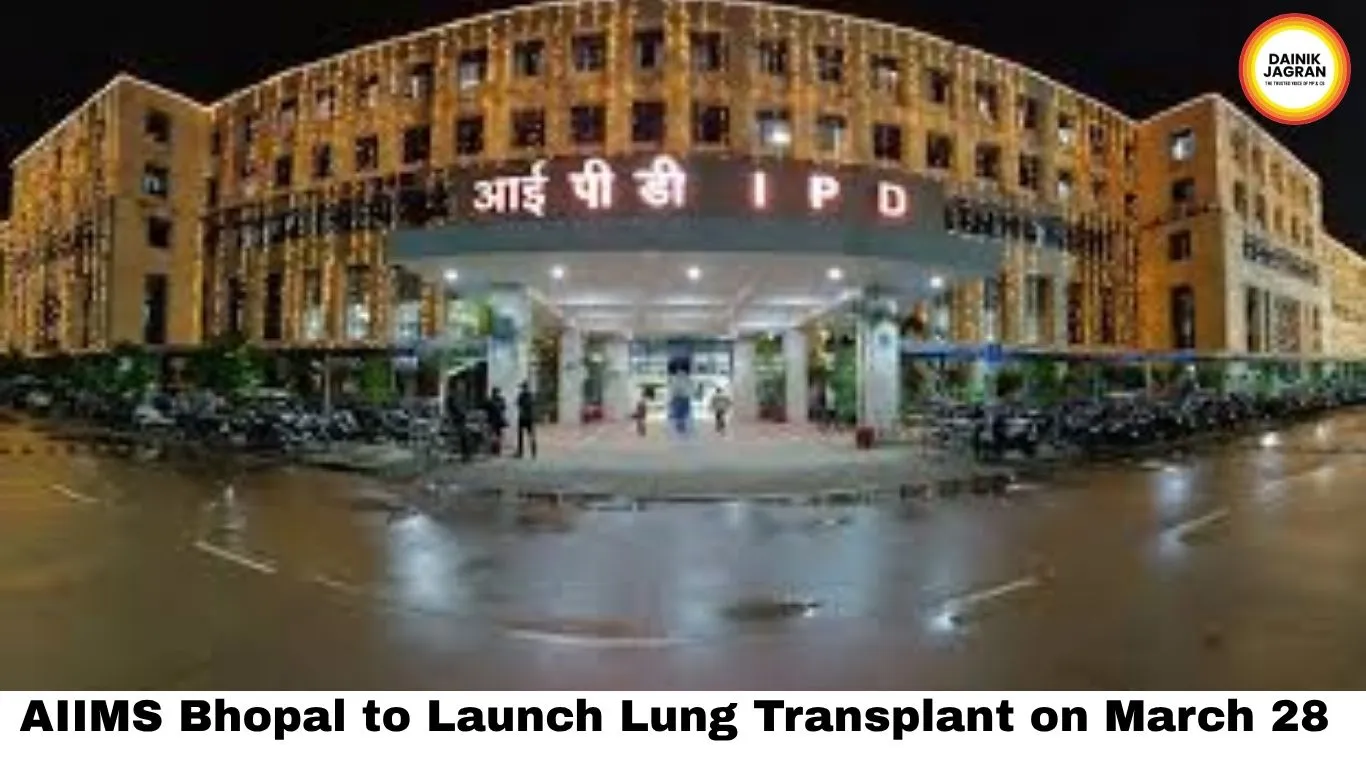
AIIMS Bhopal Lung Transplant to Launch March 28 — Central India First

Digital Desk

 AIIMS Bhopal Lung Transplant to Launch March 28 — Central India First

AIIMS Bhopal launches lung transplant programme on March 28 after SOTTO inspection — becoming Central India's only government hospital offering heart, kidney, bone marrow and lung transplants under one roof.

AIIMS Bhopal to Launch Lung Transplant on March 28 — Central India's First Government Multi-Organ Transplant Centre Takes Shape

With SOTTO's site inspection complete and final government approval imminent, AIIMS Bhopal is days away from becoming the only government hospital in Central India to offer heart, kidney, bone marrow and lung transplants — all under one roof and free of cost.


A Historic First for Central India

On March 28, 2026, AIIMS Bhopal is expected to formally launch its lung transplant programme — a milestone that will make it the first government institution in Central India to offer all four major organ transplants at a single facility. Heart transplants, kidney transplants and bone marrow transplants are already performed at the institute. When the lung transplant programme goes live, AIIMS Bhopal will stand alone in the region as a complete multi-organ transplant centre — offering life-saving procedures to critically ill patients who previously had no option but to travel to Mumbai, Delhi or Chennai, spending lakhs of rupees on private hospital care.

For the patients of Madhya Pradesh, Chhattisgarh and the broader central Indian region, this is not merely a medical milestone. It is a fundamental expansion of what government healthcare can offer.


SOTTO Inspection Done — Final Permission Awaited

The critical regulatory step before lung transplants can begin is approval from the State Organ and Tissue Transplant Organisation — SOTTO. The SOTTO team has completed its site inspection at AIIMS Bhopal, examining the infrastructure, operation theatre facilities, ICU capacity, post-transplant care protocols, and the qualifications of the surgical team. The inspection identified some minor deficiencies which have since been addressed by the hospital. Once the SOTTO team submits its report to the state government, the final official permission will be issued — clearing the path for the first procedure.

AIIMS Bhopal's public relations officer confirmed that the report and approval are awaited and that the facility will be operational as soon as clearance is received. The March 28 date has been cited internally as the target launch window.


Doctors Trained in Chennai — The Surgical Team Is Ready

The medical readiness for lung transplants at AIIMS Bhopal has been building for over a year. A dedicated team of cardiovascular surgeons from AIIMS Bhopal undertook specialised training at a leading transplant centre in Chennai — one of India's most established lung transplant hubs — where they mastered the complete techniques of both heart and lung transplantation. Lung transplants are exclusively performed by cardiovascular surgeons, and the specialised nature of the procedure demanded this focused, facility-specific training before any attempt could be made in Bhopal.

The training is complete. The team is ready. The operation theatre is prepared. The only remaining requirement is the regulatory green light.


What AIIMS Bhopal Has Already Achieved — The Transplant Track Record

AIIMS Bhopal's entry into lung transplants is not a leap into the unknown — it is the next step in a transplant programme that has been steadily expanding since 2024. In January 2025, AIIMS Bhopal performed Madhya Pradesh's first successful heart transplant — a landmark procedure that demonstrated the institute's capacity to handle the most complex organ transplant operations. To date, AIIMS Bhopal has completed 3 heart transplants and 17 kidney transplants.

The kidney transplant programme began in January 2024 — when a man donated a kidney to save his son — and has since expanded to include living donor transplants from spouses and family members. The success rate has been strong, with patients recovering well and returning to functional lives. The bone marrow transplant programme adds haematological cancer treatment to the mix.

Together, these programmes represent a transformation of what AIIMS Bhopal was when it opened — a teaching hospital still building its clinical base — into one of the most comprehensive government medical facilities in peninsular India.


What the 2026 Expansion Looks Like — Beyond Lung Transplant

The lung transplant launch is part of a broader expansion plan that AIIMS Bhopal has outlined for 2026. A dedicated transplant operation theatre — separate from the general surgical OTs and designed specifically for the sterile, infection-controlled environment that organ transplants demand — is being commissioned this year. This will allow heart, liver, kidney and lung transplants to be performed under controlled conditions with reduced waiting times and improved infection management.

In addition, AIIMS Bhopal is installing Gamma Knife technology — which allows brain tumours and complex neurological conditions to be treated using precise radiation without open surgery — and a PET Scan machine for faster, more accurate cancer diagnosis. A new four-storey ICU building is under construction near the cancer block to handle the growing volume of critical patients. Two surgical robots costing ₹60 crore are also being acquired to assist in complex operations.

The OPD numbers tell the transformation story most vividly. Two years ago, AIIMS Bhopal handled 3.76 lakh OPD patients annually. That number has since climbed to 10.5 lakh — a 179 percent increase. Major surgeries have increased by 92 percent. Minor surgeries by 300 percent. The institute's no-refusal policy in trauma and emergency has resulted in a 110 percent increase in patient intake.


What a Lung Transplant Involves — And Who Needs One

A lung transplant is a surgical procedure in which one or both diseased lungs are removed from a patient and replaced with healthy lungs from a deceased — cadaveric — donor. It is the treatment of last resort for patients with chronic, end-stage respiratory disease for whom no effective medical therapy exists.

The conditions most commonly requiring lung transplantation include Interstitial Lung Disease — the most common indication, accounting for 57 percent of referrals in Indian studies — followed by Bronchiectasis at 17 percent and Chronic Obstructive Pulmonary Disease at 13 percent. Other indications include pulmonary fibrosis, cystic fibrosis, pulmonary hypertension and silicosis.

In private hospitals across India, a single lung transplant costs between ₹25 lakh and ₹35 lakh. A double lung transplant can cost ₹40 to ₹50 lakh — followed by lifelong immunosuppressive medication at ₹10,000 to ₹30,000 per month. For the vast majority of patients who need this procedure in Madhya Pradesh and Chhattisgarh, those costs are simply impossible.

At AIIMS Bhopal, the procedure will be available at a fraction of private hospital costs — and potentially free for patients under the Ayushman Bharat Pradhan Mantri Jan Arogya Yojana scheme, which has already seen a 250 percent increase in beneficiaries at AIIMS Bhopal over the past two years.


The Organ Donation Challenge

The single biggest limiting factor for India's lung transplant programme — at AIIMS Bhopal and everywhere else — is not surgical skill, infrastructure or funding. It is organ availability. Lung transplants can only be performed using organs donated by deceased donors — cadaveric lungs that are recovered within hours of brain death and transplanted before viability is lost. Living donor lung transplants, in which a lobe of the lung is donated by a living person, are technically possible but rarely performed and not yet planned at AIIMS Bhopal.

India's deceased donor rate remains one of the lowest in the world — approximately 0.86 donors per million population, compared to 40 or more per million in Spain and the United States. For every patient on AIIMS Bhopal's lung transplant waiting list, the wait for a suitable matched donor could be months or years. Raising awareness about brain death organ donation — and removing the social, cultural and religious barriers that prevent families from consenting to donation — is as important to the success of AIIMS Bhopal's lung transplant programme as any surgical achievement.


What March 28 Means for Bhopal

When AIIMS Bhopal performs its first lung transplant — a date now days away pending final regulatory clearance — it will change what is possible for every patient in Madhya Pradesh and Chhattisgarh who has been told that their only hope lies in an expensive, distant private hospital. It will mean that the government of India has placed one of medicine's most complex and life-giving procedures within reach of a farmer from Vidisha, a coal miner from Korba, or a textile worker from Indore — all of them equally entitled to the chance at a second life that a lung transplant represents.

english.dainikjagranmpcg.com
23 Mar 2026 By Jiya.S

AIIMS Bhopal Lung Transplant to Launch March 28 — Central India First

Digital Desk

AIIMS Bhopal to Launch Lung Transplant on March 28 — Central India's First Government Multi-Organ Transplant Centre Takes Shape

With SOTTO's site inspection complete and final government approval imminent, AIIMS Bhopal is days away from becoming the only government hospital in Central India to offer heart, kidney, bone marrow and lung transplants — all under one roof and free of cost.


A Historic First for Central India

On March 28, 2026, AIIMS Bhopal is expected to formally launch its lung transplant programme — a milestone that will make it the first government institution in Central India to offer all four major organ transplants at a single facility. Heart transplants, kidney transplants and bone marrow transplants are already performed at the institute. When the lung transplant programme goes live, AIIMS Bhopal will stand alone in the region as a complete multi-organ transplant centre — offering life-saving procedures to critically ill patients who previously had no option but to travel to Mumbai, Delhi or Chennai, spending lakhs of rupees on private hospital care.

For the patients of Madhya Pradesh, Chhattisgarh and the broader central Indian region, this is not merely a medical milestone. It is a fundamental expansion of what government healthcare can offer.


SOTTO Inspection Done — Final Permission Awaited

The critical regulatory step before lung transplants can begin is approval from the State Organ and Tissue Transplant Organisation — SOTTO. The SOTTO team has completed its site inspection at AIIMS Bhopal, examining the infrastructure, operation theatre facilities, ICU capacity, post-transplant care protocols, and the qualifications of the surgical team. The inspection identified some minor deficiencies which have since been addressed by the hospital. Once the SOTTO team submits its report to the state government, the final official permission will be issued — clearing the path for the first procedure.

AIIMS Bhopal's public relations officer confirmed that the report and approval are awaited and that the facility will be operational as soon as clearance is received. The March 28 date has been cited internally as the target launch window.


Doctors Trained in Chennai — The Surgical Team Is Ready

The medical readiness for lung transplants at AIIMS Bhopal has been building for over a year. A dedicated team of cardiovascular surgeons from AIIMS Bhopal undertook specialised training at a leading transplant centre in Chennai — one of India's most established lung transplant hubs — where they mastered the complete techniques of both heart and lung transplantation. Lung transplants are exclusively performed by cardiovascular surgeons, and the specialised nature of the procedure demanded this focused, facility-specific training before any attempt could be made in Bhopal.

The training is complete. The team is ready. The operation theatre is prepared. The only remaining requirement is the regulatory green light.


What AIIMS Bhopal Has Already Achieved — The Transplant Track Record

AIIMS Bhopal's entry into lung transplants is not a leap into the unknown — it is the next step in a transplant programme that has been steadily expanding since 2024. In January 2025, AIIMS Bhopal performed Madhya Pradesh's first successful heart transplant — a landmark procedure that demonstrated the institute's capacity to handle the most complex organ transplant operations. To date, AIIMS Bhopal has completed 3 heart transplants and 17 kidney transplants.

The kidney transplant programme began in January 2024 — when a man donated a kidney to save his son — and has since expanded to include living donor transplants from spouses and family members. The success rate has been strong, with patients recovering well and returning to functional lives. The bone marrow transplant programme adds haematological cancer treatment to the mix.

Together, these programmes represent a transformation of what AIIMS Bhopal was when it opened — a teaching hospital still building its clinical base — into one of the most comprehensive government medical facilities in peninsular India.


What the 2026 Expansion Looks Like — Beyond Lung Transplant

The lung transplant launch is part of a broader expansion plan that AIIMS Bhopal has outlined for 2026. A dedicated transplant operation theatre — separate from the general surgical OTs and designed specifically for the sterile, infection-controlled environment that organ transplants demand — is being commissioned this year. This will allow heart, liver, kidney and lung transplants to be performed under controlled conditions with reduced waiting times and improved infection management.

In addition, AIIMS Bhopal is installing Gamma Knife technology — which allows brain tumours and complex neurological conditions to be treated using precise radiation without open surgery — and a PET Scan machine for faster, more accurate cancer diagnosis. A new four-storey ICU building is under construction near the cancer block to handle the growing volume of critical patients. Two surgical robots costing ₹60 crore are also being acquired to assist in complex operations.

The OPD numbers tell the transformation story most vividly. Two years ago, AIIMS Bhopal handled 3.76 lakh OPD patients annually. That number has since climbed to 10.5 lakh — a 179 percent increase. Major surgeries have increased by 92 percent. Minor surgeries by 300 percent. The institute's no-refusal policy in trauma and emergency has resulted in a 110 percent increase in patient intake.


What a Lung Transplant Involves — And Who Needs One

A lung transplant is a surgical procedure in which one or both diseased lungs are removed from a patient and replaced with healthy lungs from a deceased — cadaveric — donor. It is the treatment of last resort for patients with chronic, end-stage respiratory disease for whom no effective medical therapy exists.

The conditions most commonly requiring lung transplantation include Interstitial Lung Disease — the most common indication, accounting for 57 percent of referrals in Indian studies — followed by Bronchiectasis at 17 percent and Chronic Obstructive Pulmonary Disease at 13 percent. Other indications include pulmonary fibrosis, cystic fibrosis, pulmonary hypertension and silicosis.

In private hospitals across India, a single lung transplant costs between ₹25 lakh and ₹35 lakh. A double lung transplant can cost ₹40 to ₹50 lakh — followed by lifelong immunosuppressive medication at ₹10,000 to ₹30,000 per month. For the vast majority of patients who need this procedure in Madhya Pradesh and Chhattisgarh, those costs are simply impossible.

At AIIMS Bhopal, the procedure will be available at a fraction of private hospital costs — and potentially free for patients under the Ayushman Bharat Pradhan Mantri Jan Arogya Yojana scheme, which has already seen a 250 percent increase in beneficiaries at AIIMS Bhopal over the past two years.


The Organ Donation Challenge

The single biggest limiting factor for India's lung transplant programme — at AIIMS Bhopal and everywhere else — is not surgical skill, infrastructure or funding. It is organ availability. Lung transplants can only be performed using organs donated by deceased donors — cadaveric lungs that are recovered within hours of brain death and transplanted before viability is lost. Living donor lung transplants, in which a lobe of the lung is donated by a living person, are technically possible but rarely performed and not yet planned at AIIMS Bhopal.

India's deceased donor rate remains one of the lowest in the world — approximately 0.86 donors per million population, compared to 40 or more per million in Spain and the United States. For every patient on AIIMS Bhopal's lung transplant waiting list, the wait for a suitable matched donor could be months or years. Raising awareness about brain death organ donation — and removing the social, cultural and religious barriers that prevent families from consenting to donation — is as important to the success of AIIMS Bhopal's lung transplant programme as any surgical achievement.


What March 28 Means for Bhopal

When AIIMS Bhopal performs its first lung transplant — a date now days away pending final regulatory clearance — it will change what is possible for every patient in Madhya Pradesh and Chhattisgarh who has been told that their only hope lies in an expensive, distant private hospital. It will mean that the government of India has placed one of medicine's most complex and life-giving procedures within reach of a farmer from Vidisha, a coal miner from Korba, or a textile worker from Indore — all of them equally entitled to the chance at a second life that a lung transplant represents.

https://english.dainikjagranmpcg.com/states/madhya-pradesh/-aiims-bhopal-lung-transplant-to-launch-march-28-%E2%80%94/article-15848

Related Posts

Advertisement

Latest News


