When Krishna Came to Bhopal: Nitish Bharadwaj Opens IndieMoons Arts Festival 2026 With a Performance That Stopped Time

Digital Desk

When Krishna Came to Bhopal: Nitish Bharadwaj Opens IndieMoons Arts Festival 2026 With a Performance That Stopped Time

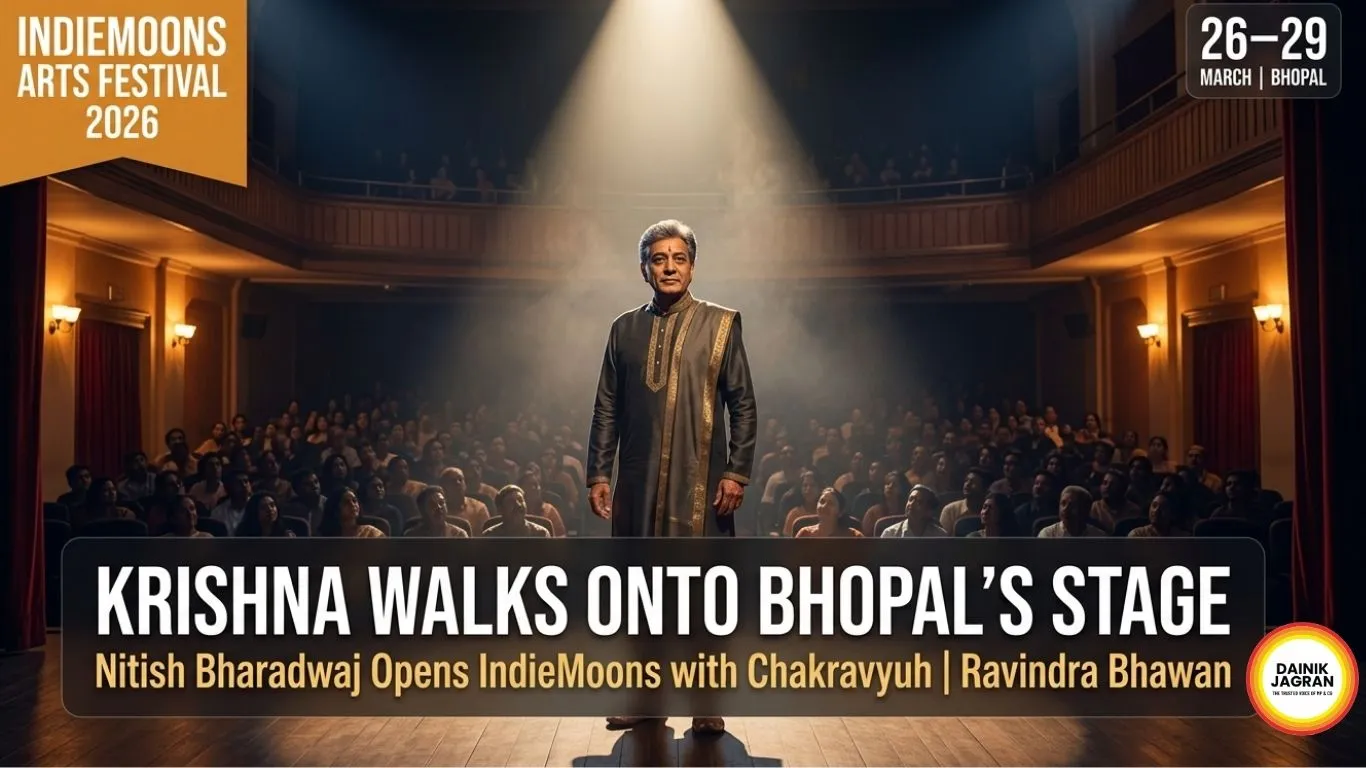
Nitish Bharadwaj opened IndieMoons Arts Festival 2026 in Bhopal with Chakravyuh. A four-day cultural celebration at Ravindra Bhawan — theatre, music, legends.

When Krishna Came to Bhopal: Nitish Bharadwaj Opens IndieMoons Arts Festival 2026 With a Performance That Stopped Time

There is something quietly extraordinary about watching a man who once played Lord Krishna on national television walk onto a stage in the City of Lakes — not as a deity, but as an actor. Fully present. Fully human. And yet somehow, unmistakably, carrying with him the weight of a role that millions of Indians still bow to when they see his face.

On the evening of March 26, 2026, Nitish Bharadwaj did exactly that. He opened the IndieMoons Arts Festival 2026 at Hansdhwani Auditorium, Ravindra Bhawan, Bhopal with a performance of his celebrated play Chakravyuh — and in doing so, set a standard for the four-day festival that everything else would have to chase.

Bhopal had seen cultural events before. But IndieMoons felt different from the moment the lights went down.


What Is IndieMoons — and Why Does It Matter?

The IndieMoons Arts Festival 2026 is not just another ticketed event on a weekend calendar. It is the result of a genuine artistic vision — organised by Rang Theatre, Cultural and Social Welfare Society, powered by Dainik Jagran MP/CG Digital, and built on a belief that Bhopal, with its deep-rooted theatre tradition and fiercely engaged cultural audience, deserves a festival of national stature.

Running from March 26 to 29, 2026, at Ravindra Bhawan's Hansdhwani Auditorium, the festival brings together some of the most celebrated names in Indian performing arts — Nitish Bharadwaj, Rakesh Bedi, Sanjay Mishra, Santosh Juvekar, Shekhar Suman — across four consecutive evenings. Each night features a headline performance at 7:30 PM. But IndieMoons is also, deliberately and thoughtfully, about what happens before the main event.

Every afternoon, CentreStage (3 PM to 5 PM) brings theatre legends and thinkers into conversation with Bhopal's audiences — exploring storytelling, mythology, and the craft of stagecraft in direct, intimate dialogue. Then OpenStage (5 PM to 7 PM) throws the floor open to young poets, student bands, and independent performers who get to showcase their work before the evening's headline act. A brass band from Scindia School, Gwalior, sets the atmosphere each evening. The structure is elegant — generous to legends, generous to newcomers, generous to the audience.

This is what distinguishes IndieMoons from a conventional theatre festival. It is not a showcase. It is a conversation between generations.


Night One: Nitish Bharadwaj and Chakravyuh

To understand why Nitish Bharadwaj opening IndieMoons matters, you have to understand who Nitish Bharadwaj is — and what Chakravyuh is.

Bharadwaj became one of Indian television's most iconic figures when he played Lord Krishna in B.R. Chopra's Mahabharat in 1988. The role made him a household name overnight — not merely a celebrity, but something approaching a cultural institution. People touched his feet in airports. Temples displayed his photographs. An entire generation grew up with his face as the face of the divine.

What he did with that fame is what separates him from actors who simply ride a single role to comfortable obscurity. He studied. He directed. He wrote. He engaged with the Bhagavad Gita not as a prop but as a philosophy. He became a Member of Parliament. He married an IAS officer. He went to London and performed French theatre in English. He returned to India and kept making art — not for the cameras, but for the stage, where you cannot edit a mistake.

Chakravyuh, the play he performed on the opening night of IndieMoons, is the vehicle through which all of this comes together. On the surface, it tells the story of Abhimanyu — the young warrior who enters the military formation known as the Chakravyuh in the Mahabharata and is slain because he knows how to enter but not how to exit. But beneath that mythological narrative, the play excavates questions that are urgently contemporary: about ambition, about the traps we build for ourselves, about the systems that promise entry but deny exit, about young people sent into battles designed for them to lose.

And in the centre of it all — as Krishna, as philosopher, as witness — stands Nitish Bharadwaj. Not performing a role. Inhabiting a truth.

The audience at Hansdhwani Auditorium on March 26 watched in something close to silence. That is the highest compliment a Bhopal theatre crowd can pay.


The Four Nights: A Festival Worthy of the City

What follows Bharadwaj across the four days of IndieMoons is equally compelling.

On March 27 — World Theatre Day, observed globally on this date each year — veteran actor Rakesh Bedi took the stage with his acclaimed one-man show Massage. Bedi, best known to mainstream audiences for his comedic roles in 1980s Hindi cinema, has spent the past decade establishing himself as a serious stage performer. Massage features him portraying 24 different characters in a single unbroken performance — a hilarious, sharp, deeply observed portrait of dreams, chaos, and the absurdity of Mumbai life. He had not performed the show in nearly 12 years. Bhopal was where it came back.

On March 28, the iconic playwright Vijay Tendulkar got his due when Sanjay Mishra and Santosh Juvekar performed Ghashiram Kotwal — Tendulkar's masterpiece of political satire on power, corruption, and ambition, performed with live folk music. The play had not been staged in this form for over a decade. Its themes — of how ordinary men become instruments of power, and how power corrupts those who yield it — feel as relevant in 2026 as they did when Tendulkar first wrote them.

And on the closing night, March 29, Shekhar Suman brought Ek Mulaqat — a dramatic telling of the real-life unfinished love story of Sahir Ludhianvi and Amrita Pritam, two of the 20th century's most luminous literary figures. With Geetika Tyagi alongside him, Suman offered Bhopal an evening of romance, heartbreak, poetry, and the particular ache of love that never found its ending.

Four nights. Four legends. Four stories that together make the argument, quietly and powerfully, that Indian theatre is not a relic of the past. It is one of the most alive art forms the country possesses.


Why Bhopal? Why Now?

The organisers of IndieMoons were asked why they chose Bhopal for the festival's debut. Their answer was straightforward: because Bhopal has always deserved it.

This is not empty flattery. Bhopal has a theatre tradition that stretches back decades — nurtured at institutions like Bharat Bhavan, sustained by local theatre groups, and kept alive by audiences who take the performing arts seriously. Unlike some cities where cultural festivals feel like imports, Bhopal's relationship with theatre is organic and long-standing.

What IndieMoons does is give that tradition a national platform — bringing artists of Bharadwaj's and Mishra's and Suman's stature to a city whose audiences are fully equipped to receive and appreciate them. It is a meeting of equals, not a gift from outside.

The decision to include OpenStage sessions for emerging artists alongside the headline performances is particularly significant. It signals that IndieMoons is not merely a prestige event for paying audiences — it is an investment in Bhopal's next generation of theatre makers. The young poet who performs at 5:30 PM on an OpenStage and then watches Nitish Bharadwaj at 7:30 PM goes home changed. That is how artistic traditions sustain themselves.


Conclusion: Bhopal Has a Festival. Now It Needs to Keep It.

IndieMoons Arts Festival 2026 is, by all accounts, a success — artistically, culturally, and in terms of the conversation it has sparked about Bhopal's place in India's performing arts landscape.

But a single edition, however good, is not a tradition. Traditions require repetition, commitment, and institutional memory. The hope is that what Rang Theatre and its partners have built this March is not a one-time event but the beginning of something annual, something that Bhopal's cultural calendar comes to depend on the way Mumbai depends on Prithvi Theatre or Delhi on its repertory theatre circuit.

Nitish Bharadwaj opened IndieMoons 2026 with a play about a warrior who knew how to enter a formation but not how to leave it. IndieMoons itself must be the opposite — a festival that knows not just how to make a spectacular entrance, but how to keep coming back, year after year, until Bhopal becomes synonymous with it.

The Chakravyuh has been entered. Now the task is to find the way through.
--------

🚨 Beat the News Rush – Join Now!

Get breaking alerts, hot exclusives, and game-changing stories instantly on your phone. No delays, no fluff – just the edge you need. ⚡

Tap to join: 

🟢 WhatsApp Channel: Dainik Jagran MP CG

Crave more?

🅕 Facebook: Dainik Jagran MP CG English

🅧 Twitter (X): Dainik Jagran MP CG

🅘 Instagram: Dainik Jagran MP CG

Share the fire – keep your crew ahead! 🗞️🔥

english.dainikjagranmpcg.com
27 Mar 2026 By Jiya.S

When Krishna Came to Bhopal: Nitish Bharadwaj Opens IndieMoons Arts Festival 2026 With a Performance That Stopped Time

Digital Desk

When Krishna Came to Bhopal: Nitish Bharadwaj Opens IndieMoons Arts Festival 2026 With a Performance That Stopped Time

There is something quietly extraordinary about watching a man who once played Lord Krishna on national television walk onto a stage in the City of Lakes — not as a deity, but as an actor. Fully present. Fully human. And yet somehow, unmistakably, carrying with him the weight of a role that millions of Indians still bow to when they see his face.

On the evening of March 26, 2026, Nitish Bharadwaj did exactly that. He opened the IndieMoons Arts Festival 2026 at Hansdhwani Auditorium, Ravindra Bhawan, Bhopal with a performance of his celebrated play Chakravyuh — and in doing so, set a standard for the four-day festival that everything else would have to chase.

Bhopal had seen cultural events before. But IndieMoons felt different from the moment the lights went down.


What Is IndieMoons — and Why Does It Matter?

The IndieMoons Arts Festival 2026 is not just another ticketed event on a weekend calendar. It is the result of a genuine artistic vision — organised by Rang Theatre, Cultural and Social Welfare Society, powered by Dainik Jagran MP/CG Digital, and built on a belief that Bhopal, with its deep-rooted theatre tradition and fiercely engaged cultural audience, deserves a festival of national stature.

Running from March 26 to 29, 2026, at Ravindra Bhawan's Hansdhwani Auditorium, the festival brings together some of the most celebrated names in Indian performing arts — Nitish Bharadwaj, Rakesh Bedi, Sanjay Mishra, Santosh Juvekar, Shekhar Suman — across four consecutive evenings. Each night features a headline performance at 7:30 PM. But IndieMoons is also, deliberately and thoughtfully, about what happens before the main event.

Every afternoon, CentreStage (3 PM to 5 PM) brings theatre legends and thinkers into conversation with Bhopal's audiences — exploring storytelling, mythology, and the craft of stagecraft in direct, intimate dialogue. Then OpenStage (5 PM to 7 PM) throws the floor open to young poets, student bands, and independent performers who get to showcase their work before the evening's headline act. A brass band from Scindia School, Gwalior, sets the atmosphere each evening. The structure is elegant — generous to legends, generous to newcomers, generous to the audience.

This is what distinguishes IndieMoons from a conventional theatre festival. It is not a showcase. It is a conversation between generations.


Night One: Nitish Bharadwaj and Chakravyuh

To understand why Nitish Bharadwaj opening IndieMoons matters, you have to understand who Nitish Bharadwaj is — and what Chakravyuh is.

Bharadwaj became one of Indian television's most iconic figures when he played Lord Krishna in B.R. Chopra's Mahabharat in 1988. The role made him a household name overnight — not merely a celebrity, but something approaching a cultural institution. People touched his feet in airports. Temples displayed his photographs. An entire generation grew up with his face as the face of the divine.

What he did with that fame is what separates him from actors who simply ride a single role to comfortable obscurity. He studied. He directed. He wrote. He engaged with the Bhagavad Gita not as a prop but as a philosophy. He became a Member of Parliament. He married an IAS officer. He went to London and performed French theatre in English. He returned to India and kept making art — not for the cameras, but for the stage, where you cannot edit a mistake.

Chakravyuh, the play he performed on the opening night of IndieMoons, is the vehicle through which all of this comes together. On the surface, it tells the story of Abhimanyu — the young warrior who enters the military formation known as the Chakravyuh in the Mahabharata and is slain because he knows how to enter but not how to exit. But beneath that mythological narrative, the play excavates questions that are urgently contemporary: about ambition, about the traps we build for ourselves, about the systems that promise entry but deny exit, about young people sent into battles designed for them to lose.

And in the centre of it all — as Krishna, as philosopher, as witness — stands Nitish Bharadwaj. Not performing a role. Inhabiting a truth.

The audience at Hansdhwani Auditorium on March 26 watched in something close to silence. That is the highest compliment a Bhopal theatre crowd can pay.


The Four Nights: A Festival Worthy of the City

What follows Bharadwaj across the four days of IndieMoons is equally compelling.

On March 27 — World Theatre Day, observed globally on this date each year — veteran actor Rakesh Bedi took the stage with his acclaimed one-man show Massage. Bedi, best known to mainstream audiences for his comedic roles in 1980s Hindi cinema, has spent the past decade establishing himself as a serious stage performer. Massage features him portraying 24 different characters in a single unbroken performance — a hilarious, sharp, deeply observed portrait of dreams, chaos, and the absurdity of Mumbai life. He had not performed the show in nearly 12 years. Bhopal was where it came back.

On March 28, the iconic playwright Vijay Tendulkar got his due when Sanjay Mishra and Santosh Juvekar performed Ghashiram Kotwal — Tendulkar's masterpiece of political satire on power, corruption, and ambition, performed with live folk music. The play had not been staged in this form for over a decade. Its themes — of how ordinary men become instruments of power, and how power corrupts those who yield it — feel as relevant in 2026 as they did when Tendulkar first wrote them.

And on the closing night, March 29, Shekhar Suman brought Ek Mulaqat — a dramatic telling of the real-life unfinished love story of Sahir Ludhianvi and Amrita Pritam, two of the 20th century's most luminous literary figures. With Geetika Tyagi alongside him, Suman offered Bhopal an evening of romance, heartbreak, poetry, and the particular ache of love that never found its ending.

Four nights. Four legends. Four stories that together make the argument, quietly and powerfully, that Indian theatre is not a relic of the past. It is one of the most alive art forms the country possesses.


Why Bhopal? Why Now?

The organisers of IndieMoons were asked why they chose Bhopal for the festival's debut. Their answer was straightforward: because Bhopal has always deserved it.

This is not empty flattery. Bhopal has a theatre tradition that stretches back decades — nurtured at institutions like Bharat Bhavan, sustained by local theatre groups, and kept alive by audiences who take the performing arts seriously. Unlike some cities where cultural festivals feel like imports, Bhopal's relationship with theatre is organic and long-standing.

What IndieMoons does is give that tradition a national platform — bringing artists of Bharadwaj's and Mishra's and Suman's stature to a city whose audiences are fully equipped to receive and appreciate them. It is a meeting of equals, not a gift from outside.

The decision to include OpenStage sessions for emerging artists alongside the headline performances is particularly significant. It signals that IndieMoons is not merely a prestige event for paying audiences — it is an investment in Bhopal's next generation of theatre makers. The young poet who performs at 5:30 PM on an OpenStage and then watches Nitish Bharadwaj at 7:30 PM goes home changed. That is how artistic traditions sustain themselves.


Conclusion: Bhopal Has a Festival. Now It Needs to Keep It.

IndieMoons Arts Festival 2026 is, by all accounts, a success — artistically, culturally, and in terms of the conversation it has sparked about Bhopal's place in India's performing arts landscape.

But a single edition, however good, is not a tradition. Traditions require repetition, commitment, and institutional memory. The hope is that what Rang Theatre and its partners have built this March is not a one-time event but the beginning of something annual, something that Bhopal's cultural calendar comes to depend on the way Mumbai depends on Prithvi Theatre or Delhi on its repertory theatre circuit.

Nitish Bharadwaj opened IndieMoons 2026 with a play about a warrior who knew how to enter a formation but not how to leave it. IndieMoons itself must be the opposite — a festival that knows not just how to make a spectacular entrance, but how to keep coming back, year after year, until Bhopal becomes synonymous with it.

The Chakravyuh has been entered. Now the task is to find the way through.

https://english.dainikjagranmpcg.com/states/madhya-pradesh/69c62e0ee2d38/article-16083

Advertisement

Latest News