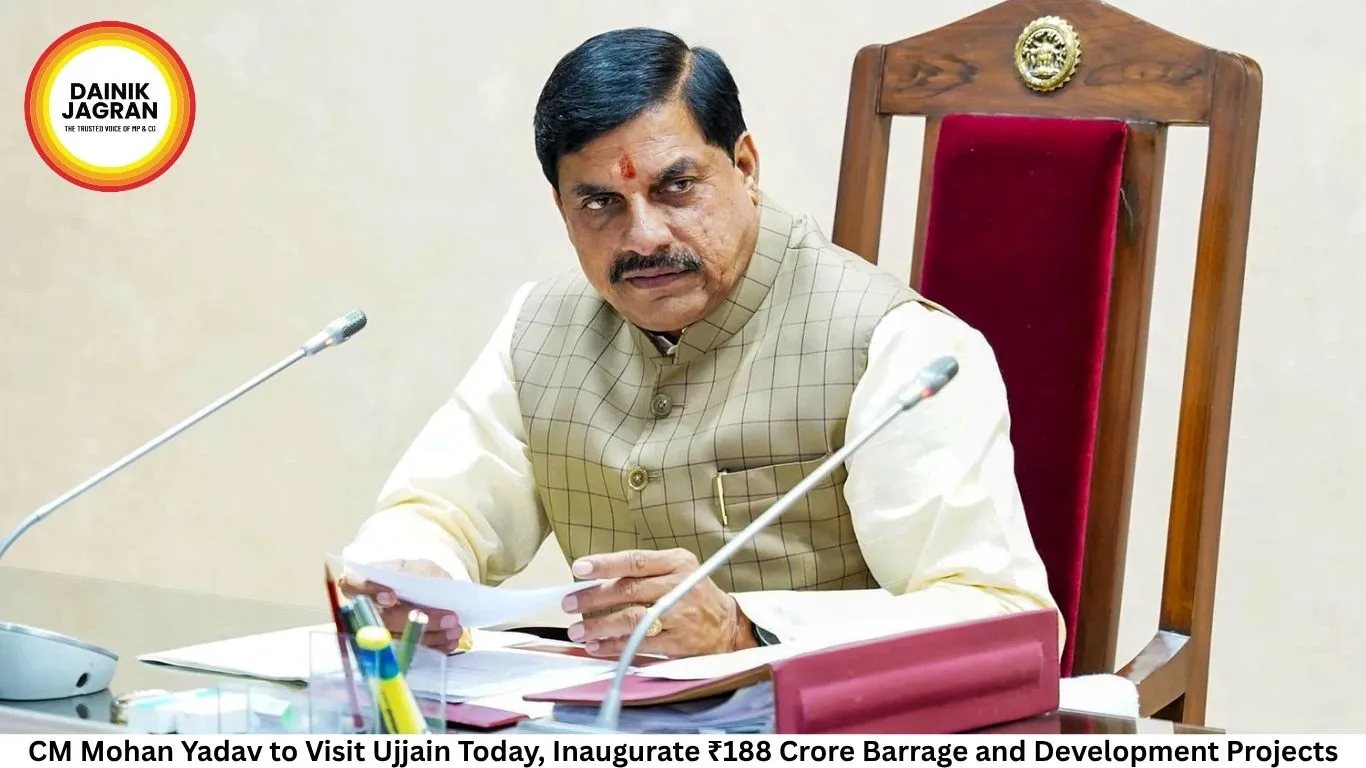
CM Mohan Yadav to Visit Ujjain Today, Inaugurate ₹188 Crore Barrage and Development Projects
Digital Desk
Chief Minister to dedicate Samakota Barrage and multiple public infrastructure projects worth over ₹207 crore in Jharada region
Madhya Pradesh Chief Minister Dr. Mohan Yadav is scheduled to visit Ujjain district on Wednesday, where he will inaugurate the Samakota Barrage, a major irrigation project constructed at a cost of ₹188.42 crore. Located on the Chhoti Kalisindh River in Jharada tehsil, the project is expected to provide irrigation benefits to thousands of farming families and strengthen agricultural infrastructure in the region.
According to officials, the barrage has been designed to improve water availability for agriculture and support sustainable farming practices. The project is expected to benefit more than 11,000 farmer families across 18 villages by ensuring a reliable irrigation network for a large area of cultivable land.
The inauguration forms part of a broader development initiative under which the Chief Minister will dedicate public infrastructure projects worth more than ₹207 crore to the people of the district.
Major Boost for Irrigation
The Samakota Barrage has a water storage capacity of 17.57 million cubic metres and is designed to irrigate approximately 7,236 hectares of agricultural land through a pipeline-based distribution system.
Officials said the project will directly benefit farmers in villages including Nalkheda, Panodia, Neemkheda, Ghattiyajassa, Melakhedi, Khoriyapadma, Kherla, Lasudiyanahata, Nagpura, Chhajjukhedi, Delakhedi, Dungarkhedi, Khedamadda, Kason, Mahidpuriya, Somchidi, and Jharada.
Agriculture experts believe improved irrigation infrastructure can help increase crop productivity, reduce dependence on erratic rainfall, and enhance rural livelihoods in the region.
Additional Development Projects
During the visit, the Chief Minister will also inaugurate several public infrastructure projects valued at more than ₹19 crore. These projects cover sectors such as education, healthcare, and power distribution.
Among the key initiatives are a college building constructed by the Higher Education Department at a cost of ₹4.35 crore and new girls' school buildings in Semalia, Mahidpur Road, and Kundikheda under the School Education Department.
The development package also includes a 33/11 KV power substation at Mochikheda, aimed at improving electricity supply in the area. In addition, 13 sub-health centre buildings in the Jharada region will be inaugurated to strengthen healthcare services in rural communities.
Focus on Rural Development
Officials stated that the projects reflect the state's focus on improving infrastructure in rural and semi-urban areas. Investments in irrigation, education, healthcare, and energy are expected to contribute to long-term socio-economic growth and improve the quality of life for residents.
The irrigation project, in particular, is being viewed as a significant step toward enhancing agricultural resilience in the region, where farming remains a primary source of income for a large section of the population.
--------
🚨 Beat the News Rush – Join Now!
Get breaking alerts, hot exclusives, and game-changing stories instantly on your phone. No delays, no fluff – just the edge you need. ⚡
Tap to join:
🟢 WhatsApp Channel: Dainik Jagran MP CG
Crave more?
🅕 Facebook: Dainik Jagran MP CG English
🅧 Twitter (X): Dainik Jagran MP CG
🅘 Instagram: Dainik Jagran MP CG
Share the fire – keep your crew ahead! 🗞️🔥
CM Mohan Yadav to Visit Ujjain Today, Inaugurate ₹188 Crore Barrage and Development Projects
Digital Desk
Madhya Pradesh Chief Minister Dr. Mohan Yadav is scheduled to visit Ujjain district on Wednesday, where he will inaugurate the Samakota Barrage, a major irrigation project constructed at a cost of ₹188.42 crore. Located on the Chhoti Kalisindh River in Jharada tehsil, the project is expected to provide irrigation benefits to thousands of farming families and strengthen agricultural infrastructure in the region.
According to officials, the barrage has been designed to improve water availability for agriculture and support sustainable farming practices. The project is expected to benefit more than 11,000 farmer families across 18 villages by ensuring a reliable irrigation network for a large area of cultivable land.
The inauguration forms part of a broader development initiative under which the Chief Minister will dedicate public infrastructure projects worth more than ₹207 crore to the people of the district.
Major Boost for Irrigation
The Samakota Barrage has a water storage capacity of 17.57 million cubic metres and is designed to irrigate approximately 7,236 hectares of agricultural land through a pipeline-based distribution system.
Officials said the project will directly benefit farmers in villages including Nalkheda, Panodia, Neemkheda, Ghattiyajassa, Melakhedi, Khoriyapadma, Kherla, Lasudiyanahata, Nagpura, Chhajjukhedi, Delakhedi, Dungarkhedi, Khedamadda, Kason, Mahidpuriya, Somchidi, and Jharada.
Agriculture experts believe improved irrigation infrastructure can help increase crop productivity, reduce dependence on erratic rainfall, and enhance rural livelihoods in the region.
Additional Development Projects
During the visit, the Chief Minister will also inaugurate several public infrastructure projects valued at more than ₹19 crore. These projects cover sectors such as education, healthcare, and power distribution.
Among the key initiatives are a college building constructed by the Higher Education Department at a cost of ₹4.35 crore and new girls' school buildings in Semalia, Mahidpur Road, and Kundikheda under the School Education Department.
The development package also includes a 33/11 KV power substation at Mochikheda, aimed at improving electricity supply in the area. In addition, 13 sub-health centre buildings in the Jharada region will be inaugurated to strengthen healthcare services in rural communities.
Focus on Rural Development
Officials stated that the projects reflect the state's focus on improving infrastructure in rural and semi-urban areas. Investments in irrigation, education, healthcare, and energy are expected to contribute to long-term socio-economic growth and improve the quality of life for residents.
The irrigation project, in particular, is being viewed as a significant step toward enhancing agricultural resilience in the region, where farming remains a primary source of income for a large section of the population.