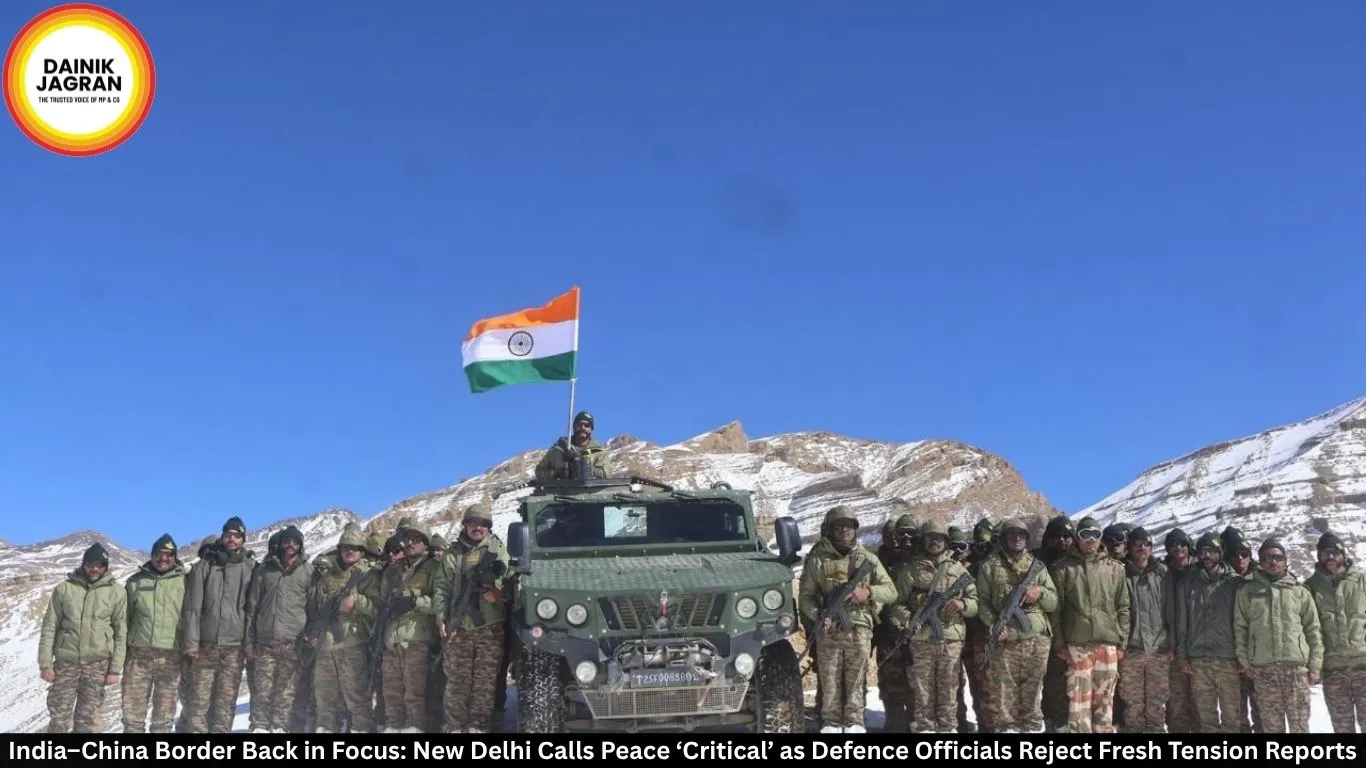
India–China Border Back in Focus: New Delhi Calls Peace ‘Critical’ as Defence Officials Reject Fresh Tension Reports

Digital Desk

India–China Border Back in Focus: New Delhi Calls Peace ‘Critical’ as Defence Officials Reject Fresh Tension Reports

Reports of an India–China patrol face-off near Taksing have revived border concerns. Here is what India, China and defence officials have said.

The India–China border has returned to the national spotlight after reports of a fresh face-off between patrols in a remote part of Arunachal Pradesh, even as Indian defence authorities rejected claims of renewed military tension as unsubstantiated.

The Ministry of External Affairs has reiterated that peace and tranquillity in border areas are essential for the wider relationship between India and China. The statement is significant because it comes at a time when both countries are attempting to stabilise ties following years of military and diplomatic strain after the deadly Galwan Valley clashes of 2020.

According to a report cited by Reuters, Indian and Chinese patrols came face to face in late July near Taksing, a border village in Arunachal Pradesh’s Upper Subansiri district. The report claimed the encounter occurred in territory controlled by India and that the Chinese patrol initially withdrew. It further alleged that Chinese personnel later returned to the area and erected temporary tents.

Indian defence authorities have not confirmed that account. A defence spokesperson for Arunachal Pradesh described the reports as unsubstantiated and uncorroborated. China’s foreign ministry, meanwhile, said the situation along the border was generally stable.

The differing accounts make careful reporting essential. There is no official confirmation of a new incursion or a continuing military standoff. The immediate story is therefore not that a fresh clash has occurred, but that reports of an encounter have prompted New Delhi to restate its long-standing position: conditions along the border will influence the entire bilateral relationship.

India and China share a disputed 3,488-km frontier, commonly referred to as the Line of Actual Control. Patrols from both sides occasionally encounter one another because the two countries do not agree on the precise alignment of the boundary in several areas.

The latest concern comes just weeks before the BRICS summit scheduled in New Delhi on September 12 and 13. Chinese President Xi Jinping is expected to attend, increasing the diplomatic importance of preventing a local border issue from disrupting a high-profile multilateral meeting.

Both sides held a meeting of their border-affairs consultation mechanism in New Delhi last week and agreed to maintain diplomatic and military communication. Beijing said the two countries would work jointly to preserve peace and tranquillity in border areas.

The shadow of the 2020 crisis remains important. Twenty Indian soldiers and four Chinese troops were killed in the Galwan Valley clash, after which both countries deployed tens of thousands of personnel and heavy equipment along parts of the frontier. A disengagement agreement reached in 2024 reduced tension at some friction points, but it did not settle the boundary dispute.

This is also why language matters. A patrol encounter can occur when soldiers following different perceptions of the LAC reach the same area; it is not automatically proof that territory has changed hands. A confirmed encampment, prolonged denial of patrol access or new permanent construction would be more serious indicators, but Indian authorities have not confirmed any of those developments at Taksing.

India has consistently maintained that Arunachal Pradesh is an integral and inalienable part of the country. China refers to the state as “Zangnan” and claims it as part of southern Tibet, a position New Delhi firmly rejects.

For now, the situation calls for vigilance rather than alarm. There is no official announcement of troop mobilisation, a clash or a new disengagement process. The most consequential development is India’s warning that border stability cannot be separated from progress in trade, diplomacy and political relations with China.


english.dainikjagranmpcg.com
13 Aug 2026 By Sandeep.P

India–China Border Back in Focus: New Delhi Calls Peace ‘Critical’ as Defence Officials Reject Fresh Tension Reports

Digital Desk

The India–China border has returned to the national spotlight after reports of a fresh face-off between patrols in a remote part of Arunachal Pradesh, even as Indian defence authorities rejected claims of renewed military tension as unsubstantiated.

The Ministry of External Affairs has reiterated that peace and tranquillity in border areas are essential for the wider relationship between India and China. The statement is significant because it comes at a time when both countries are attempting to stabilise ties following years of military and diplomatic strain after the deadly Galwan Valley clashes of 2020.

According to a report cited by Reuters, Indian and Chinese patrols came face to face in late July near Taksing, a border village in Arunachal Pradesh’s Upper Subansiri district. The report claimed the encounter occurred in territory controlled by India and that the Chinese patrol initially withdrew. It further alleged that Chinese personnel later returned to the area and erected temporary tents.

Indian defence authorities have not confirmed that account. A defence spokesperson for Arunachal Pradesh described the reports as unsubstantiated and uncorroborated. China’s foreign ministry, meanwhile, said the situation along the border was generally stable.

The differing accounts make careful reporting essential. There is no official confirmation of a new incursion or a continuing military standoff. The immediate story is therefore not that a fresh clash has occurred, but that reports of an encounter have prompted New Delhi to restate its long-standing position: conditions along the border will influence the entire bilateral relationship.

India and China share a disputed 3,488-km frontier, commonly referred to as the Line of Actual Control. Patrols from both sides occasionally encounter one another because the two countries do not agree on the precise alignment of the boundary in several areas.

The latest concern comes just weeks before the BRICS summit scheduled in New Delhi on September 12 and 13. Chinese President Xi Jinping is expected to attend, increasing the diplomatic importance of preventing a local border issue from disrupting a high-profile multilateral meeting.

Both sides held a meeting of their border-affairs consultation mechanism in New Delhi last week and agreed to maintain diplomatic and military communication. Beijing said the two countries would work jointly to preserve peace and tranquillity in border areas.

The shadow of the 2020 crisis remains important. Twenty Indian soldiers and four Chinese troops were killed in the Galwan Valley clash, after which both countries deployed tens of thousands of personnel and heavy equipment along parts of the frontier. A disengagement agreement reached in 2024 reduced tension at some friction points, but it did not settle the boundary dispute.

This is also why language matters. A patrol encounter can occur when soldiers following different perceptions of the LAC reach the same area; it is not automatically proof that territory has changed hands. A confirmed encampment, prolonged denial of patrol access or new permanent construction would be more serious indicators, but Indian authorities have not confirmed any of those developments at Taksing.

India has consistently maintained that Arunachal Pradesh is an integral and inalienable part of the country. China refers to the state as “Zangnan” and claims it as part of southern Tibet, a position New Delhi firmly rejects.

For now, the situation calls for vigilance rather than alarm. There is no official announcement of troop mobilisation, a clash or a new disengagement process. The most consequential development is India’s warning that border stability cannot be separated from progress in trade, diplomacy and political relations with China.

https://english.dainikjagranmpcg.com/top-stories/india%E2%80%93china-border-back-in-focus-new-delhi-calls-peace-%E2%80%98critical%E2%80%99/article-25871

Recommended For You

--------

🚨 Beat the News Rush – Join Now!

Get breaking alerts, hot exclusives, and game-changing stories instantly on your phone. No delays, no fluff – just the edge you need. ⚡

Tap to join: 

🟢 WhatsApp Channel: Dainik Jagran MP CG

Crave more?

🅕 Facebook: Dainik Jagran MP CG English

🅧 Twitter (X): Dainik Jagran MP CG

🅘 Instagram: Dainik Jagran MP CG

Share the fire – keep your crew ahead! 🗞️🔥

Trending News