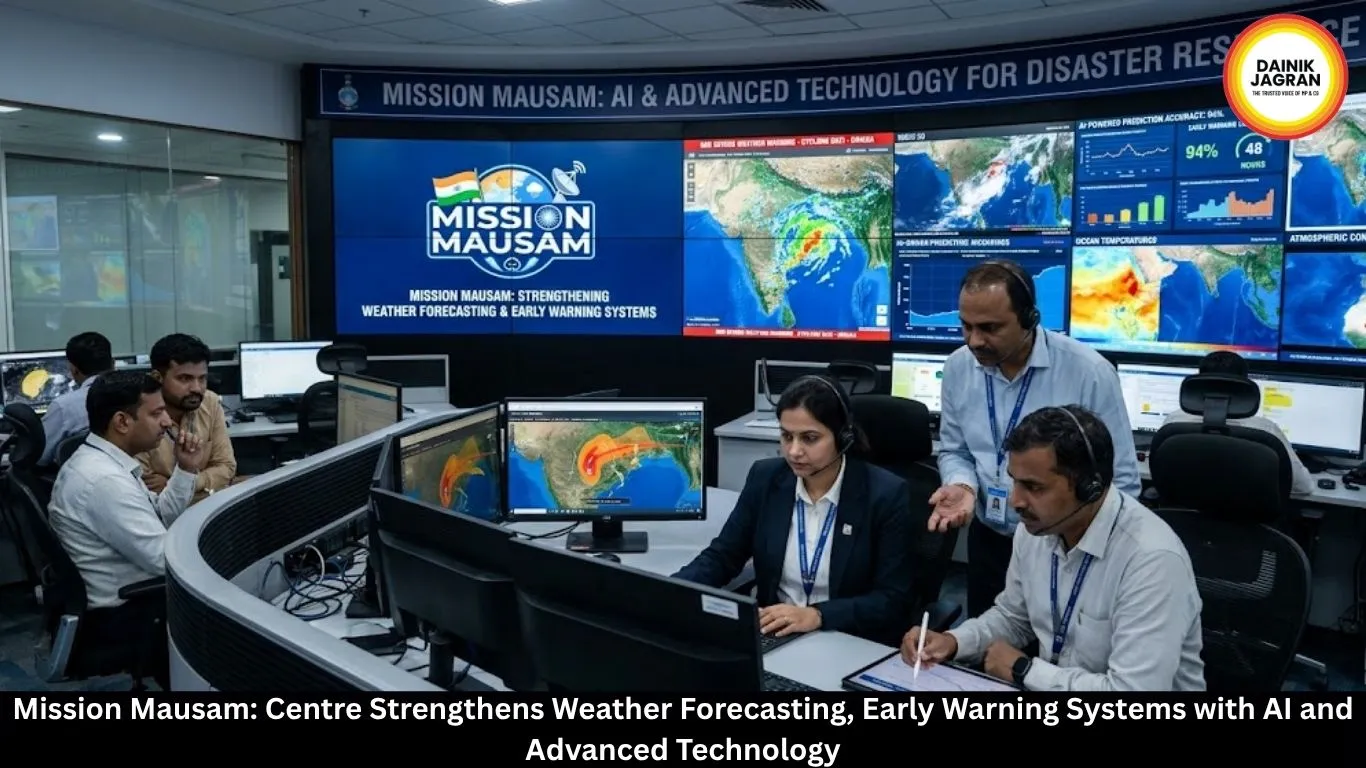
Mission Mausam: India Strengthens Weather Forecasting with AI and Advanced Technology

Digital desk

Mission Mausam: India Strengthens Weather Forecasting with AI and Advanced Technology

Mission Mausam aims to make India weather-ready by strengthening forecasting, early warning systems, Doppler radars, high-performance computing and AI-based weather models.

The Government of India is implementing Mission Mausam, a comprehensive Central Sector Scheme of the Ministry of Earth Sciences aimed at making India a “weather-ready and climate-smart nation.” The mission focuses on strengthening weather and Earth-system observation, improving early warnings for high-impact weather events and expanding seamless weather and climate services.

Mission Mausam was approved by the Union Cabinet in 2024 and was formally launched by Prime Minister Narendra Modi on January 14, 2025. An allocation of ₹2,000 crore was provided for 2024-25 and 2025-26.

Focus on Advanced Weather Systems

The mission seeks to modernise India's weather monitoring and forecasting infrastructure through advanced technologies.

Also Read... PM Modi to Attend IIT Delhi Convocation, Inaugurate Param Pragya Supercomputer

Key objectives include developing state-of-the-art weather monitoring systems, improving the resolution and coverage of atmospheric observations, deploying next-generation Doppler weather radars and wind profilers, and equipping satellites with advanced instrument payloads.

Also Read... Youth Empowerment in India: Education, Skills, Jobs and Startups Drive Viksit Bharat@2047

The programme also focuses on expanding high-performance computing (HPC) infrastructure and developing advanced Earth-system models and data-driven forecasting methods using Artificial Intelligence (AI) and Machine Learning (ML).

Also Read... NBA Releases ₹15.52 Crore ABS Funds From Mustard Genetic Resources

Six Areas for 2026-31

For the 2026-31 period, Mission Mausam is proposed to operate through six major areas — Observe All, Develop, Weather MOD, AtComp, Frontier and NEET.

These areas cover enhanced weather observations, Earth-system model development, weather modification research, atmospheric composition monitoring and forecasting, frontier technologies and national initiatives for atmospheric technology.

For 2026-27, the estimated budget for Mission Mausam is ₹1,342.29 crore. This includes ₹855.29 crore under revenue expenditure and ₹487 crore under capital expenditure.

AI to Improve Forecast Accuracy

One of the major components of Mission Mausam is the use of AI and ML alongside conventional numerical weather prediction systems.

The government plans to use AI/ML and hybrid physics-AI technologies for weather forecasting, forecast improvement, post-processing and development of location-specific weather information.

High-resolution numerical weather prediction models, coupled Earth-system models, ensemble forecasting systems and advanced data-assimilation techniques will also be used to improve forecasts of high-impact weather events.

Stronger Early Warning Network

Mission Mausam is designed to strengthen the entire forecasting and warning chain, from observation and modelling to the delivery of actionable information to people at the last mile.

The programme includes modernisation of surface, upper-air, radar, satellite, lightning, aviation, marine and ocean observation systems. Advanced remote-sensing technologies will also be deployed.

Decision-support systems, impact-based forecasting and multi-channel dissemination platforms are being strengthened to ensure that weather warnings reach users in a timely and actionable manner.

Focus on Extreme Weather

The upgraded systems are expected to improve the accuracy, spatial resolution and lead time of forecasts and warnings for extreme weather events.

These include cyclones, heavy rainfall, thunderstorms, lightning, heatwaves and urban flooding.

The emphasis on impact-based and risk-based warnings is intended to help authorities and communities prepare for weather-related hazards before they cause widespread damage.

Benefits for Agriculture

Farmers are expected to benefit from improved weather and agrometeorological advisories.

More accurate, location-specific forecasts can support decisions related to crop planning, irrigation and other farm-level activities, while helping reduce weather-related risks.

Support for Fisheries and Aviation

For the fisheries sector, improved marine weather forecasts and early warnings about adverse sea and weather conditions are expected to support safer fishing operations and coastal livelihoods.

The aviation sector is also expected to benefit from better forecasts and timely information about fog, thunderstorms, strong winds and other aviation-related weather hazards, helping improve operational safety and efficiency.

Strengthening Disaster Preparedness

Mission Mausam is also expected to play an important role in disaster management by providing earlier and more detailed warnings for high-impact weather events.

Impact-based forecasts can help authorities plan evacuation, emergency response and risk-reduction measures more effectively.

The government expects the upgraded observation, modelling and computational infrastructure to support better decision-making, strengthen disaster risk reduction and improve climate resilience across weather-sensitive sectors.

Building a Weather-Ready India

Mission Mausam represents an effort to move India's weather services towards more accurate, timely and location-specific forecasting through a combination of advanced observation systems, high-performance computing, numerical modelling and AI-based technologies.

By strengthening the forecasting and early-warning ecosystem, the mission aims to reduce weather-related losses, improve planning across sensitive sectors and enhance India's preparedness for increasingly complex weather and climate risks.


 

english.dainikjagranmpcg.com
13 Aug 2026 By Abhishek Joshi

Mission Mausam: India Strengthens Weather Forecasting with AI and Advanced Technology

Digital desk

The Government of India is implementing Mission Mausam, a comprehensive Central Sector Scheme of the Ministry of Earth Sciences aimed at making India a “weather-ready and climate-smart nation.” The mission focuses on strengthening weather and Earth-system observation, improving early warnings for high-impact weather events and expanding seamless weather and climate services.

Mission Mausam was approved by the Union Cabinet in 2024 and was formally launched by Prime Minister Narendra Modi on January 14, 2025. An allocation of ₹2,000 crore was provided for 2024-25 and 2025-26.

Focus on Advanced Weather Systems

The mission seeks to modernise India's weather monitoring and forecasting infrastructure through advanced technologies.

Key objectives include developing state-of-the-art weather monitoring systems, improving the resolution and coverage of atmospheric observations, deploying next-generation Doppler weather radars and wind profilers, and equipping satellites with advanced instrument payloads.

The programme also focuses on expanding high-performance computing (HPC) infrastructure and developing advanced Earth-system models and data-driven forecasting methods using Artificial Intelligence (AI) and Machine Learning (ML).

Six Areas for 2026-31

For the 2026-31 period, Mission Mausam is proposed to operate through six major areas — Observe All, Develop, Weather MOD, AtComp, Frontier and NEET.

These areas cover enhanced weather observations, Earth-system model development, weather modification research, atmospheric composition monitoring and forecasting, frontier technologies and national initiatives for atmospheric technology.

For 2026-27, the estimated budget for Mission Mausam is ₹1,342.29 crore. This includes ₹855.29 crore under revenue expenditure and ₹487 crore under capital expenditure.

AI to Improve Forecast Accuracy

One of the major components of Mission Mausam is the use of AI and ML alongside conventional numerical weather prediction systems.

The government plans to use AI/ML and hybrid physics-AI technologies for weather forecasting, forecast improvement, post-processing and development of location-specific weather information.

High-resolution numerical weather prediction models, coupled Earth-system models, ensemble forecasting systems and advanced data-assimilation techniques will also be used to improve forecasts of high-impact weather events.

Stronger Early Warning Network

Mission Mausam is designed to strengthen the entire forecasting and warning chain, from observation and modelling to the delivery of actionable information to people at the last mile.

The programme includes modernisation of surface, upper-air, radar, satellite, lightning, aviation, marine and ocean observation systems. Advanced remote-sensing technologies will also be deployed.

Decision-support systems, impact-based forecasting and multi-channel dissemination platforms are being strengthened to ensure that weather warnings reach users in a timely and actionable manner.

Focus on Extreme Weather

The upgraded systems are expected to improve the accuracy, spatial resolution and lead time of forecasts and warnings for extreme weather events.

These include cyclones, heavy rainfall, thunderstorms, lightning, heatwaves and urban flooding.

The emphasis on impact-based and risk-based warnings is intended to help authorities and communities prepare for weather-related hazards before they cause widespread damage.

Benefits for Agriculture

Farmers are expected to benefit from improved weather and agrometeorological advisories.

More accurate, location-specific forecasts can support decisions related to crop planning, irrigation and other farm-level activities, while helping reduce weather-related risks.

Support for Fisheries and Aviation

For the fisheries sector, improved marine weather forecasts and early warnings about adverse sea and weather conditions are expected to support safer fishing operations and coastal livelihoods.

The aviation sector is also expected to benefit from better forecasts and timely information about fog, thunderstorms, strong winds and other aviation-related weather hazards, helping improve operational safety and efficiency.

Strengthening Disaster Preparedness

Mission Mausam is also expected to play an important role in disaster management by providing earlier and more detailed warnings for high-impact weather events.

Impact-based forecasts can help authorities plan evacuation, emergency response and risk-reduction measures more effectively.

The government expects the upgraded observation, modelling and computational infrastructure to support better decision-making, strengthen disaster risk reduction and improve climate resilience across weather-sensitive sectors.

Building a Weather-Ready India

Mission Mausam represents an effort to move India's weather services towards more accurate, timely and location-specific forecasting through a combination of advanced observation systems, high-performance computing, numerical modelling and AI-based technologies.

By strengthening the forecasting and early-warning ecosystem, the mission aims to reduce weather-related losses, improve planning across sensitive sectors and enhance India's preparedness for increasingly complex weather and climate risks.

 

https://english.dainikjagranmpcg.com/national/mission-mausam-india-strengthens-weather-forecasting-with-ai-and-advanced/article-25951

--------

🚨 Beat the News Rush – Join Now!

Get breaking alerts, hot exclusives, and game-changing stories instantly on your phone. No delays, no fluff – just the edge you need. ⚡

Tap to join: 

🟢 WhatsApp Channel: Dainik Jagran MP CG

Crave more?

🅕 Facebook: Dainik Jagran MP CG English

🅧 Twitter (X): Dainik Jagran MP CG

🅘 Instagram: Dainik Jagran MP CG

Share the fire – keep your crew ahead! 🗞️🔥

Trending News