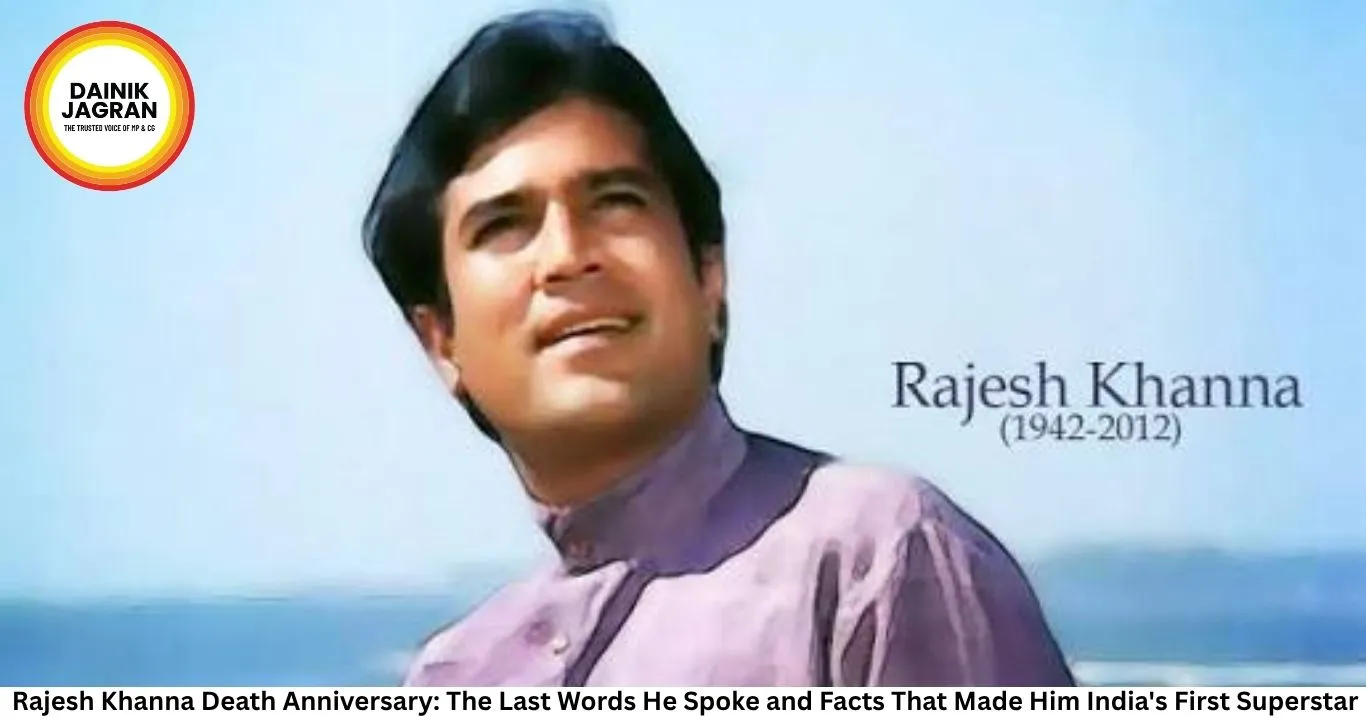
Rajesh Khanna Death Anniversary: The Last Words He Spoke and Facts That Made Him India's First Superstar
Digital desk
Fourteen years ago today, on July 18, 2012, India lost the man widely regarded as its first true movie superstar. Rajesh Khanna died at his Mumbai residence "Aashirwad" at the age of 69, after a prolonged battle with cancer — but even in death, his story stayed tied to the film that defined him.
His last words echoed his most famous role
In a blog tribute written shortly after Khanna's death, Amitabh Bachchan — his co-star and close friend from Anand — revealed that a person close to Khanna had shared his final words with him: "Time ho gaya hai, pack up" ("It's time, pack up"). The line struck a haunting parallel with Anand itself, where Khanna's character delivers his final line as just two words — "Babu Moshai" — before passing away on screen. Bachchan wrote that acting alongside Khanna in that film had felt like a blessing, describing something almost regal in his co-star's boyish plainness that drew people to him.
Before superstardom, an unlikely nickname
Long before he was Bollywood's first Superstar, Khanna was reportedly dismissed by some as a "faaltu hero" — a nobody — because of his unconventional looks by the industry's standards of the time. That changed dramatically through the 1970s, when he strung together a run of consecutive hit films rarely matched before or since, earning nicknames like "Kaka" and the "Pasha of Passion" along the way.
A pay grade shared only with one man
Khanna was India's highest-paid actor from 1970 to 1979. He shared that distinction with Amitabh Bachchan — the same actor who'd go on to eclipse him — from 1980 to 1987, as the industry's "angry young man" era gradually took over from Khanna's romantic-hero years.
His first film nearly represented India at the Oscars
Khanna's debut, Aakhri Khat (1966), was chosen as India's official entry for the Academy Awards in 1967, though it didn't make the final shortlist.
Off-screen life beyond the movies
Khanna married actress Dimple Kapadia in 1973; the two separated years later but never formally divorced. He's also the father-in-law of actor Akshay Kumar, who is married to Khanna's daughter Twinkle Khanna. Beyond films, Khanna served as a Member of Parliament from New Delhi from 1992 to 1996 on a Congress ticket, and was posthumously honoured with the Padma Bhushan in 2013.
A friendship the industry still talks about
His bond with Amitabh Bachchan, forged on the sets of Anand and Namak Haram, remained one of Hindi cinema's most enduring off-screen friendships, one that outlasted the industry's shift away from Khanna and toward Bachchan as its defining leading man.
Fourteen years on, the line that defined Anand still gets quoted every time his death anniversary comes around: "Zindagi badi honi chahiye, lambi nahi" — life should be big, not necessarily long. For an actor who packed more stardom into a single decade than most manage in a lifetime, it's hard to find a better epitaph.
--------
🚨 Beat the News Rush – Join Now!
Get breaking alerts, hot exclusives, and game-changing stories instantly on your phone. No delays, no fluff – just the edge you need. ⚡
Tap to join:
🟢 WhatsApp Channel: Dainik Jagran MP CG
Crave more?
🅕 Facebook: Dainik Jagran MP CG English
🅧 Twitter (X): Dainik Jagran MP CG
🅘 Instagram: Dainik Jagran MP CG
Share the fire – keep your crew ahead! 🗞️🔥
Rajesh Khanna Death Anniversary: The Last Words He Spoke and Facts That Made Him India's First Superstar
Digital desk
His last words echoed his most famous role
In a blog tribute written shortly after Khanna's death, Amitabh Bachchan — his co-star and close friend from Anand — revealed that a person close to Khanna had shared his final words with him: "Time ho gaya hai, pack up" ("It's time, pack up"). The line struck a haunting parallel with Anand itself, where Khanna's character delivers his final line as just two words — "Babu Moshai" — before passing away on screen. Bachchan wrote that acting alongside Khanna in that film had felt like a blessing, describing something almost regal in his co-star's boyish plainness that drew people to him.
Before superstardom, an unlikely nickname
Long before he was Bollywood's first Superstar, Khanna was reportedly dismissed by some as a "faaltu hero" — a nobody — because of his unconventional looks by the industry's standards of the time. That changed dramatically through the 1970s, when he strung together a run of consecutive hit films rarely matched before or since, earning nicknames like "Kaka" and the "Pasha of Passion" along the way.
A pay grade shared only with one man
Khanna was India's highest-paid actor from 1970 to 1979. He shared that distinction with Amitabh Bachchan — the same actor who'd go on to eclipse him — from 1980 to 1987, as the industry's "angry young man" era gradually took over from Khanna's romantic-hero years.
His first film nearly represented India at the Oscars
Khanna's debut, Aakhri Khat (1966), was chosen as India's official entry for the Academy Awards in 1967, though it didn't make the final shortlist.
Off-screen life beyond the movies
Khanna married actress Dimple Kapadia in 1973; the two separated years later but never formally divorced. He's also the father-in-law of actor Akshay Kumar, who is married to Khanna's daughter Twinkle Khanna. Beyond films, Khanna served as a Member of Parliament from New Delhi from 1992 to 1996 on a Congress ticket, and was posthumously honoured with the Padma Bhushan in 2013.
A friendship the industry still talks about
His bond with Amitabh Bachchan, forged on the sets of Anand and Namak Haram, remained one of Hindi cinema's most enduring off-screen friendships, one that outlasted the industry's shift away from Khanna and toward Bachchan as its defining leading man.
Fourteen years on, the line that defined Anand still gets quoted every time his death anniversary comes around: "Zindagi badi honi chahiye, lambi nahi" — life should be big, not necessarily long. For an actor who packed more stardom into a single decade than most manage in a lifetime, it's hard to find a better epitaph.