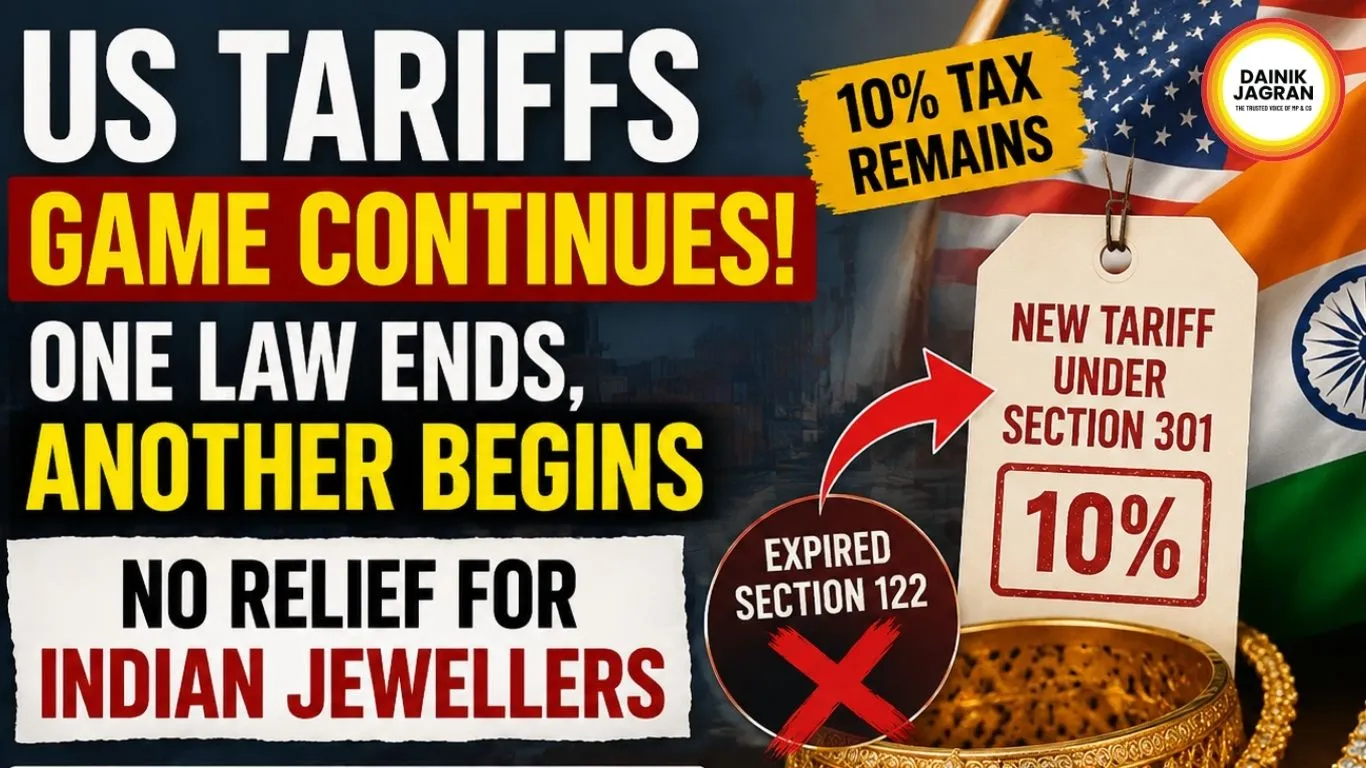
Indian Jewellers Get No Relief as US Replaces Expired Tariffs with New 10% Duty
Digital Desk
Indian gems and jewellery exporters are unlikely to benefit from the expiry of the US's temporary tariffs, as Washington has simultaneously imposed a new 10% duty under a different legal provision. The move keeps export costs largely unchanged, leaving the industry waiting for relief through the proposed India-US trade agreement.
India's gems and jewellery industry will not receive the expected relief from US import duties despite the expiry of temporary tariffs on July 24. While the earlier emergency tariff imposed under Section 122 of the US Trade Act, 1974 has expired, the United States has introduced a fresh 10% tariff under Section 301, effectively keeping the tax burden on Indian exports unchanged.
The development comes at a time when exporters were hoping for lower duties following the expiration of the temporary measure. Instead, the new tariff framework ensures that Indian jewellery shipments to the US continue to face the same effective rate.
One Law Ends, Another Takes Effect
The temporary 10% tariff imposed under Section 122 came into force on February 24, 2026, as an emergency trade measure. Under US law, such tariffs can remain in effect for only 150 days unless extended by Congress.
With no extension approved, the Section 122 tariff automatically expired on July 24.
However, almost simultaneously, the US government implemented a new tariff regime under Section 301 of the US Trade Act, 1974, citing concerns related to imports linked to forced labour. India is among 17 countries facing an additional 10% tariff, while several other nations have been subjected to duties of 12.5%.
As a result, Indian exporters continue to pay virtually the same overall tariff despite the legal change.
Impact on India's Jewellery Industry
The United States remains one of India's largest export destinations for gems and jewellery.
Industry experts believe the continuation of tariffs means exporters will continue facing pricing pressure in an already competitive global market.
Current effective tariff structure includes:
- Gold Jewellery: Basic duty of 6% plus the additional 10%, resulting in a total effective tariff of 16%.
- Cut and Polished Diamonds: While diamonds remain duty-free under the basic tariff structure, they now attract the additional 10% tariff.
Since the earlier tariff has simply been replaced by another at the same rate, exporters are unlikely to experience any meaningful cost savings.
Gujarat Remains the Industry's Backbone
According to official export data, India exported US$27.72 billion (approximately ₹2.45 lakh crore) worth of gems and jewellery during FY26.
Among the major export categories:
- Cut and polished diamonds accounted for nearly 44% of total exports.
- Gold jewellery contributed around 41%.
Gujarat remains India's largest exporting state, accounting for approximately 31.5% of the country's total gems and jewellery exports.
The city of Surat continues to dominate the global diamond cutting and polishing industry, processing a significant share of the world's natural and lab-grown diamonds.
Together, Gujarat and Maharashtra contribute nearly 88% of India's total gems and jewellery exports.
Trade Policy Has Seen Frequent Changes
Indian exporters have experienced considerable uncertainty over US trade policy during the past year.
Since April 2025, tariff announcements have undergone multiple revisions, including:
- Initial baseline tariffs.
- Higher reciprocal tariffs.
- Additional duties linked to Russian oil purchases.
- Subsequent reductions following diplomatic discussions.
- Replacement of temporary tariffs with new Section 301 duties.
Although discussions on an interim India-US trade agreement have continued, the proposed framework has not yet translated into lower tariffs for exporters.
Industry Awaits Trade Agreement
Exporters are now pinning their hopes on the ongoing India-US trade negotiations.
Officials from both countries have repeatedly indicated that an interim trade agreement is nearing completion. Industry stakeholders expect that such an agreement could eventually provide tariff concessions for sectors including gems, jewellery, engineering goods, textiles, and manufacturing.
Until then, exporters are expected to continue operating under the current tariff regime.
Indian Jewellers Get No Relief as US Replaces Expired Tariffs with New 10% Duty
Digital Desk
India's gems and jewellery industry will not receive the expected relief from US import duties despite the expiry of temporary tariffs on July 24. While the earlier emergency tariff imposed under Section 122 of the US Trade Act, 1974 has expired, the United States has introduced a fresh 10% tariff under Section 301, effectively keeping the tax burden on Indian exports unchanged.
The development comes at a time when exporters were hoping for lower duties following the expiration of the temporary measure. Instead, the new tariff framework ensures that Indian jewellery shipments to the US continue to face the same effective rate.
One Law Ends, Another Takes Effect
The temporary 10% tariff imposed under Section 122 came into force on February 24, 2026, as an emergency trade measure. Under US law, such tariffs can remain in effect for only 150 days unless extended by Congress.
With no extension approved, the Section 122 tariff automatically expired on July 24.
However, almost simultaneously, the US government implemented a new tariff regime under Section 301 of the US Trade Act, 1974, citing concerns related to imports linked to forced labour. India is among 17 countries facing an additional 10% tariff, while several other nations have been subjected to duties of 12.5%.
As a result, Indian exporters continue to pay virtually the same overall tariff despite the legal change.
Impact on India's Jewellery Industry
The United States remains one of India's largest export destinations for gems and jewellery.
Industry experts believe the continuation of tariffs means exporters will continue facing pricing pressure in an already competitive global market.
Current effective tariff structure includes:
- Gold Jewellery: Basic duty of 6% plus the additional 10%, resulting in a total effective tariff of 16%.
- Cut and Polished Diamonds: While diamonds remain duty-free under the basic tariff structure, they now attract the additional 10% tariff.
Since the earlier tariff has simply been replaced by another at the same rate, exporters are unlikely to experience any meaningful cost savings.
Gujarat Remains the Industry's Backbone
According to official export data, India exported US$27.72 billion (approximately ₹2.45 lakh crore) worth of gems and jewellery during FY26.
Among the major export categories:
- Cut and polished diamonds accounted for nearly 44% of total exports.
- Gold jewellery contributed around 41%.
Gujarat remains India's largest exporting state, accounting for approximately 31.5% of the country's total gems and jewellery exports.
The city of Surat continues to dominate the global diamond cutting and polishing industry, processing a significant share of the world's natural and lab-grown diamonds.
Together, Gujarat and Maharashtra contribute nearly 88% of India's total gems and jewellery exports.
Trade Policy Has Seen Frequent Changes
Indian exporters have experienced considerable uncertainty over US trade policy during the past year.
Since April 2025, tariff announcements have undergone multiple revisions, including:
- Initial baseline tariffs.
- Higher reciprocal tariffs.
- Additional duties linked to Russian oil purchases.
- Subsequent reductions following diplomatic discussions.
- Replacement of temporary tariffs with new Section 301 duties.
Although discussions on an interim India-US trade agreement have continued, the proposed framework has not yet translated into lower tariffs for exporters.
Industry Awaits Trade Agreement
Exporters are now pinning their hopes on the ongoing India-US trade negotiations.
Officials from both countries have repeatedly indicated that an interim trade agreement is nearing completion. Industry stakeholders expect that such an agreement could eventually provide tariff concessions for sectors including gems, jewellery, engineering goods, textiles, and manufacturing.
Until then, exporters are expected to continue operating under the current tariff regime.

Recommended For You
--------
🚨 Beat the News Rush – Join Now!
Get breaking alerts, hot exclusives, and game-changing stories instantly on your phone. No delays, no fluff – just the edge you need. ⚡
Tap to join:
🟢 WhatsApp Channel: Dainik Jagran MP CG
Crave more?
🅕 Facebook: Dainik Jagran MP CG English
🅧 Twitter (X): Dainik Jagran MP CG
🅘 Instagram: Dainik Jagran MP CG
Share the fire – keep your crew ahead! 🗞️🔥