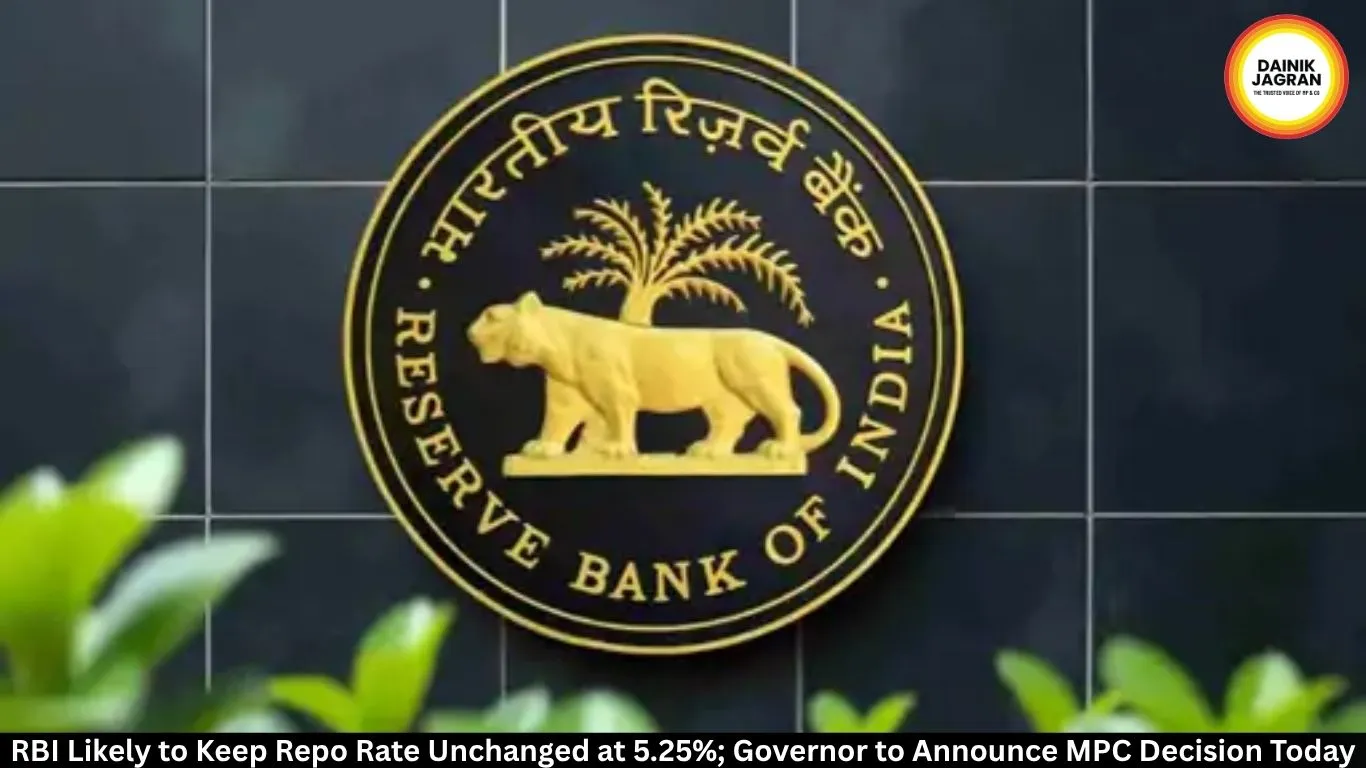
RBI MPC Meeting Today: Repo Rate Likely to Stay at 5.25%, Governor to Announce Decision
Digital desk
The RBI is widely expected to keep the repo rate unchanged at 5.25% as the Monetary Policy Committee concludes its meeting today. Markets await the Governor's policy announcement and inflation outlook.
The Reserve Bank of India (RBI) is expected to keep the benchmark repo rate unchanged at 5.25% when Governor Sanjay Malhotra announces the outcome of the Monetary Policy Committee (MPC) meeting at 10:00 AM on Tuesday. Market participants and economists largely expect the central bank to maintain the status quo, citing rising inflation risks and global economic uncertainty.
The three-day MPC meeting concludes today, marking the RBI's third monetary policy review of the current financial year.
Focus on Inflation and Growth
Economists believe the RBI is unlikely to alter interest rates immediately despite concerns over slowing global growth. The central bank is expected to prioritize balancing inflation control with domestic economic expansion.
Higher crude oil prices, weather-related risks to food inflation and uncertainty surrounding global monetary policy have prompted the RBI to adopt a cautious approach, according to analysts.
June Policy Maintained Status Quo
At its previous policy meeting in June, the RBI had also left the repo rate unchanged at 5.25%. However, it revised its inflation projection for 2027 upward from 4.6% to 5.1%, indicating growing concerns over price pressures.
The current review is the third of six scheduled MPC meetings for the financial year, following the April and June policy decisions.
Experts See No Immediate Rate Change
Financial market experts expect the central bank to avoid any immediate policy shift amid elevated global uncertainty.
According to Maulik Patel, Head of Research at Equirus Securities, rising fuel prices and weather-related disruptions have increased both wholesale and retail inflationary pressures. The brokerage estimates India's Consumer Price Index (CPI) inflation to average around 4.9% during the current financial year.
Patel said the RBI is likely to remain cautious given tighter monetary conditions globally and could consider a 25 basis point rate hike during the December policy review if inflationary pressures persist.
Why Repo Rate Matters
The repo rate is the interest rate at which the RBI lends short-term funds to commercial banks and serves as the central bank's primary monetary policy tool.
When inflation rises sharply, the RBI typically increases the repo rate, making borrowing costlier for banks. Banks, in turn, raise lending rates for consumers and businesses, reducing overall demand and helping contain inflation.
Conversely, during periods of weak economic activity, the RBI lowers the repo rate to encourage borrowing, investment and consumption by making loans cheaper.
Markets Await Policy Guidance
Apart from the interest rate decision, investors will closely monitor the RBI Governor's commentary on inflation, liquidity management, economic growth and future policy direction.
Any change in the central bank's inflation outlook or policy stance could influence bond yields, equity markets, banking stocks and lending rates over the coming months.
With inflation remaining a key concern and global uncertainties continuing, markets expect the RBI to signal a measured and data-driven approach while maintaining policy flexibility.

RBI MPC Meeting Today: Repo Rate Likely to Stay at 5.25%, Governor to Announce Decision
Digital desk
The Reserve Bank of India (RBI) is expected to keep the benchmark repo rate unchanged at 5.25% when Governor Sanjay Malhotra announces the outcome of the Monetary Policy Committee (MPC) meeting at 10:00 AM on Tuesday. Market participants and economists largely expect the central bank to maintain the status quo, citing rising inflation risks and global economic uncertainty.
The three-day MPC meeting concludes today, marking the RBI's third monetary policy review of the current financial year.
Focus on Inflation and Growth
Economists believe the RBI is unlikely to alter interest rates immediately despite concerns over slowing global growth. The central bank is expected to prioritize balancing inflation control with domestic economic expansion.
Higher crude oil prices, weather-related risks to food inflation and uncertainty surrounding global monetary policy have prompted the RBI to adopt a cautious approach, according to analysts.
June Policy Maintained Status Quo
At its previous policy meeting in June, the RBI had also left the repo rate unchanged at 5.25%. However, it revised its inflation projection for 2027 upward from 4.6% to 5.1%, indicating growing concerns over price pressures.
The current review is the third of six scheduled MPC meetings for the financial year, following the April and June policy decisions.
Experts See No Immediate Rate Change
Financial market experts expect the central bank to avoid any immediate policy shift amid elevated global uncertainty.
According to Maulik Patel, Head of Research at Equirus Securities, rising fuel prices and weather-related disruptions have increased both wholesale and retail inflationary pressures. The brokerage estimates India's Consumer Price Index (CPI) inflation to average around 4.9% during the current financial year.
Patel said the RBI is likely to remain cautious given tighter monetary conditions globally and could consider a 25 basis point rate hike during the December policy review if inflationary pressures persist.
Why Repo Rate Matters
The repo rate is the interest rate at which the RBI lends short-term funds to commercial banks and serves as the central bank's primary monetary policy tool.
When inflation rises sharply, the RBI typically increases the repo rate, making borrowing costlier for banks. Banks, in turn, raise lending rates for consumers and businesses, reducing overall demand and helping contain inflation.
Conversely, during periods of weak economic activity, the RBI lowers the repo rate to encourage borrowing, investment and consumption by making loans cheaper.
Markets Await Policy Guidance
Apart from the interest rate decision, investors will closely monitor the RBI Governor's commentary on inflation, liquidity management, economic growth and future policy direction.
Any change in the central bank's inflation outlook or policy stance could influence bond yields, equity markets, banking stocks and lending rates over the coming months.
With inflation remaining a key concern and global uncertainties continuing, markets expect the RBI to signal a measured and data-driven approach while maintaining policy flexibility.

Recommended For You
--------
🚨 Beat the News Rush – Join Now!
Get breaking alerts, hot exclusives, and game-changing stories instantly on your phone. No delays, no fluff – just the edge you need. ⚡
Tap to join:
🟢 WhatsApp Channel: Dainik Jagran MP CG
Crave more?
🅕 Facebook: Dainik Jagran MP CG English
🅧 Twitter (X): Dainik Jagran MP CG
🅘 Instagram: Dainik Jagran MP CG
Share the fire – keep your crew ahead! 🗞️🔥