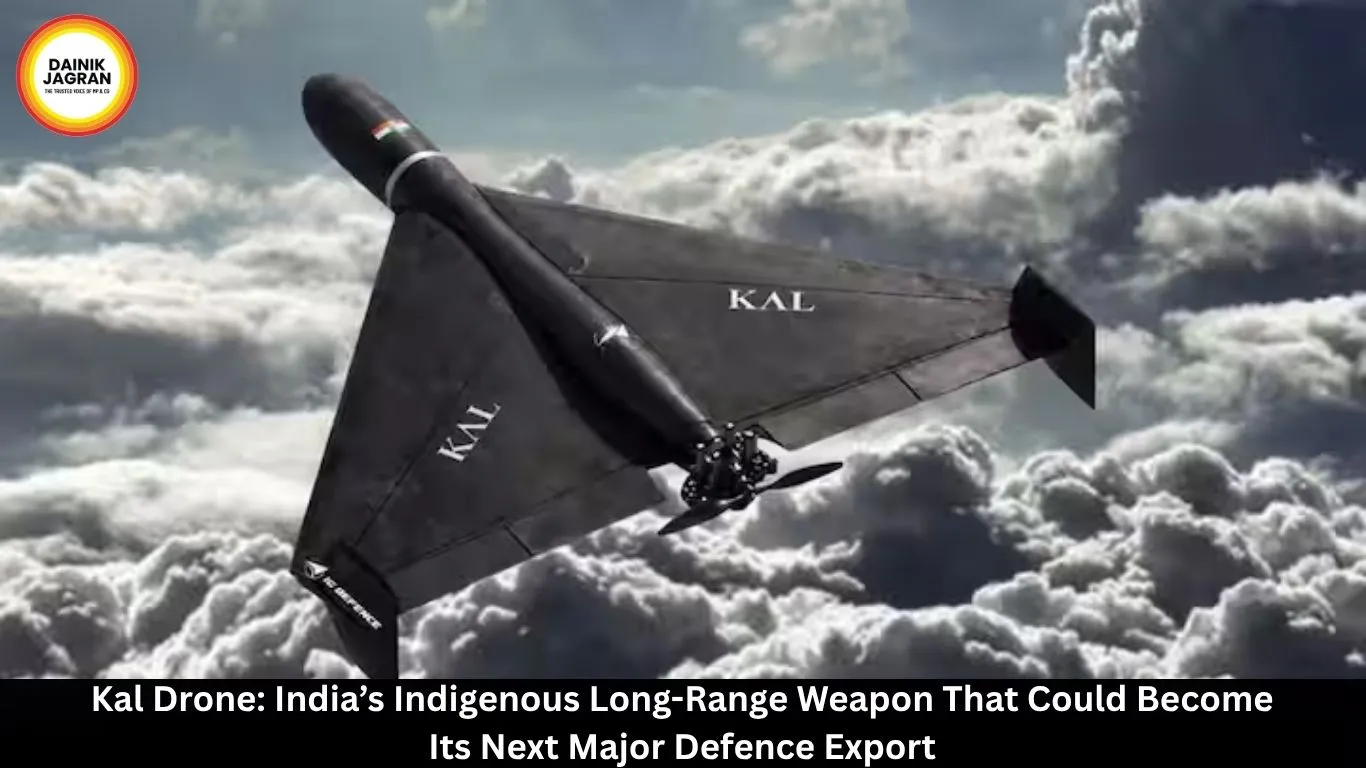
Kal Drone: India’s Indigenous Long-Range Weapon Eyes Gulf Defence Export Market
Digital desk
India's Kal drone, developed by IG Defence, is reportedly attracting interest from Gulf nations, with a claimed 1,000-km range and 50-kg payload.
India’s defence export ambitions could soon get another boost with the emergence of the Kal drone, an indigenous long-range loitering munition developed by Odisha-based defence startup IG Defence.
The Shahed-class one-way attack drone is reportedly attracting interest from several Gulf countries, potentially opening a new market for Indian-made autonomous strike systems.
The development comes as India continues to expand its defence manufacturing and export footprint. According to the Defence Ministry, India's defence exports reached a record ₹38,424 crore in 2025-26, marking a 62.66 per cent increase over the previous financial year.
The Kal could become another prominent export product alongside systems such as the BrahMos missile, which has emerged as one of India's best-known defence exports.
What Is the Kal Drone?
Developed by IG Defence, the Kal is a long-range, one-way attack drone designed for deep-strike missions.
Its operational concept is broadly similar to other loitering munitions, including Iran's Shahed family of drones. The system can reportedly remain airborne over a designated area before identifying or engaging a target.
According to specifications provided by IG Defence, the Kal has an operational range of up to 1,000 kilometres and an endurance of approximately seven to eight hours.
The company says the drone can carry a 50-kg payload and cruise at around 160 kmph, with a maximum speed of approximately 200 kmph.
It is designed to operate at altitudes of up to 5,000 metres above mean sea level.
Designed for Deep-Strike Missions
The Kal is intended to target high-value assets at operational depth.
According to IG Defence, its potential targets include infrastructure, radar installations, air-defence systems and soft or semi-hardened military targets.
The drone features an advanced guidance and navigation system intended to support autonomous flight during missions.
As a loitering munition, the system can remain in an area before conducting a strike, potentially allowing operators greater flexibility compared with conventional fixed-flight-path weapons.
The company also says the Kal can be launched using rocket-assisted take-off systems or vehicles, giving operators different deployment options.
Gulf Nations Show Interest
Interest in the Kal is reportedly growing outside India, particularly among countries in the Gulf and other strategically important regions.
IG Defence said on August 5 that it was in advanced discussions with multiple Gulf countries regarding possible procurement.
People associated with the company said talks were at an advanced stage and that some agreements could potentially be concluded during the current financial year.
If successful, the deals could result in the first overseas consignments of the Kal being exported from India.
However, any such export would remain subject to Government of India approvals and applicable defence export regulations.
Why the Gulf Market Matters
The reported interest comes at a time when military planners worldwide are paying greater attention to relatively affordable long-range unmanned systems.
Recent conflicts have demonstrated how drones can be used for surveillance, precision strikes and attacks against military infrastructure without exposing pilots to direct combat risks.
The wider conflict environment in West Asia has also highlighted the demand for autonomous systems capable of operating over long distances.
For India, securing export orders for the Kal could strengthen the country's position in the international unmanned systems market.
Following the BrahMos Model
The Kal is being discussed as a potential future defence export success story similar to BrahMos.
Jointly developed by India's DRDO and Russia's NPO Mashinostroyenia, BrahMos has become one of India's most prominent defence exports.
The missile's combination of speed, precision and multi-platform launch capability has contributed to its international appeal.
India's growing defence export portfolio now includes missiles, artillery systems, radars, electronic systems, protective equipment and unmanned platforms.
The government's push to increase domestic defence manufacturing has also encouraged private companies and startups to develop products for both Indian and international markets.
Export Potential and Challenges
Despite the reported foreign interest, the Kal's emergence as a major export product will depend on several factors.
Potential customers would need to assess its performance, reliability, navigation capabilities and operational effectiveness through testing and evaluation.
The company will also have to secure the necessary regulatory clearances before exporting the system.
IG Defence has said that, subject to government approvals, the Kal could contribute to India's objective of becoming a trusted supplier of indigenous defence technology to friendly foreign countries.
India’s Defence Export Push
India's record defence exports indicate a broader shift from its traditional position as a major defence importer towards becoming a supplier of military equipment.
The government has set ambitious targets for domestic defence production and exports, while private-sector participation has expanded significantly.
If IG Defence succeeds in securing international orders for the Kal, the drone could become an important example of how India's private defence industry is moving into advanced unmanned and autonomous weapons technology.
For now, the Kal remains an emerging system with export discussions underway. But if the reported Gulf interest translates into contracts, the drone could become one of the more significant additions to India's growing defence export portfolio.

Kal Drone: India’s Indigenous Long-Range Weapon Eyes Gulf Defence Export Market
Digital desk
India’s defence export ambitions could soon get another boost with the emergence of the Kal drone, an indigenous long-range loitering munition developed by Odisha-based defence startup IG Defence.
The Shahed-class one-way attack drone is reportedly attracting interest from several Gulf countries, potentially opening a new market for Indian-made autonomous strike systems.
The development comes as India continues to expand its defence manufacturing and export footprint. According to the Defence Ministry, India's defence exports reached a record ₹38,424 crore in 2025-26, marking a 62.66 per cent increase over the previous financial year.
The Kal could become another prominent export product alongside systems such as the BrahMos missile, which has emerged as one of India's best-known defence exports.
What Is the Kal Drone?
Developed by IG Defence, the Kal is a long-range, one-way attack drone designed for deep-strike missions.
Its operational concept is broadly similar to other loitering munitions, including Iran's Shahed family of drones. The system can reportedly remain airborne over a designated area before identifying or engaging a target.
According to specifications provided by IG Defence, the Kal has an operational range of up to 1,000 kilometres and an endurance of approximately seven to eight hours.
The company says the drone can carry a 50-kg payload and cruise at around 160 kmph, with a maximum speed of approximately 200 kmph.
It is designed to operate at altitudes of up to 5,000 metres above mean sea level.
Designed for Deep-Strike Missions
The Kal is intended to target high-value assets at operational depth.
According to IG Defence, its potential targets include infrastructure, radar installations, air-defence systems and soft or semi-hardened military targets.
The drone features an advanced guidance and navigation system intended to support autonomous flight during missions.
As a loitering munition, the system can remain in an area before conducting a strike, potentially allowing operators greater flexibility compared with conventional fixed-flight-path weapons.
The company also says the Kal can be launched using rocket-assisted take-off systems or vehicles, giving operators different deployment options.
Gulf Nations Show Interest
Interest in the Kal is reportedly growing outside India, particularly among countries in the Gulf and other strategically important regions.
IG Defence said on August 5 that it was in advanced discussions with multiple Gulf countries regarding possible procurement.
People associated with the company said talks were at an advanced stage and that some agreements could potentially be concluded during the current financial year.
If successful, the deals could result in the first overseas consignments of the Kal being exported from India.
However, any such export would remain subject to Government of India approvals and applicable defence export regulations.
Why the Gulf Market Matters
The reported interest comes at a time when military planners worldwide are paying greater attention to relatively affordable long-range unmanned systems.
Recent conflicts have demonstrated how drones can be used for surveillance, precision strikes and attacks against military infrastructure without exposing pilots to direct combat risks.
The wider conflict environment in West Asia has also highlighted the demand for autonomous systems capable of operating over long distances.
For India, securing export orders for the Kal could strengthen the country's position in the international unmanned systems market.
Following the BrahMos Model
The Kal is being discussed as a potential future defence export success story similar to BrahMos.
Jointly developed by India's DRDO and Russia's NPO Mashinostroyenia, BrahMos has become one of India's most prominent defence exports.
The missile's combination of speed, precision and multi-platform launch capability has contributed to its international appeal.
India's growing defence export portfolio now includes missiles, artillery systems, radars, electronic systems, protective equipment and unmanned platforms.
The government's push to increase domestic defence manufacturing has also encouraged private companies and startups to develop products for both Indian and international markets.
Export Potential and Challenges
Despite the reported foreign interest, the Kal's emergence as a major export product will depend on several factors.
Potential customers would need to assess its performance, reliability, navigation capabilities and operational effectiveness through testing and evaluation.
The company will also have to secure the necessary regulatory clearances before exporting the system.
IG Defence has said that, subject to government approvals, the Kal could contribute to India's objective of becoming a trusted supplier of indigenous defence technology to friendly foreign countries.
India’s Defence Export Push
India's record defence exports indicate a broader shift from its traditional position as a major defence importer towards becoming a supplier of military equipment.
The government has set ambitious targets for domestic defence production and exports, while private-sector participation has expanded significantly.
If IG Defence succeeds in securing international orders for the Kal, the drone could become an important example of how India's private defence industry is moving into advanced unmanned and autonomous weapons technology.
For now, the Kal remains an emerging system with export discussions underway. But if the reported Gulf interest translates into contracts, the drone could become one of the more significant additions to India's growing defence export portfolio.

Recommended For You
--------
🚨 Beat the News Rush – Join Now!
Get breaking alerts, hot exclusives, and game-changing stories instantly on your phone. No delays, no fluff – just the edge you need. ⚡
Tap to join:
🟢 WhatsApp Channel: Dainik Jagran MP CG
Crave more?
🅕 Facebook: Dainik Jagran MP CG English
🅧 Twitter (X): Dainik Jagran MP CG
🅘 Instagram: Dainik Jagran MP CG
Share the fire – keep your crew ahead! 🗞️🔥