


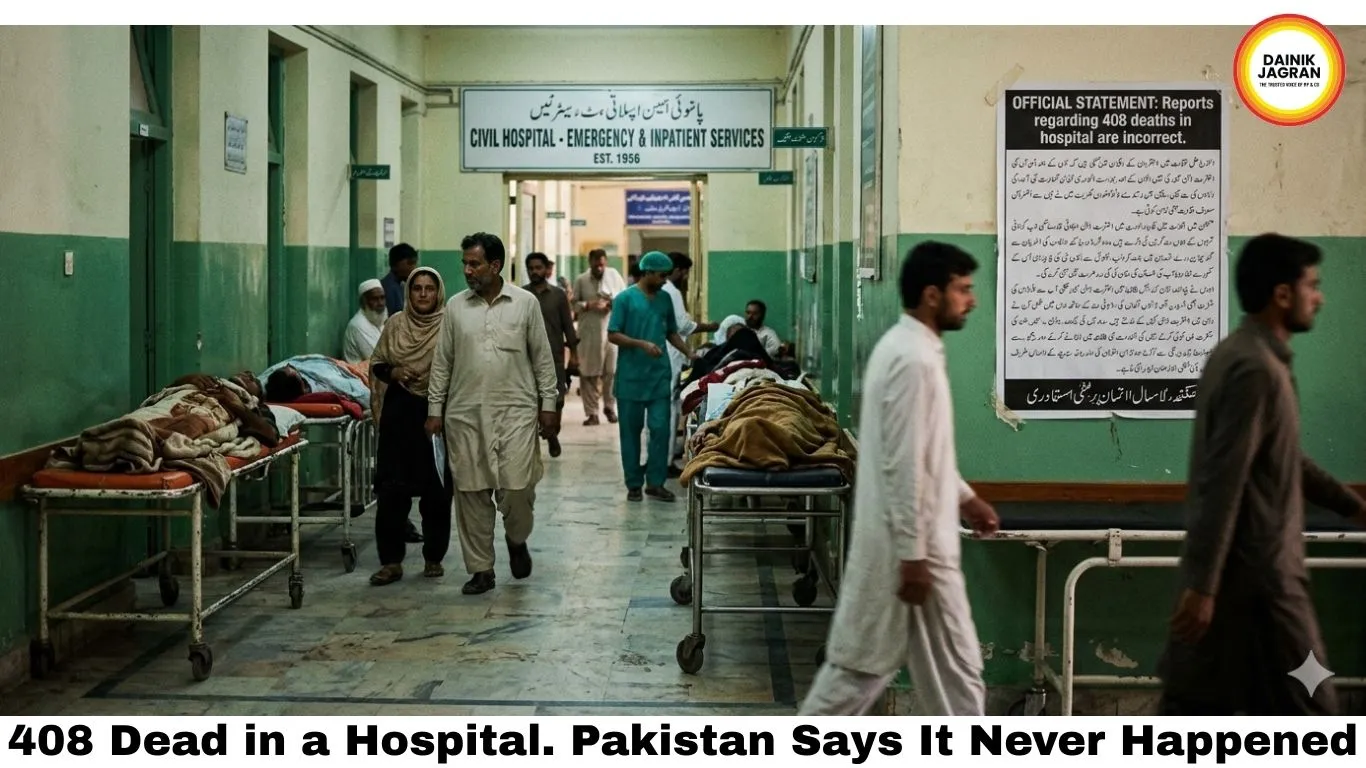
408 Dead in a Hospital. Pakistan Says It Never Happened.
Digital Desk
The Night Kabul's Patients Never Saw Coming
It was 9 o'clock on Monday night, March 16. Kabul's streets were quieter than usual — Ramadan, the holy month of fasting, meant that most residents had eaten, prayed, and retired early after the day's long fast. Inside the Omid Addiction Treatment Hospital, a 2,000-bed government-run rehabilitation facility for drug-dependent patients managed by the Ministry of Interior, approximately 3,000 patients from across Afghanistan were receiving treatment — recovering addicts, many of them referred by their families, some involuntarily admitted, all of them civilians in every legal, moral, and humanitarian sense of the word.
Then the jets came.
By the time the fires were extinguished and the rubble had been searched through the early hours of Tuesday morning, Afghanistan's Interior Ministry confirmed 408 people killed and 265 injured — making the strike on the Omid Hospital the single deadliest attack on Afghan civilian infrastructure since the chaotic US withdrawal from the country in 2021. Families gathered outside hospitals across Kabul through the night and into Tuesday, searching desperately for names on lists, for faces in wards, for any confirmation that their son or brother or father had survived.
Pakistan says it did not hit a hospital. The evidence on the ground says otherwise.
What Happened: The Attack That Broke a Conflict Wide Open
The Pakistan-Afghanistan conflict had been intensifying steadily since late February 2026, when a ceasefire brokered by Qatar in October 2025 — after earlier fighting that killed dozens of soldiers and civilians on both sides — finally collapsed under the weight of accumulated grievances and continued cross-border strikes.
Pakistan's consistent position has been that Afghanistan's Taliban government provides safe haven for the Tehrik-i-Taliban Pakistan — the Pakistani Taliban, or TTP — as well as Baloch separatist groups, both of which conduct deadly attacks inside Pakistani territory. The Taliban government in Kabul denies this, describing Pakistani internal security failures as Pakistan's own problem to solve. This foundational dispute has driven the conflict through multiple escalation cycles since late 2025.
On Monday, March 16, Pakistan's military conducted airstrikes in Kabul and in the eastern Afghan province of Nangarhar. Pakistan's Information Minister publicly described the strikes as precise, deliberate, and professional — targeting military installations and what he called terrorist support infrastructure including technical equipment storage and ammunition storage. He pointed to secondary detonations visible after the strikes as proof that ammunition depots had been hit.
What was visible on the ground in Kabul the morning after was not an ammunition depot. It was a blackened, demolished hospital. A single-storey structure bore the marks of intense flame. Other sections had been reduced to heaps of wood and metal, with bunk beds still standing among the rubble and patients' blankets and personal belongings scattered across the debris field. Security forces searched the ruins with flashlights while firefighters worked through the night.
Pakistan's Denial — and the Evidence That Contradicts It
Pakistan's Information Minister maintained emphatically that no hospital, no drug rehabilitation centre, and no civilian facility was targeted. He stated that Pakistan's strikes hit only facilities being used to plan, facilitate, shelter, train, or enable terrorist attacks inside Pakistan. He described reports of mass civilian casualties as propaganda aimed at stirring anti-Pakistan sentiment and covering what he called the Taliban government's support for cross-border terrorism.
Afghanistan's Health Ministry spokesman directly rejected this framing, stating that there were no military facilities in the vicinity of the Omid Hospital. The UN mission in Afghanistan — which is not an actor with any reason to take sides between the Taliban government and Islamabad — issued a formal statement expressing its deepest condolences and describing the attack explicitly as one carried out by Pakistani military forces impacting a healthcare facility for the treatment of drug-addicted individuals.
The World Health Organisation's director-general confirmed more than 400 people killed and at least 250 injured at the Omid facility, and noted that since hostilities between Pakistan and Afghanistan escalated at the end of February, at least six health facilities had been impacted in Afghanistan. An independent aid organisation whose staff visited the site on Tuesday morning reported finding hundreds of civilians dead and injured. The UN's human rights spokesperson described witnesses' accounts of a scene of total destruction, with hundreds of families searching for relatives.
Afghanistan's own deputy information minister described the attack as a crime against humanity. The country's acting ambassador to Qatar called it a war crime — noting pointedly that it occurred during Ramadan. Afghan cricketer Rashid Khan, one of the most globally recognised figures from the country, called it a war crime and described it as sickening during the holy month, urging the UN and human rights agencies to investigate immediately.
The Wider War: Three Weeks, 104 Children, Tens of Thousands Displaced
The hospital attack did not happen in isolation. It is the bloodiest single incident in a conflict that has been grinding through its third week with a brutality that the international community has been dangerously slow to confront with the urgency it deserves.
Since Pakistan and Afghanistan began fighting in earnest in late February, at least 289 Afghan civilians have been killed or injured — including 104 children and 59 women. Tens of thousands of people, mostly in the south and southeast of Afghanistan, have been displaced from their homes. Peace talks between the two sides broke down in Istanbul amid rising border tensions earlier this week. Pakistan's Defence Minister has now publicly declared that his country is in open war with Afghanistan — the first time any senior official has used that phrase openly, marking a significant escalation in the conflict's official characterisation.
The UN Security Council passed a resolution condemning terrorist activity originating from within Afghanistan — but did not name Pakistan in the text, a diplomatic balancing act that Afghanistan's Taliban government found deeply inadequate and that Pakistan interpreted as vindication. The UN Secretary-General's special envoy has called for immediate de-escalation and an independent investigation into the hospital strike. The UN Human Rights Office has called for those responsible to be held to account in line with international standards.
International humanitarian law is unambiguous on the status of medical facilities: hospitals are specially protected objects under the Geneva Conventions and their Additional Protocols. Attacking a hospital is a war crime under international law unless it can be proven that the facility was being used, beyond its medical function, for acts harmful to the enemy — and that adequate warning was given before the strike.
No such warning was given. Three thousand patients were inside.
India's Position: Watching Two Neighbours Go to War
For India, the Pakistan-Afghanistan conflict carries a specific and sobering strategic dimension. Pakistan — India's western neighbour and the world's fifth most populous nuclear-armed state — is now simultaneously in open conflict with Afghanistan on its western border, under diplomatic and economic pressure from the West Asia war disrupting regional trade, and managing its own internal political pressures.
A Pakistan that is militarily stretched on its western front, economically stressed by rising oil prices and disrupted trade routes, and politically embattled at home is not a more predictable or more manageable neighbour from New Delhi's perspective. It is a more volatile one. India has maintained studied silence on the Pakistan-Afghanistan conflict thus far — a silence that reflects both caution and the realistic understanding that no Indian statement on this conflict will be welcome in Islamabad and none will be neutral in its interpretation.
But silence has limits. As a founding member of the UN and as a country with deep historical ties to both Afghanistan and its civilian population, India's voice on a war that has now killed over 400 people in a single hospital strike — during Ramadan — is going to be harder to withhold indefinitely.
When Denial Becomes Its Own War Crime
Pakistan's denial of the Omid Hospital strike deserves to be addressed directly, because it is not simply a disagreement about facts. It is an attempt to make 408 deaths disappear through assertion.
The weight of independent evidence — the UN mission statement, the WHO confirmation, the aid organisation eyewitness accounts, the visual documentation from the site, the 3,000 patients who were present, the families who spent Tuesday night searching hospitals for their loved ones — does not leave meaningful room for reasonable doubt about what happened. A hospital was struck. More than 400 people died. The vast majority, if not all of them, were civilian patients receiving treatment for addiction.
The claim that secondary detonations prove an ammunition depot was present is, in the specific context of a hospital treating drug dependency patients, not a credible alternate explanation for what the world saw on the ground.
Pakistan may have genuine grievances about TTP support from Afghan territory. Those grievances may even be legitimate. But legitimate grievances do not create the legal or moral authority to strike a 2,000-bed hospital during Ramadan and deny it happened while 408 bodies are still being pulled from the rubble.
The world is already stretched thin — watching West Asia burn, managing the Hormuz crisis, navigating the Iran-US war. It cannot afford to look away from Kabul as well. The people who died in the Omid Hospital on the night of March 16 were patients — not combatants, not militants, not collateral damage in any sense that international law recognises.
They were sick people in a hospital. And they are dead.
.jpg)




