


The EC Removed Bengal's Chief Secretary, DGP and 19 Police Officers in 48 Hours. Is That Democracy or Overreach?
Digital Desk
No Chief Secretary Has Ever Been Removed by the EC Before. Until Now.
In the entire history of Indian elections — across hundreds of state assembly elections, 17 general elections, and decades of evolving practice under Article 324 — the Election Commission of India had never removed a sitting state Chief Secretary. Not once.
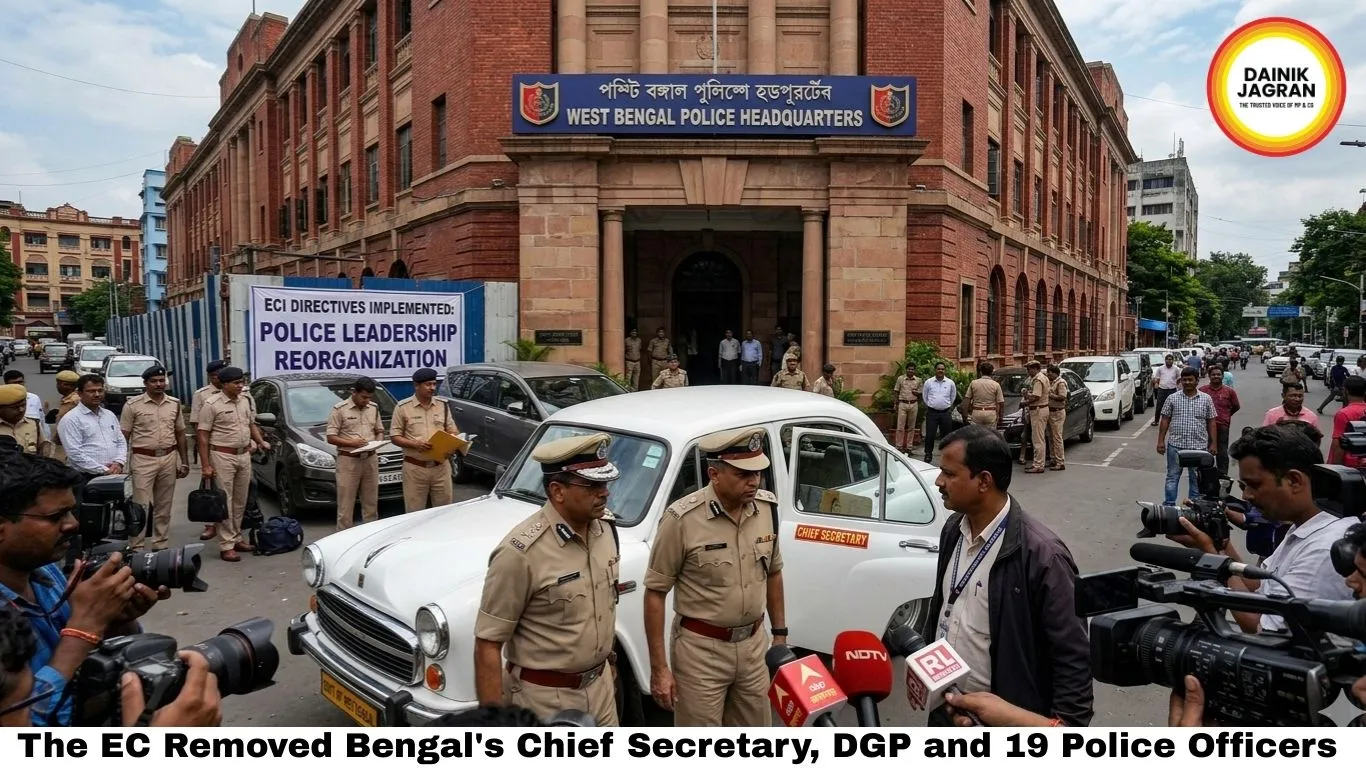
That record ended on the night of March 15, 2026, within hours of the West Bengal assembly election schedule being announced, when the Election Commission of India issued a directive transferring Chief Secretary Nandini Chakravorty and ordering Dushyant Nariala — a 1993 batch IAS officer — to take charge with immediate effect.
What followed over the next 48 hours was the most sweeping administrative intervention in a poll-bound state that India's election machinery has ever executed. Home Secretary Jagdish Prasad Meena was removed. DGP Peeyush Pandey was replaced by Siddh Nath Gupta. Kolkata Police Commissioner Supratim Sarkar was replaced by Ajay Kumar Nand. And on March 17, a second wave of transfers replaced 19 senior IPS officers across the state — including the Commissioners of Police for Asansol-Durgapur, Howrah, Barrackpore, and Chandannagar.
The Election Commission directed all transfers to take effect by 3 PM on March 16 and demanded compliance reports within hours. Officers transferred out were barred from all election-related assignments until the completion of polling. The message was unambiguous: Bengal's administrative machinery, as it existed on March 15, did not meet the Election Commission's standard for neutrality. It was being replaced.
Why the EC Acted: The Signal in the Details
The Election Commission did not explain its reasoning in exhaustive public detail — constitutional bodies rarely do. But the details available make the rationale clear to anyone paying attention.
Chief Secretary Nandini Chakravorty was not a neutral administrative figure in the political landscape of Bengal. She was widely understood to be a close aide of Chief Minister Mamata Banerjee. More specifically, she had been present alongside Mamata at the I-PAC office during the ED's January 8 search operation — a presence that the Election Commission, reviewing poll preparedness under its Article 324 mandate, likely flagged as incompatible with the neutrality standards required of an officer overseeing election administration.
Furthermore, Chakravorty's own appointment had been unusual: she had reportedly superseded three senior batches of officers to become Chief Secretary — a pattern of appointment that the Commission appears to have assessed as reflecting political favour rather than seniority or merit. Former bureaucrat and Rajya Sabha MP Jawhar Sircar noted publicly that this scale of transfers is eye-catching and without precedent — and that the appointment itself was striking. His assessment: while the EC's powers under the Model Code are legally valid, the removal of a state's administrative head sends a signal that people will interpret in their own ways.
The EC's own communication was clear on its objective: transparent, free of fear, violence-free, and inducement-free elections in a state that has historically witnessed intense, sometimes violent, political competition.
Mamata's Response: Letter, Allegation, and a Warning
Chief Minister Mamata Banerjee did not accept the transfers quietly. She wrote a formal letter to Chief Election Commissioner Gyanesh Kumar on March 17, describing the orders as unilateral and questioning their basis. She accused the Election Commission of playing a game at the behest of the BJP — alleging that the transfers were politically motivated and designed to weaken the elected state government's administrative control in the crucial weeks before polling.
She questioned the specific timing: the transfers were ordered and implemented ahead of Eid — a period when large parts of Bengal's Muslim community would be engaged in religious observance, and when she argued that disruption of established administrative relationships could create unnecessary uncertainty. She issued a direct warning that the poll body and the BJP would be responsible for any untoward incident that occurred as a result of the transfers.
TMC's parliamentary response was equally sharp. The party staged a walkout from Rajya Sabha, with senior MP Derek O'Brien calling the overnight transfers unacceptable. MP Sagarika Ghose said the EC was misusing its powers to damage an elected government. TMC MP Kirti Azad went further, describing the reshuffle as a move to appease the ruling party's masters at the Centre.
The BJP's position was, predictably, the opposite: the reshuffle was necessary, overdue, and entirely within the EC's constitutional mandate — a long-overdue assertion of institutional neutrality in a state with a documented record of election-time intimidation and violence.
What Article 324 Actually Allows — And Where the Line Is
The constitutional authority of the Election Commission under Article 324 is broad but not unlimited. The EC has the power and the duty to supervise, direct, and control elections — and that authority extends to ensuring that the administrative machinery overseeing an election is neutral and not compromised by political loyalty.
Removing a state Chief Secretary, however, is a step that no commission has previously taken because it sits at the intersection of two constitutional principles: the EC's election management authority and the state government's executive authority over its own civil services. The transfer of police officers, district collectors, and even DGPs has precedent — the EC has done this routinely in sensitive states for decades. The removal of the head of a state's civil service is different in kind, not just in degree.
Whether the EC crossed a line or established a new and necessary precedent will be debated by constitutional scholars for years. What is not debatable is the Commission's rationale: an officer who appears at the site of a federal investigation alongside the Chief Minister, who was appointed by superseding three batches, and who would oversee the administrative machinery of a state election in which the appointing Chief Minister is a candidate — does not present the appearance of neutrality that Article 324 demands.
The appearance of neutrality matters as much as its reality. The EC concluded, correctly or otherwise, that Nandini Chakravorty's presence at the top of Bengal's bureaucracy failed that test.
Unprecedented Is Not Automatically Wrong
The removal of Bengal's Chief Secretary is without precedent. Unprecedented actions by constitutional bodies should always attract scrutiny — and the scrutiny here is legitimate. There is a real and important question about how far the EC's Article 324 powers extend into the executive domain of a state government, and that question deserves serious constitutional examination rather than reflexive dismissal.
But unprecedented is not automatically wrong. West Bengal has one of the most documented histories of election-time state machinery misuse in Indian democratic history. Violence, booth capturing, intimidation of opposition candidates and voters — these are not allegations invented by the BJP. They are documented in the EC's own observer reports, in court judgments, in NHRC findings going back two decades across multiple governments.
If the Election Commission's assessment — based on its own confidential reports from the state — is that the administrative machinery in place on March 15 was not capable of delivering a free and fair election, then its duty under Article 324 is to change that machinery. It did so. The scale was unprecedented. The constitutional authority was real.
Bengal votes on April 23 and 29. Whether the reshuffle produces the neutral administration the EC intended — or whether it generates its own disruption — will be visible in the conduct of those elections. The Commission has made its move. Now comes the part that matters: what actually happens at the booth.


.jpg)




