


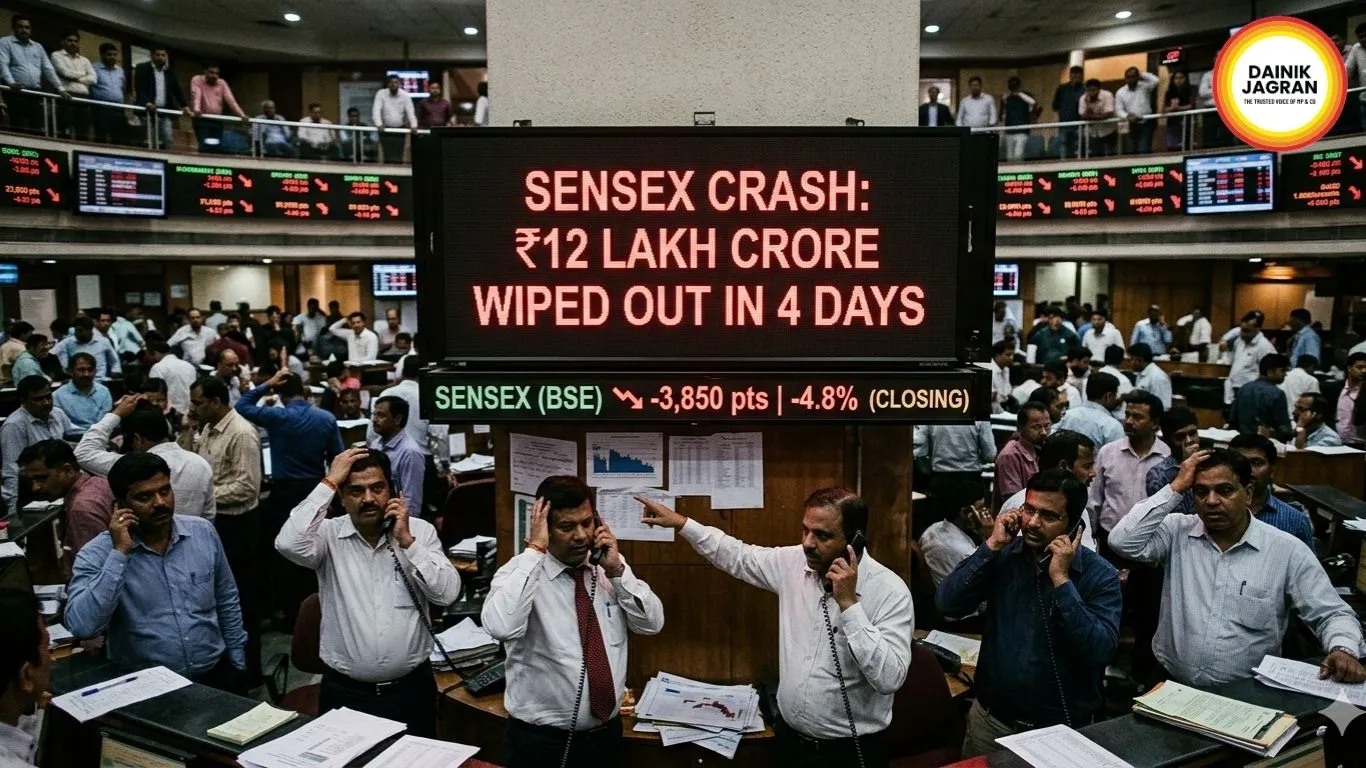
Sensex Lost ₹12 Lakh Crore in Four Days. Today It Is Climbing Back. Here Is the Full Story.
Digital Desk
The Worst Is Behind Dalal Street — For Now
On the morning of March 9, Indian investors sat down at their trading terminals and watched something frightening happen in real time. The Sensex plunged over 1,900 points in the opening minutes. Nearly ₹12 lakh crore in market capitalisation vanished before the first hour of trading was done. The trigger was news that US and Israeli strikes had hit Iran overnight — launching a war that nobody had fully priced in, in a region whose waterways carry the fuel that powers India's economy.
Four brutal trading sessions later, by the close of March 13, the BSE Sensex had shed over 3,500 points from its pre-war level and was sitting at 74,563. The Nifty had fallen to 23,151. Foreign Institutional Investors had pulled out over ₹21,000 crore in four days. The rupee had touched near-record lows against the dollar. Brent crude was above $107. The market was in genuine distress.
Today, March 18, the Sensex has risen 700 points in morning trade to 76,556 and the Nifty is trading at 23,723 — extending a two-session recovery rally that began on March 17. The question every investor in India is asking right now is the same: is this the real bottom, or just a bounce before the next leg down?
Why the Market Crashed: The Four-Day Wipeout Explained
To understand the recovery, you must first understand the crash — because the forces that drove the market down are not fully resolved, even as the index climbs today.
The trigger was geopolitical: US and Israeli strikes on Iran on February 28 launched a conflict that sent Brent crude surging above $100 per barrel almost immediately. For India — which imports over 88 percent of its crude oil — rising oil prices are not just a global headline. They are a direct cost increase that flows through to inflation, widens the current account deficit, pressures the rupee, and squeezes corporate margins in aviation, logistics, paint, chemicals, tyres, and every other oil-dependent sector.
The selling that followed was fast and indiscriminate. Foreign institutional investors, who had already been cautiously positioned in Indian equities following global risk-off sentiment in late February, began exiting aggressively. Over ₹21,000 crore of FII net selling in four trading sessions is not rotation or rebalancing. It is a coordinated exit from a market perceived to be directly in the blast radius of a geopolitical event.
The sectoral damage was broad. Nifty Auto fell over 2 percent in a single session — fuel-dependent businesses get hammered by oil spikes. Nifty Realty fell sharply on concerns about input cost inflation feeding through to developer margins. Consumer durables dropped as household spending sentiment soured. Even FMCG — traditionally the defensive play in a downturn — could not hold its ground as the scale of the selloff overwhelmed sector-specific logic.
The Volatility Index — the market's fear gauge — jumped 6.32 percent on March 13, signalling that traders were actively buying protection against further falls. ₹9.5 trillion of market cap was erased in a single session. The total wealth destruction from March 9 to March 13 across BSE-listed firms crossed ₹12 lakh crore.
Why the Market Is Recovering Today: Five Forces Working in Bulls' Favour
The Sensex's 568-point gain on March 17 and today's 700-point morning advance are not random. They reflect five specific forces that have shifted the near-term calculus for equity investors.
The most important is the diplomatic breakthrough on the Strait of Hormuz. The arrival of LPG tankers Shivalik and Nanda Devi at Gujarat ports this week — after direct Indian diplomatic negotiations secured their passage — has signalled that the Hormuz waterway, while still restricted, is not completely closed to Indian vessels. Crude oil tanker Jag Laadki's 80,800 metric tonne cargo arriving at Mundra simultaneously has reinforced the message that supply lines, however strained, have not been severed. The oil market has responded: Brent crude has pulled back from its $107 peak to around $98 to $100 per barrel in recent sessions — still elevated but off the panic highs.
The second force is domestic institutional buying. Indian mutual funds and insurance companies have been consistent buyers through this correction — domestic institutional investors added net purchases against the FII selling, providing a floor that prevented the decline from becoming a rout. This systematic buying by domestic long-term capital is one of the most significant structural changes in Indian markets over the past decade and has proven its value in every crisis since COVID.
Third, defence and energy stocks are leading today's rally — and this is entirely logical. BEL has announced ₹1,011 crore in new orders across advanced defence systems. Defence stocks broadly have re-rated upward as the West Asia conflict has reminded markets globally that defence spending is a durable, crisis-resistant growth theme. Energy infrastructure companies — gas pipeline operators, LNG terminal owners, PNG network operators — are also in strong demand as the structural imperative of India's energy security diversification becomes investable thesis rather than policy aspiration.
Fourth, the FOMC meeting — the US Federal Reserve's policy decision, due tonight — has created a wait-and-see dynamic that is, paradoxically, supportive of equities today. If the Fed signals a pause on rate hikes or hints at cuts later in the year, emerging market equities including India will benefit from renewed FII interest as the dollar softens. The market is cautiously positioning for a benign Fed outcome.
Fifth, the broader Indian growth story remains intact. Fitch has reaffirmed India's GDP growth estimate at 7.5 percent for FY2026. Tax collections are running 10 percent ahead of last year. Capital expenditure has been maintained despite the global disruption. The crisis is real but the underlying economy has not broken.
The Sectors to Watch: Where the Money Is Moving
Today's rally is not broad-based optimism — it is selective, and the selection tells you something important about how institutional money is repositioning.
Capital goods, defence, infrastructure, and telecom are leading gains — up 1 to 2 percent as a bloc. These are businesses with strong domestic revenue visibility, limited direct crude oil exposure, and order books that the West Asia crisis has either not affected or actively strengthened in the case of defence. BEL, HAL, and the broader defence PSU space are the standout performers of the entire crisis period.
Banking and private financial services are recovering after taking the heaviest FII selling during the crash. HDFC Bank, ICICI Bank, Kotak Mahindra, and Bajaj Finance — the four names that institutional investors sell first and buy back first in Indian market cycles — are all trading positively today. Their fundamentals — loan growth, asset quality, net interest margins — have not deteriorated in eighteen days of geopolitical crisis. The selling was sentiment-driven. The recovery is fundamental-driven.
IT stocks remain under pressure — not because of the war but because of global client spending uncertainty and the specific weight of US business exposure in a moment when American corporate confidence is wobbling. TCS's launch of its Rapid Outcome AI platform is the kind of product innovation that builds long-term value but does not move the short-term needle in a risk-off environment.
Eternal — the food delivery and quick commerce platform formerly known as Zomato — has surged 6 percent today, recovering from crisis-period lows that reflected concerns about restaurant closures from the LPG shortage. As commercial LPG supply partially restores, the restaurant sector's operational capacity is improving, and food delivery volumes are expected to normalise. Eternal's 6 percent single-day move suggests the market believes the worst of the restaurant disruption is behind us.
What Investors Should Actually Do Right Now
The practical question behind all this analysis is always the same: what does this mean for my money?
For long-term equity investors — SIP holders, goal-based investors, people with a five-year-plus horizon — the answer is the same as it always is during a geopolitically-driven correction: nothing. Do not stop your SIP. Do not try to time the bottom. The ₹12 lakh crore that was wiped out between March 9 and 13 is in the process of being partially restored. The investors who panicked and exited at the bottom have crystallised real losses. The investors who continued their systematic investments through the correction have bought units or shares at significantly lower prices that will generate excess returns when the market fully recovers.
For investors who held cash going into the crisis and are now wondering whether to deploy — the setup looks incrementally more favourable than it did a week ago, particularly in the four themes the market is rewarding: defence, domestic infrastructure, banking, and energy security infrastructure. These are not short-term trades. They are structural positions in themes that the crisis has validated with a clarity that no analyst report can match.
The risk that remains — and it is a real risk — is that the West Asia conflict escalates further, that the FOMC disappoints the market tonight, or that crude oil spikes again on fresh supply disruption. None of these outcomes can be ruled out. The Nifty's Volatility Index, while lower than its March 13 peak, is still elevated at around 20 — meaning the market is not complacent about further shocks.
Opinion: Markets Are Not the Economy — But They Are a Mirror
The Sensex's crash and partial recovery over the past ten days is not the most important story about what has happened to India since February 28. The most important story is the 50,000 hotels that went dark, the 89 lakh Ujjwala households who stood in queues, the 611 sailors who waited at sea, and the families whose monthly food budget stretched to breaking point as black market cylinders hit ₹5,000.
But the market does tell us something real: the professional assessment of India's economic resilience under pressure. And that assessment, expressed in the price action of the past two sessions, is cautiously optimistic. India negotiated passage for its tankers. The government boosted LPG production by 28 percent in five days. Domestic institutions bought aggressively through the FII selling. The economy's fundamentals — 7.5 percent GDP growth, disciplined fiscal management, rising tax collections — have not been shaken by eighteen days of geopolitical chaos.
The Sensex at 76,556 today is not a victory. It is a provisional vote of confidence. Whether that confidence is vindicated will depend on how the next act of the West Asia conflict unfolds — and on whether India emerges from this crisis with the energy infrastructure reforms that would prevent the next one from being equally disruptive.
The market is watching. So should every policymaker.
.jpg)




