


RSS at 100: The Sangh Just Rewrote How It Will Work for the Next Century
Digital Desk
The World's Largest Volunteer Organisation Just Had Its Most Important Meeting in a Century
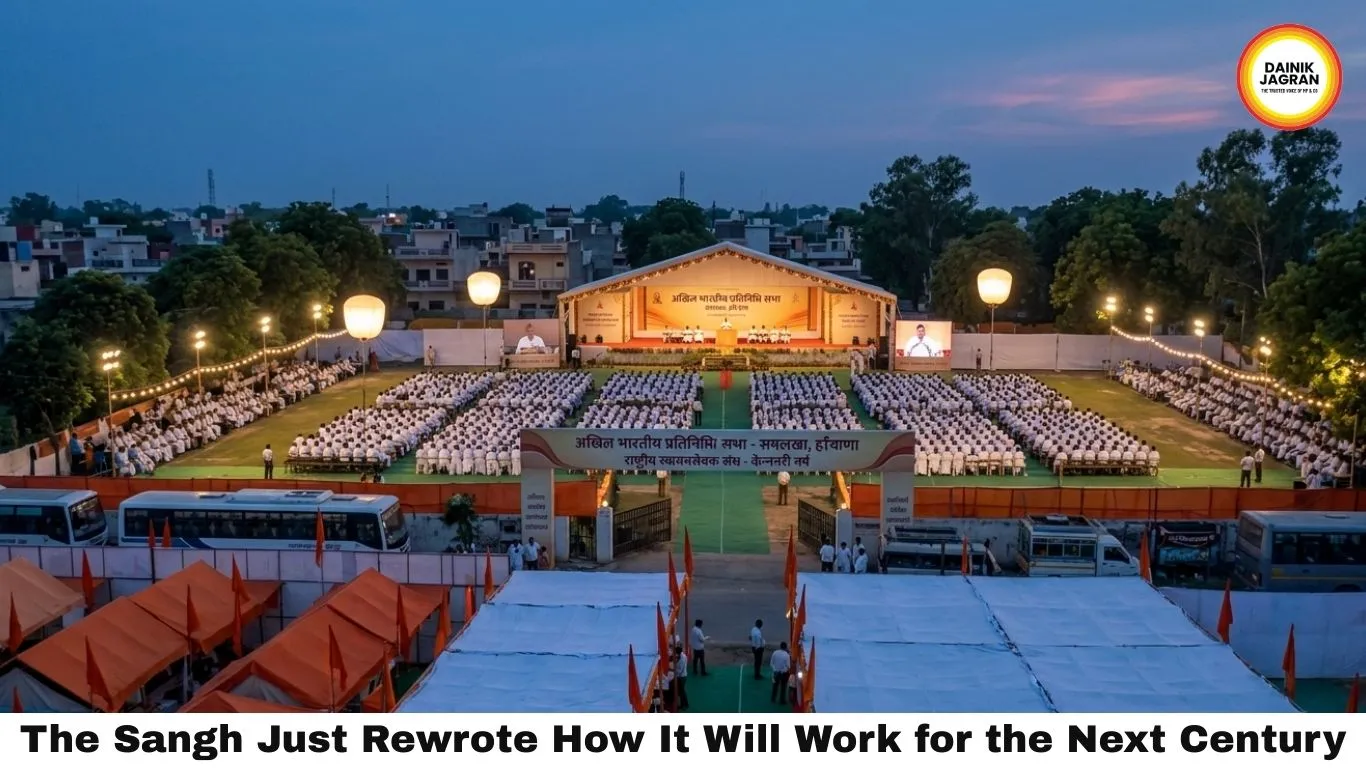
From March 13 to 15, in the town of Samalkha in Haryana, approximately 1,500 of the most consequential organisational delegates in India gathered for the Rashtriya Swayamsevak Sangh's annual Akhil Bharatiya Pratinidhi Sabha — the supreme decision-making assembly of an organisation that is, in its centenary year, the largest volunteer organisation in the world by any credible measure.
What came out of those three days is not merely a set of resolutions. It is a blueprint for how the RSS intends to operate, expand, and embed itself into Indian society for the next phase of its existence — and the decisions taken at Samalkha on state-level leadership appointments, working format changes, shakha expansion targets, and outreach methodology represent the most significant structural evolution the Sangh has undertaken in years.
New State Sarkaryavahs: Leadership Renewal at the Grassroots
The most operationally significant decision from the ABPS 2026 concerns state-level leadership. The RSS has appointed new Pranth Sarkaryavahs — state general secretaries — across multiple provinces as part of a deliberate generational renewal exercise that the Sangh has been building toward through its centenary year.
This is not routine rotation. The RSS traditionally holds its Sarkaryavah positions — at both the national and state level — for periods of three years, renewable by the ABPS. But the centenary year has provided the organisation with both the occasion and the mandate for a more comprehensive renewal: bringing in younger, digitally fluent, grassroots-experienced functionaries into state-level leadership roles while retaining the institutional wisdom of senior Pracharaks in advisory capacities.
The new appointments reflect a conscious geographic emphasis on regions where the RSS has historically been weaker — the northeast, the southern states, and the tribal belt of central India. The Samalkha ABPS was told that over the past two to three years, more than 4,000 new locations have been added to the shakha network, and the number of daily shakhas has increased by over 5,000 across the country. State Sarkaryavahs in these newly expanded regions now carry the specific mandate of consolidating these gains — ensuring that new shakhas become permanent, self-sustaining units rather than paper additions to an organisational map.
The Working Format Change: From Shakha to Society
Perhaps the most substantive shift announced at Samalkha is in the RSS's primary engagement methodology — and it represents a significant evolution from the organisation's founding model.
The shakha — the daily morning or evening session of physical exercise, patriotic songs, discussions, and community gathering — has been the RSS's core operational unit since its founding in Nagpur in 1925. It remains central to the organisation's identity. But the Samalkha ABPS has now formally institutionalised a second, parallel engagement track: the systematic house-to-house and village-to-village contact programme that the RSS has been piloting through its centenary outreach year.
The scale of this programme, as described at the ABPS, is extraordinary. Across all states, Swayamsevaks have been conducting household visits covering families from every section of society — including, strikingly, families with communist political leanings in Kerala, where the programme reportedly received a warm response. In Kerala alone, approximately 55,000 Muslim families and 54,000 Christian families were contacted through this outreach — a number that reflects the RSS's deliberate push beyond the boundaries of traditional Hindu majority community engagement.
Across the country, around 36,000 Hindu Sammelan meetings — community gatherings that bring neighbourhood groups together for discussions on national issues, social harmony, and what the RSS calls Panch Parivartan — have been conducted, with more planned in urban, rural, tribal, and remote regions through the rest of the year.
This house-contact model is significant because it does not require the daily time commitment of shakha attendance. It reaches families through a single, relationship-based conversation rather than requiring physical presence at a daily gathering. It is, in the language of modern organisational theory, a lower-barrier entry point into the RSS's social ecosystem — and it has demonstrably worked, given the 4,000-plus new locations added to the network in recent years.
Panch Parivartan: The Five Transformations at the Heart of the New RSS
The conceptual framework that the ABPS has placed at the centre of the RSS's centenary and post-centenary work is Panch Parivartan — five transformations that the organisation believes must occur within Indian society for the Hindu Rashtra's full realisation.
These five areas — social harmony, family awakening, environmental consciousness, civic responsibility, and self-reliance — form the discussion agenda for the house-contact visits, the Hindu Sammelans, and the shakha sessions across the country. The framework is deliberately non-sectarian in its surface presentation: environmental consciousness and civic responsibility are not exclusively Hindu concerns. They are concerns the RSS is using to build broad social coalitions around conversations that ultimately lead back to its core ideological project.
The sophistication of this approach — using universally acceptable social values as the entry point for an ideologically specific organisational mission — is one of the reasons analysts who study the RSS with genuine attention, rather than reflexive dismissal, consistently note that the organisation is more strategically adaptive than its public image suggests.
The 100 Percent Coverage Claim — and What It Actually Means
The centenary ABPS was told that the RSS has now achieved 100 percent village and neighbourhood coverage in several states — meaning that every gram panchayat and every urban mohalla in those states has at least one contact person or active Swayamsevak. The organisation claimed that in some states it has now reached 90 percent of all households through its outreach programme.
These numbers require contextualisation. A contact visit and an active shakha member are not the same thing. A single conversation with a household does not mean that household is now part of the RSS network. The organisation's own data distinguishes between contact coverage and active participation, and the gap between the two remains significant in many regions.
But the direction of travel is clear, and it is backed by something more reliable than claimed statistics: the BJP's electoral performance in state after state over the past decade has tracked closely with RSS organisational depth in those regions. The shakha network is not a theoretical asset. It is a ground-level mobilisation infrastructure that has repeatedly proven its electoral utility — and the new state Sarkaryavahs appointed at Samalkha are tasked with deepening exactly that infrastructure in the regions where it is still weakest.
On West Asia and India: The RSS Speaks Its Mind
The Samalkha ABPS also made clear that the RSS has opinions on India's foreign policy response to the West Asia conflict — and is not shy about expressing them through the appropriate channels.
The organisation's position, articulated at the press conference by Sah Sarkaryavah CR Mukunda, is that the Government of India should maintain truth and balance in its dialogues with the leaders of the countries involved in the conflict, and that the protection of Indian society in the Gulf region — both the approximately 8 million Indian workers and the broader Indian diaspora — remains a specific concern that the Sangh is monitoring through its affiliate contacts in the region.
This is the RSS operating in its traditional mode on foreign policy: not directing government action but making public the principles it believes should guide it — in this case, directness, balance, and priority for Indian citizens' safety. The alignment between this position and the Modi government's actual diplomatic approach — direct talks with Tehran, bilateral engagement over multilateral posturing, focus on Indian worker safety — suggests, as it often does, that the distance between RSS advice and government action on this issue is narrow.
An Organisation That Understands Compound Growth
The RSS at 100 is not the same organisation as the RSS at 50 or even the RSS at 75. The uniform changed from khaki shorts to khaki trousers. The shakha evolved to include digital discussion sessions alongside physical drill. The outreach methodology expanded from daily gathering to household contact. The ideological conversation shifted from explicit Hindu nationalism to the more accessible language of social transformation and Panch Parivartan.
What has not changed is the organisational discipline — the willingness to invest in grassroots human capital over decades without expecting immediate political returns, the patience to build networks across 4,000 new locations while few are watching, and the understanding that an organisation built on voluntary daily commitment is more resilient than any structure built on financial incentive or political patronage.
The RSS's critics — and they are numerous and often right on specific points — focus on its ideology. The organisation's supporters focus on its social work. Both, in their focus on content, often miss the more fundamental point: the RSS is the most effective civil society organisation India has produced, by the simple measure of sustained reach, voluntary participation, and institutional durability over a century.
Whether India ultimately becomes what the RSS wants it to become is a political question that will be answered by elections, courts, and the choices of 1.4 billion citizens over the coming decades. But the organisation that emerged from Samalkha on March 15, 2026 — with new state leaders, a new working format, and a hundred years of compounding organisational investment behind it — is not a spent force preparing for irrelevance
.jpg)




