

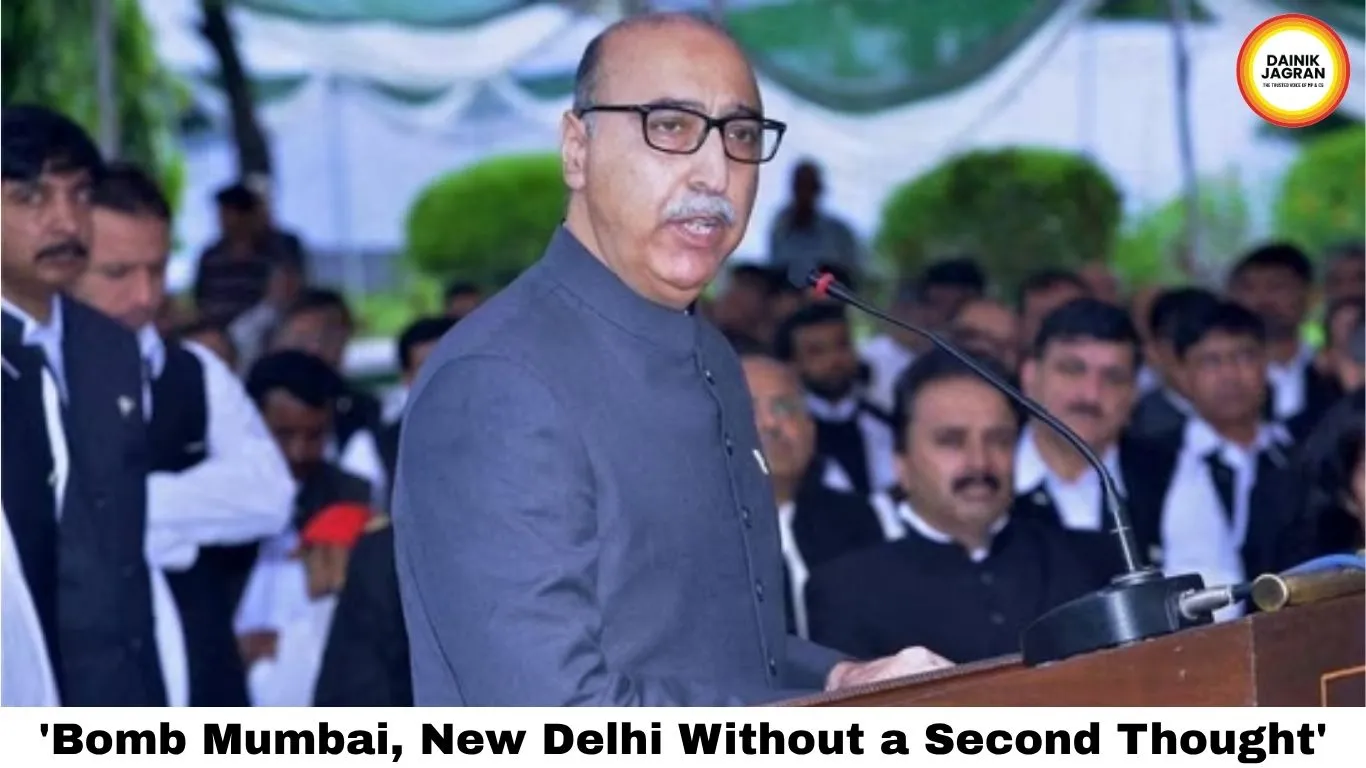
Ex-Pak Envoy Abdul Basit Threatens to Bomb Mumbai, Delhi
Digital Desk
Former Pakistan High Commissioner Abdul Basit says Pakistan would bomb Mumbai and New Delhi without hesitation if the US attacked Pakistan — remarks go viral, spark outrage in India.
'Bomb Mumbai, New Delhi Without a Second Thought': Ex-Pak Envoy Abdul Basit's Threat to India Sparks Outrage
Former Pakistani High Commissioner to India Abdul Basit suggests Pakistan would target Mumbai and Delhi if the US attacked Pakistan — remarks made during a live TV debate now viral across South Asia.
A Remark That Crossed Every Line
A statement by a former Pakistani diplomat has sent shockwaves across India's strategic and diplomatic community. Abdul Basit, who served as Pakistan's High Commissioner to India from 2014 to 2017, said on a Pakistani news channel that if the United States were to attack Pakistan — particularly its nuclear programme — Pakistan would, without hesitation, strike Indian cities including Mumbai and New Delhi. The remarks, made during a prime-time television debate, went viral within hours and triggered sharp reactions from Indian analysts, security experts and the public alike.
What Basit Said — Word for Word
Basit framed his comments around a hypothetical worst-case scenario. He asked viewers to imagine a situation where tensions in Iran deteriorate, Israel positions itself closer to Pakistan, and the US decides to target Pakistan's nuclear facilities. "I am talking about a worst-case scenario, something that is among the impossibilities," he said — before immediately proceeding to outline exactly what Pakistan would do in that scenario.
"If America attacks Pakistan and we cannot reach their bases in the Gulf or strike Israel, then what would be our only option? India," he said. "We would have nothing else to do. We would, without hesitation, attack India — Mumbai, New Delhi — we would not hold back. Whatever happens afterward would be dealt with later."
He also asserted: "Whether educated or uneducated, rich or poor — everyone in Pakistan is a Jihadi."
The 'Default Target' Logic
What has alarmed security analysts the most is not merely the content of the statement — but its underlying strategic logic. Basit explicitly articulated a framework in which India becomes Pakistan's "default target" — a retaliatory destination of choice not because India has done anything, but simply because Pakistan cannot reach its actual adversaries. This "displacement aggression" doctrine — strike India when you can't strike the West — has long been suspected as a strand of thinking within Pakistan's security establishment. Hearing it stated openly by a former High Commissioner to India has lent it a new and disturbing visibility.
Analysts note that such statements, even if framed as hypothetical, carry the risk of normalising nuclear signalling against a civilian population — directly invoking memories of the 2008 Mumbai attacks by referencing the city by name.
Why These Remarks Are Being Taken Seriously
Basit is not a fringe figure. He served as Pakistan's top diplomat in New Delhi during one of the most sensitive periods in bilateral relations. He interacted with senior Indian officials, diplomats, and civil society. His familiarity with India's political and strategic landscape makes these remarks far more than the ramblings of a retired official — they are being read, in several quarters, as a reflection of a broader mindset within Pakistan's establishment.
Intelligence assessments quoted in security circles describe Basit's comments as part of what they characterise as a "tutored narrative" — one that serves to signal resolve domestically and test reactions internationally. The timing is significant. The remarks come just days after US Director of National Intelligence Tulsi Gabbard, in her annual threat assessment before the US Senate, designated Pakistan as one of the four countries posing the most significant nuclear threats to the United States — alongside Russia, China, and North Korea. Pakistan, already under pressure over its nuclear track record and its long-range missile programme, is clearly operating in an environment of heightened international scrutiny.
The US Intelligence Backdrop
Gabbard's testimony before the Senate panel noted that Pakistan is actively developing advanced long-range ballistic missile systems that could potentially evolve into intercontinental ballistic missiles capable of reaching the United States. The report also flagged growing concerns over the security of Pakistan's nuclear arsenal.
Pakistan has rejected the characterisation, maintaining that its nuclear programme is defensive and primarily oriented toward deterring India. But the designation has placed Islamabad's nuclear posture under a new international spotlight — and Basit's remarks have now added a volatile public dimension to that already fraught conversation.
India Has Not Officially Responded
New Delhi has not issued an official response to Basit's statement. That restraint is itself a message. India's strategic doctrine does not engage publicly with every provocation from across the border. However, security analysts warn that such statements, even when framed as hypothetical, cannot be entirely dismissed in a nuclearised neighbourhood where miscalculation carries catastrophic consequences.
India's counter-terror and strategic deterrence architecture has been significantly upgraded in recent years — with enhanced intelligence coordination, precision strike capabilities, and a clear political doctrine of zero-tolerance for cross-border threats. Any attempt to translate rhetoric into action, officials have consistently signalled, would invite a decisive response.
A Pattern, Not an Aberration
This is not the first time a Pakistani establishment figure has directed inflammatory rhetoric toward India in the context of a broader conflict involving other actors. The pattern — of positioning India as a pressure valve or a convenient secondary target — has deep roots in Pakistan's strategic culture. What makes Basit's statement particularly significant is the moment in which it was made: as the Middle East burns, as the US designates Pakistan a nuclear threat, and as Pakistan faces increasing international isolation. Channelling that anxiety toward India has historically served as a domestic political release valve. Whether it retains that function in 2026, as India's strategic weight on the global stage grows, is an open question.
What Comes Next
There is no expectation of formal diplomatic consequences in the immediate term. Pakistan's government has not endorsed or distanced itself from Basit's remarks. India continues to monitor developments closely. But the statement has added a fresh layer of tension to an already volatile regional environment — and ensured that South Asia's nuclear dynamics remain very much part of the global conversation as the world watches the Middle East crisis unfold.
Ex-Pak Envoy Abdul Basit Threatens to Bomb Mumbai, Delhi
Digital Desk
'Bomb Mumbai, New Delhi Without a Second Thought': Ex-Pak Envoy Abdul Basit's Threat to India Sparks Outrage
Former Pakistani High Commissioner to India Abdul Basit suggests Pakistan would target Mumbai and Delhi if the US attacked Pakistan — remarks made during a live TV debate now viral across South Asia.
A Remark That Crossed Every Line
A statement by a former Pakistani diplomat has sent shockwaves across India's strategic and diplomatic community. Abdul Basit, who served as Pakistan's High Commissioner to India from 2014 to 2017, said on a Pakistani news channel that if the United States were to attack Pakistan — particularly its nuclear programme — Pakistan would, without hesitation, strike Indian cities including Mumbai and New Delhi. The remarks, made during a prime-time television debate, went viral within hours and triggered sharp reactions from Indian analysts, security experts and the public alike.
What Basit Said — Word for Word
Basit framed his comments around a hypothetical worst-case scenario. He asked viewers to imagine a situation where tensions in Iran deteriorate, Israel positions itself closer to Pakistan, and the US decides to target Pakistan's nuclear facilities. "I am talking about a worst-case scenario, something that is among the impossibilities," he said — before immediately proceeding to outline exactly what Pakistan would do in that scenario.
"If America attacks Pakistan and we cannot reach their bases in the Gulf or strike Israel, then what would be our only option? India," he said. "We would have nothing else to do. We would, without hesitation, attack India — Mumbai, New Delhi — we would not hold back. Whatever happens afterward would be dealt with later."
He also asserted: "Whether educated or uneducated, rich or poor — everyone in Pakistan is a Jihadi."
The 'Default Target' Logic
What has alarmed security analysts the most is not merely the content of the statement — but its underlying strategic logic. Basit explicitly articulated a framework in which India becomes Pakistan's "default target" — a retaliatory destination of choice not because India has done anything, but simply because Pakistan cannot reach its actual adversaries. This "displacement aggression" doctrine — strike India when you can't strike the West — has long been suspected as a strand of thinking within Pakistan's security establishment. Hearing it stated openly by a former High Commissioner to India has lent it a new and disturbing visibility.
Analysts note that such statements, even if framed as hypothetical, carry the risk of normalising nuclear signalling against a civilian population — directly invoking memories of the 2008 Mumbai attacks by referencing the city by name.
Why These Remarks Are Being Taken Seriously
Basit is not a fringe figure. He served as Pakistan's top diplomat in New Delhi during one of the most sensitive periods in bilateral relations. He interacted with senior Indian officials, diplomats, and civil society. His familiarity with India's political and strategic landscape makes these remarks far more than the ramblings of a retired official — they are being read, in several quarters, as a reflection of a broader mindset within Pakistan's establishment.
Intelligence assessments quoted in security circles describe Basit's comments as part of what they characterise as a "tutored narrative" — one that serves to signal resolve domestically and test reactions internationally. The timing is significant. The remarks come just days after US Director of National Intelligence Tulsi Gabbard, in her annual threat assessment before the US Senate, designated Pakistan as one of the four countries posing the most significant nuclear threats to the United States — alongside Russia, China, and North Korea. Pakistan, already under pressure over its nuclear track record and its long-range missile programme, is clearly operating in an environment of heightened international scrutiny.
The US Intelligence Backdrop
Gabbard's testimony before the Senate panel noted that Pakistan is actively developing advanced long-range ballistic missile systems that could potentially evolve into intercontinental ballistic missiles capable of reaching the United States. The report also flagged growing concerns over the security of Pakistan's nuclear arsenal.
Pakistan has rejected the characterisation, maintaining that its nuclear programme is defensive and primarily oriented toward deterring India. But the designation has placed Islamabad's nuclear posture under a new international spotlight — and Basit's remarks have now added a volatile public dimension to that already fraught conversation.
India Has Not Officially Responded
New Delhi has not issued an official response to Basit's statement. That restraint is itself a message. India's strategic doctrine does not engage publicly with every provocation from across the border. However, security analysts warn that such statements, even when framed as hypothetical, cannot be entirely dismissed in a nuclearised neighbourhood where miscalculation carries catastrophic consequences.
India's counter-terror and strategic deterrence architecture has been significantly upgraded in recent years — with enhanced intelligence coordination, precision strike capabilities, and a clear political doctrine of zero-tolerance for cross-border threats. Any attempt to translate rhetoric into action, officials have consistently signalled, would invite a decisive response.
A Pattern, Not an Aberration
This is not the first time a Pakistani establishment figure has directed inflammatory rhetoric toward India in the context of a broader conflict involving other actors. The pattern — of positioning India as a pressure valve or a convenient secondary target — has deep roots in Pakistan's strategic culture. What makes Basit's statement particularly significant is the moment in which it was made: as the Middle East burns, as the US designates Pakistan a nuclear threat, and as Pakistan faces increasing international isolation. Channelling that anxiety toward India has historically served as a domestic political release valve. Whether it retains that function in 2026, as India's strategic weight on the global stage grows, is an open question.
What Comes Next
There is no expectation of formal diplomatic consequences in the immediate term. Pakistan's government has not endorsed or distanced itself from Basit's remarks. India continues to monitor developments closely. But the statement has added a fresh layer of tension to an already volatile regional environment — and ensured that South Asia's nuclear dynamics remain very much part of the global conversation as the world watches the Middle East crisis unfold.


