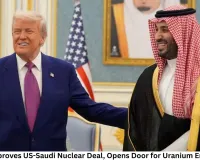
US-Saudi Nuclear Deal Is a Gamble With Global Safeguards
Saumya Gupta
The US-Saudi nuclear deal offers strategic and commercial gains, but Washington should not permit sensitive fuel-cycle activity without enforceable international inspections.
The new US-Saudi nuclear deal makes sense at one level. Saudi Arabia wants to diversify its energy mix, develop technical expertise and reduce the amount of oil and gas it burns to generate electricity. The United States wants American companies, rather than Chinese or Russian suppliers, to shape the kingdom’s civilian nuclear programme.
The agreement signed on July 22 establishes a legal framework for long-term nuclear cooperation. The US Department of Energy says it will improve access for American companies and support a multi-billion-dollar partnership while maintaining high standards of safety and non-proliferation.
Those are legitimate objectives. Saudi Arabia has the right to pursue civilian nuclear energy, and Washington has a strong interest in keeping the programme connected to American technology, training and oversight.
The Core Contradiction
The difficulty lies not in the construction of nuclear reactors but in the possible transfer of uranium-enrichment and spent-fuel reprocessing capabilities.
Both technologies have civilian applications. They can also produce material relevant to a nuclear weapons programme. This is why many countries operating nuclear power plants import reactor fuel rather than enrich uranium domestically.
Reports indicate that the deal creates a pathway for Saudi enrichment after a joint technical study. It reportedly does not contain the “gold standard” prohibition on enrichment and reprocessing accepted by the United Arab Emirates in its nuclear agreement with Washington.
That difference cannot be treated as a technical footnote. It changes the regional significance of the entire agreement.
Safeguards Must Be Public
The Trump administration says a bilateral safeguards agreement will prevent misuse. Yet the full documents have not been published, making independent assessment difficult.
More troublingly, reports say Saudi Arabia has not accepted the International Atomic Energy Agency’s Additional Protocol under the agreement. The protocol gives inspectors wider access and stronger tools to investigate undeclared nuclear activity.
A private bilateral arrangement may supplement international inspections, but it should not replace them. Nuclear safeguards must remain credible even when governments change, diplomatic relations deteriorate or regional tensions escalate.
Washington cannot simply ask the world to trust assurances that have not been subjected to transparent scrutiny.
Iran Double Standard
The timing makes the deal particularly sensitive. The United States has repeatedly identified Iran’s enrichment programme as a major security threat. It now risks appearing to accept similar technology for a close partner while opposing it for an adversary.
Saudi Arabia and Iran are not identical cases. Riyadh remains a US security partner and a member of the Nuclear Non-Proliferation Treaty. However, Crown Prince Mohammed bin Salman has previously said that Saudi Arabia would pursue a nuclear weapon if Iran acquired one. That statement inevitably affects how enrichment on Saudi territory will be viewed.
Non-proliferation rules lose authority when countries believe that strategic alignment, rather than consistent standards, determines who may control sensitive technology.
Commercial Logic Is Real
The economic case should not be dismissed. American companies could gain major contracts for reactors, fuel services, training and long-term maintenance. US participation could also provide Washington with greater visibility into the Saudi programme than it would have under a Chinese or Russian partnership.
Saudi Arabia has alternatives. Companies from China, Russia, South Korea and France have shown interest in its nuclear plans. Rejecting cooperation entirely could push Riyadh towards suppliers that offer weaker transparency or fewer political conditions.
The choice, therefore, is not between a perfect US-controlled programme and no Saudi programme. The real choice is between different models of international involvement.
That strengthens the argument for engagement—but not for lowering safeguards.
What India Should Watch
For India, the US-Saudi nuclear deal carries consequences beyond Washington and Riyadh. India has deep interests across West Asia and benefits from regional stability, predictable energy markets and secure commercial shipping.
A nuclear competition involving Saudi Arabia and Iran would add another layer of risk to an already fragile region. India should therefore support Saudi Arabia’s right to peaceful nuclear energy while favouring uniform, internationally supervised safeguards.
New Delhi should also watch how Washington explains any exception granted to Riyadh. India has consistently defended responsible access to civilian nuclear technology, but responsible access requires credible verification and clear separation between energy programmes and weapons capability.
Congress Must Set Terms
Congress should not reject the agreement merely to deny President Donald Trump a diplomatic victory. Nor should lawmakers approve it simply because it promises contracts for US companies.
They should demand publication of the relevant safeguards, acceptance of inspection measures equivalent to the Additional Protocol, strict limits on enrichment levels and quantities, and a permanent prohibition on producing weapons-grade material.
Any future enrichment facility should operate under continuous international monitoring, with automatic suspension provisions if Saudi Arabia blocks inspections or violates agreed limits.
The US-Saudi nuclear deal could become a model for combining clean energy, commercial cooperation and responsible diplomacy. Without enforceable safeguards, however, it could instead establish a dangerous principle: that sensitive nuclear capabilities are available to countries with sufficient strategic importance.
That is too great a gamble for the Middle East—and for the global non-proliferation system.
--------
🚨 Beat the News Rush – Join Now!
Get breaking alerts, hot exclusives, and game-changing stories instantly on your phone. No delays, no fluff – just the edge you need. ⚡
Tap to join:
🟢 WhatsApp Channel: Dainik Jagran MP CG
Crave more?
🅕 Facebook: Dainik Jagran MP CG English
🅧 Twitter (X): Dainik Jagran MP CG
🅘 Instagram: Dainik Jagran MP CG
Share the fire – keep your crew ahead! 🗞️🔥
US-Saudi Nuclear Deal Is a Gamble With Global Safeguards
Saumya Gupta
The new US-Saudi nuclear deal makes sense at one level. Saudi Arabia wants to diversify its energy mix, develop technical expertise and reduce the amount of oil and gas it burns to generate electricity. The United States wants American companies, rather than Chinese or Russian suppliers, to shape the kingdom’s civilian nuclear programme.
The agreement signed on July 22 establishes a legal framework for long-term nuclear cooperation. The US Department of Energy says it will improve access for American companies and support a multi-billion-dollar partnership while maintaining high standards of safety and non-proliferation.
Those are legitimate objectives. Saudi Arabia has the right to pursue civilian nuclear energy, and Washington has a strong interest in keeping the programme connected to American technology, training and oversight.
The Core Contradiction
The difficulty lies not in the construction of nuclear reactors but in the possible transfer of uranium-enrichment and spent-fuel reprocessing capabilities.
Both technologies have civilian applications. They can also produce material relevant to a nuclear weapons programme. This is why many countries operating nuclear power plants import reactor fuel rather than enrich uranium domestically.
Reports indicate that the deal creates a pathway for Saudi enrichment after a joint technical study. It reportedly does not contain the “gold standard” prohibition on enrichment and reprocessing accepted by the United Arab Emirates in its nuclear agreement with Washington.
That difference cannot be treated as a technical footnote. It changes the regional significance of the entire agreement.
Safeguards Must Be Public
The Trump administration says a bilateral safeguards agreement will prevent misuse. Yet the full documents have not been published, making independent assessment difficult.
More troublingly, reports say Saudi Arabia has not accepted the International Atomic Energy Agency’s Additional Protocol under the agreement. The protocol gives inspectors wider access and stronger tools to investigate undeclared nuclear activity.
A private bilateral arrangement may supplement international inspections, but it should not replace them. Nuclear safeguards must remain credible even when governments change, diplomatic relations deteriorate or regional tensions escalate.
Washington cannot simply ask the world to trust assurances that have not been subjected to transparent scrutiny.
Iran Double Standard
The timing makes the deal particularly sensitive. The United States has repeatedly identified Iran’s enrichment programme as a major security threat. It now risks appearing to accept similar technology for a close partner while opposing it for an adversary.
Saudi Arabia and Iran are not identical cases. Riyadh remains a US security partner and a member of the Nuclear Non-Proliferation Treaty. However, Crown Prince Mohammed bin Salman has previously said that Saudi Arabia would pursue a nuclear weapon if Iran acquired one. That statement inevitably affects how enrichment on Saudi territory will be viewed.
Non-proliferation rules lose authority when countries believe that strategic alignment, rather than consistent standards, determines who may control sensitive technology.
Commercial Logic Is Real
The economic case should not be dismissed. American companies could gain major contracts for reactors, fuel services, training and long-term maintenance. US participation could also provide Washington with greater visibility into the Saudi programme than it would have under a Chinese or Russian partnership.
Saudi Arabia has alternatives. Companies from China, Russia, South Korea and France have shown interest in its nuclear plans. Rejecting cooperation entirely could push Riyadh towards suppliers that offer weaker transparency or fewer political conditions.
The choice, therefore, is not between a perfect US-controlled programme and no Saudi programme. The real choice is between different models of international involvement.
That strengthens the argument for engagement—but not for lowering safeguards.
What India Should Watch
For India, the US-Saudi nuclear deal carries consequences beyond Washington and Riyadh. India has deep interests across West Asia and benefits from regional stability, predictable energy markets and secure commercial shipping.
A nuclear competition involving Saudi Arabia and Iran would add another layer of risk to an already fragile region. India should therefore support Saudi Arabia’s right to peaceful nuclear energy while favouring uniform, internationally supervised safeguards.
New Delhi should also watch how Washington explains any exception granted to Riyadh. India has consistently defended responsible access to civilian nuclear technology, but responsible access requires credible verification and clear separation between energy programmes and weapons capability.
Congress Must Set Terms
Congress should not reject the agreement merely to deny President Donald Trump a diplomatic victory. Nor should lawmakers approve it simply because it promises contracts for US companies.
They should demand publication of the relevant safeguards, acceptance of inspection measures equivalent to the Additional Protocol, strict limits on enrichment levels and quantities, and a permanent prohibition on producing weapons-grade material.
Any future enrichment facility should operate under continuous international monitoring, with automatic suspension provisions if Saudi Arabia blocks inspections or violates agreed limits.
The US-Saudi nuclear deal could become a model for combining clean energy, commercial cooperation and responsible diplomacy. Without enforceable safeguards, however, it could instead establish a dangerous principle: that sensitive nuclear capabilities are available to countries with sufficient strategic importance.
That is too great a gamble for the Middle East—and for the global non-proliferation system.