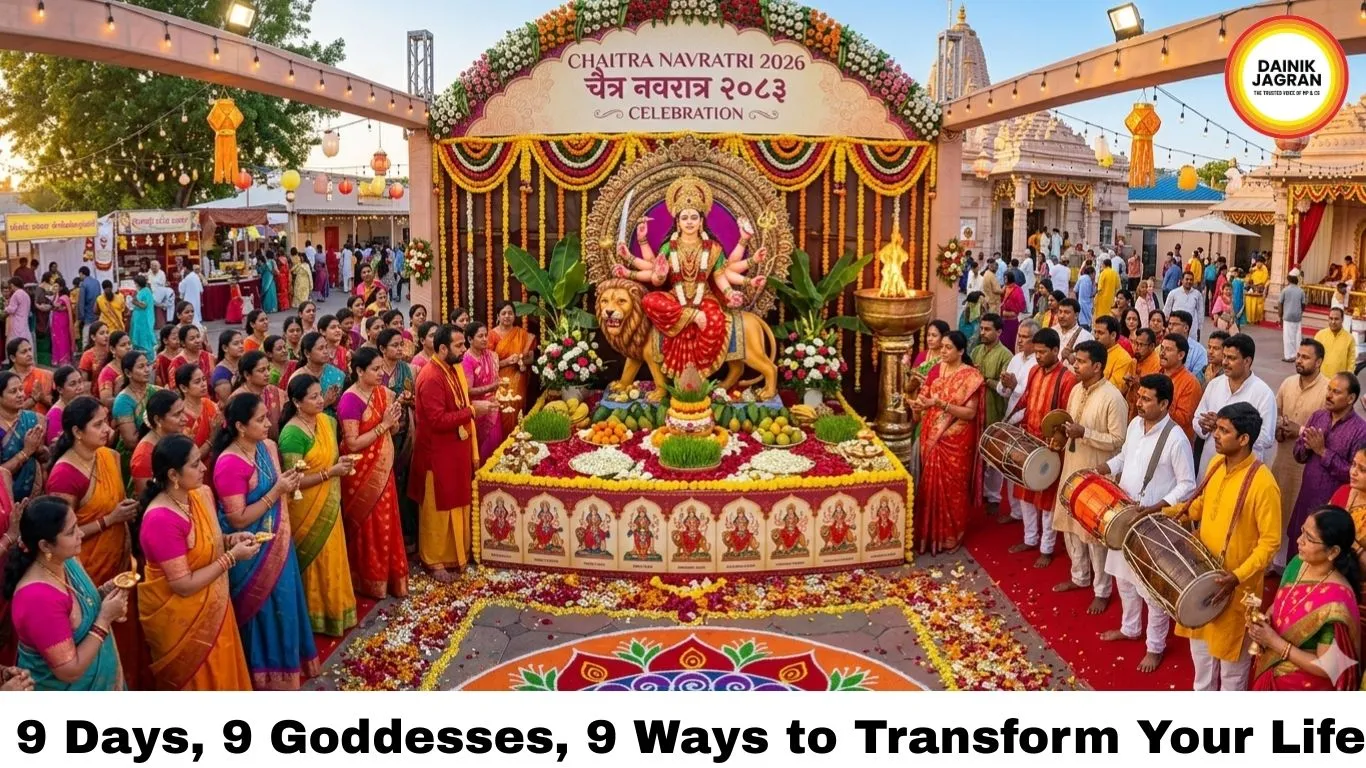
Chaitra Navratri 2026: 9 Days, 9 Goddesses, 9 Ways to Transform Your Life
Digital Desk
Nine Days That Can Change Everything — If You Let Them
Twice a year, the Hindu calendar pauses the ordinary rhythm of life and offers something extraordinary: nine consecutive days of divine feminine energy, concentrated worship, inner discipline, and collective spiritual power. The first of these sacred windows — Chaitra Navratri 2026 — begins tomorrow, March 19, and runs through March 27.
This is not merely a religious festival. For those who engage with it fully — through fasting, prayer, colour, music, and genuine inner reflection — Navratri is one of the most powerful personal transformation opportunities the entire year offers. Nine days. Nine goddess forms. Nine chances to shed what no longer serves you and step into a version of yourself that is stronger, cleaner, and more aligned with who you actually want to be.
Here is your complete guide to living Chaitra Navratri 2026 with depth, intention, and joy.
The Dates, the Muhurat, and What Makes 2026 Special
Chaitra Navratri 2026 runs from March 19 to March 27 — beginning on Chaitra Shukla Pratipada, the Hindu New Year, and culminating on Ram Navami, the birthday of Lord Rama.
This year carries rare and exceptional auspiciousness: Durga Ashtami and Ram Navami fall on the same day — March 26 — a convergence that occurs only once every several years and is considered extraordinarily powerful for worship, new beginnings, and spiritual practice.
Ghatasthapana Muhurat — Day 1, March 19:
- Primary window: 6:17 AM to 7:43 AM
- Abhijit Muhurat: 12:05 PM to 12:53 PM
The Ghatasthapana — the ceremonial installation of a clay pot representing the goddess — is the ritual that formally opens the nine days of Navratri. Performing it within the muhurat window sets the spiritual tone for everything that follows.
Nine Days, Nine Goddesses: Your Daily Guide
Each day of Navratri is dedicated to a specific form of Maa Durga — each embodying a distinct divine quality and offering a distinct spiritual lesson.
Day 1 — March 19 | Maa Shailputri | Colour: Grey Daughter of the Himalayas, Shailputri represents the groundedness and strength of the mountains. Begin your Navratri by rooting yourself — in your intentions, your home, your practice. Colour grey anchors the mind and signals readiness for transformation.
Day 2 — March 20 | Maa Brahmacharini | Colour: Orange The goddess of penance and devotion, Brahmacharini teaches that discipline is not deprivation — it is the highest form of self-respect. Wear orange, the colour of energy and enthusiasm, and commit today to one habit of genuine discipline you will carry through the nine days.
Day 3 — March 21 | Maa Chandraghanta | Colour: White Named for the crescent moon that adorns her forehead, Chandraghanta is the goddess of peace and serenity — and of the courage that comes from inner stillness. White today: clarity, calm, and the clearing of mental noise.
Day 4 — March 22 | Maa Kushmanda | Colour: Red The creator goddess who brought the universe into being with her smile, Kushmanda radiates warmth, creative power, and abundance. Red today: passion, life force, and the courage to create something new.
Day 5 — March 23 | Maa Skandamata | Colour: Royal Blue The mother of Kartikeya, the divine warrior, Skandamata embodies the ferocious, unconditional love of motherhood. Royal blue today — deep, protective, vast as the sky that holds everything.
Day 6 — March 24 | Maa Katyayani | Colour: Yellow The warrior goddess, Katyayani is invoked for courage, justice, and the defeat of inner demons. Yellow today: optimism, intellectual clarity, and the warmth of sunlight breaking through obstacles.
Day 7 — March 25 | Maa Kalaratri | Colour: Green The most fearsome form of Durga, Kalaratri destroys ignorance, illusion, and all that is false within us. Green today — the colour of growth that emerges precisely from destruction, from clearing, from the dark soil after a storm.
Day 8 — March 26 | Maa Mahagauri | Colour: Peacock Green The goddess of purity and grace, Mahagauri embodies the divine feminine at its most radiant. This day carries double power in 2026 — Durga Ashtami and Ram Navami combined. Perform your most significant puja of the entire Navratri today.
Day 9 — March 27 | Maa Siddhidatri | Colour: Purple The final and most complete form — the goddess of all siddhis, all accomplishments, all powers. Purple today: wisdom, completion, and the deep satisfaction of having stayed the course for nine full days.
Fasting: The Why Behind the What
Navratri fasting is perhaps the most misunderstood aspect of the festival — reduced in popular culture to a list of what you cannot eat, when its actual purpose is far more profound.
Fasting during Navratri is an Ayurvedic seasonal cleanse built into the cultural calendar. The transition from winter to summer — happening precisely now in late March — is one of the two major seasonal junctions when the digestive system naturally slows and the body benefits enormously from lighter, simpler, easily digestible food. The Navratri fast, stripped of heavy grains, meat, alcohol, onion, and garlic, is essentially a nine-day anti-inflammatory, gut-healing protocol wrapped in the language of devotion.
What you can eat — and what to make with it:
Sama rice — also called barnyard millet — is the staple grain of Navratri fasting and is far more nutritious than it is given credit for. Sama khichdi with ghee, sendha namak, and a handful of cashews is a warm, complete, protein-rich meal. Sama rice kheer — cooked in full-fat milk with jaggery and cardamom — is both a dessert and a nutritional powerhouse.
Kuttu ka atta — buckwheat flour — makes outstanding rotis and pakoras. Kuttu pakoras with coriander chutney are a Navratri classic for good reason: deeply satisfying, crispy, and genuinely delicious.
Sabudana — tapioca pearls — soaked overnight and cooked with ghee, cumin, crushed peanuts, and a squeeze of lemon make the perfect Navratri breakfast or light meal. High in carbohydrates for sustained energy, easy on the digestive system, and endlessly versatile.
Fresh fruits, full-fat milk, yoghurt, makhana — fox nuts — roasted in ghee with rock salt and spices, sweet potatoes, and all root vegetables are your core pantry during these nine days. Eat them with gratitude and without apology. This is not deprivation. This is nourishment.
The Navratri Wellness Practice: Beyond the Fast
The nine days of Chaitra Navratri align with one of the most powerful Ayurvedic seasonal transitions of the year — and the tradition offers a complete wellness protocol for those willing to follow it.
Wake before sunrise each day. The Brahma Muhurat — approximately 4:30 AM to 6:00 AM — is considered the most spiritually potent time of the day, when the mind is naturally calm and receptive and the air carries a quality of stillness that is difficult to find at any other hour. Even ten minutes of silence, prayer, or simple deep breathing in this window will shift the quality of your entire day.
Follow your morning practice with oil pulling — swishing a tablespoon of sesame or coconut oil in your mouth for ten to fifteen minutes — a traditional Ayurvedic oral hygiene and detoxification practice that is extraordinarily effective and takes nothing but patience.
Reduce or eliminate screens after sunset during the nine days if you can. Navratri evenings are made for aarti, for the sound of dhol and devotional music, for lighting diyas, for sitting quietly with family. The contrast between the connected quiet of Navratri evenings and the ordinary digital noise of your regular nights will surprise you.
Dressing the Nine Days: Colour as Spiritual Practice
The Navratri colour tradition is not fashion — it is a daily act of alignment with the specific divine energy of each day. When you dress in the day's colour consciously — not because someone told you to but because you understand what it represents — clothing becomes a form of walking prayer.
This year, invest in at least three or four outfits in the Navratri colour palette rather than forcing the same two into rotation. Ethnic wear in cotton or chanderi is ideal for the warming March weather — light, breathable, and naturally beautiful. Pair each outfit with simple temple jewellery, fresh flowers in the hair if possible, and the specific intention of each day held in your mind as you dress.
For Ashtami — the most powerful day of this year's Navratri — wear your most beautiful outfit. The goddess on her most auspicious day deserves your full devotion, expressed in every dimension including how you present yourself to the world.
Kanya Puja: The Most Human Ritual of Navratri
On Ashtami or Navami — March 26 or 27 — the tradition of Kanya Puja invites you to invite young girls between the ages of two and ten into your home, wash their feet, seat them with care, feed them with the best food your kitchen can produce — Puri, Halwa, Chana — and offer them gifts and new clothes.
The theology behind Kanya Puja is radical in the most beautiful way: the divine feminine is not only in the temple. She is in every girl child. Worshipping her in human form — with the same reverence, the same care, the same generosity you would offer the goddess — is a practice that transforms not just the child being honoured but the person doing the honouring.
In a country where the girl child still faces profound inequalities in homes and communities across every social stratum, the ancient instruction to see divinity in her face is not merely religious teaching. It is a call to conscience.
Opinion: Nine Days to Become Who You Want to Be
Chaitra Navratri arrives this year at a moment when many of us — navigating a world that has felt unusually heavy, unusually uncertain, unusually loud — are quietly desperate for exactly what this festival offers: structure, beauty, discipline, and the reassurance that something larger than our individual anxieties is present and powerful.
The nine forms of the goddess are not separate deities. They are nine aspects of the same divine force — and nine aspects of yourself. Shailputri's groundedness, Brahmacharini's discipline, Chandraghanta's peace, Kushmanda's creative joy, Skandamata's fierce love, Katyayani's courage, Kalaratri's radical honesty, Mahagauri's purity, Siddhidatri's completeness — these are not qualities you pray to receive from outside. They are qualities you already carry, waiting to be activated.
Nine days of fasting, prayer, colour, music, early rising, and intentional living will not fix the world. But they will — if you do them honestly — change you. And changed people, one at a time, are still how the world gets better.