


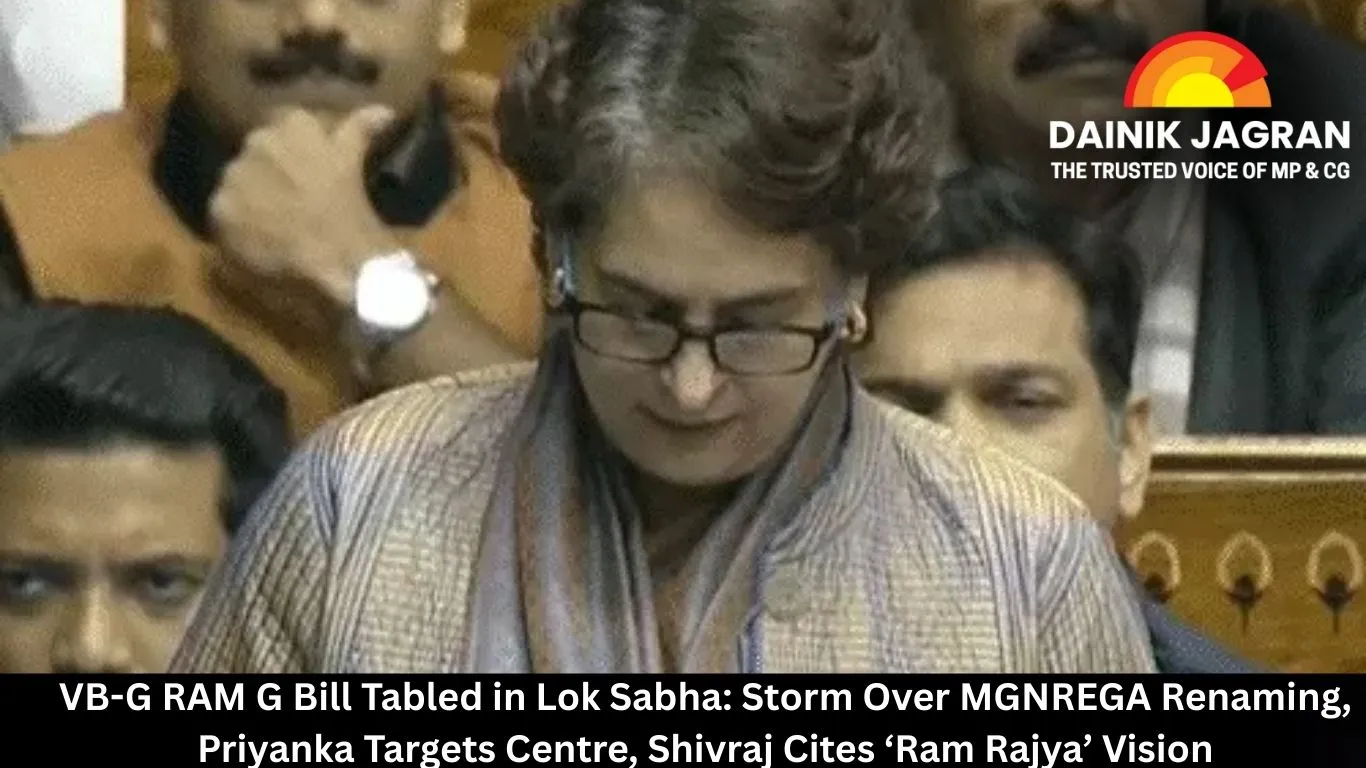
VB-G RAM G Bill Tabled in Lok Sabha: Storm Over MGNREGA Renaming, Priyanka Targets Centre, Shivraj Cites ‘Ram Rajya’ Vision
Digital Desk
VB-G RAM G Bill Sparks Row in Parliament
The government’s new VB-G RAM G Bill, 2025, aimed at overhauling the rural job guarantee framework and replacing MGNREGA, triggered uproar in Lok Sabha on Tuesday as Opposition parties accused the Centre of weakening Panchayati Raj and “erasing” Mahatma Gandhi’s legacy. Union Agriculture and Rural Development Minister Shivraj Singh Chouhan tabled the Viksit Bharat – Guarantee for Employment and Livelihood Mission (Rural) (VB-G RAM G) Bill amid loud protests, forcing the House to be adjourned till 2 pm.
The Bill proposes a statutory guarantee of 125 days of wage employment per rural household every year, up from 100 days under MGNREGA, and is pitched by the government as central to the “Viksit Bharat 2047” rural development vision. But Opposition leaders warned that the change is not just about numbers and name, arguing it alters the spirit, funding pattern and democratic control of India’s flagship rural jobs law.
Priyanka Gandhi: ‘Against Spirit of Panchayati Raj’
Leading the Opposition attack, Congress MP Priyanka Gandhi said her party firmly opposes the VB-G RAM G Bill and questioned the “obsession” with renaming schemes instead of strengthening them. She said MGNREGA had, for 20 years, provided a legal guarantee of work to rural households with cross-party support and called it a “revolutionary law” visible on the ground in every constituency.
Priyanka argued that under the new framework, the legal guarantee becomes effectively “demand-driven” by budget caps decided in advance by the Centre, which she claimed would weaken the right to work and dilute Panchayati Raj. She urged the government to withdraw the Bill, hold wider consultations and at least send it to a Standing Committee, warning that no law should be drafted to satisfy “personal ambition, obsession or prejudice”.
Shivraj Singh Cites ‘Ram Rajya’, Defends 125-Day Guarantee
Defending the VB-G RAM G Bill, Shivraj Singh Chouhan said Mahatma Gandhi “resides in our hearts” and that the government is in fact expanding rural protection by raising the work guarantee to 125 days and significantly increasing allocations compared to UPA years. He said more than ₹1.5 lakh crore has been provided for the revamped mission and insisted that renaming does not mean disrespect, pointing out that Congress itself had earlier renamed the Jawahar Rozgar Yojana.
Chouhan framed the Bill as aligned with the vision of “Ram Rajya”, saying it honours the poor and fulfills Gandhi and Deendayal Upadhyaya’s resolve to prioritise the most vulnerable. The government’s pitch is that VB-G RAM G will link wage work to durable rural assets, water security and climate resilience, moving beyond mere short-term relief to long-term rural transformation.
Tharoor, SP, NCP Raise Gandhi, Federalism Concerns
Congress MP Shashi Tharoor opposed the VB-G RAM G Bill on the floor of the House, arguing that removing Mahatma Gandhi’s name was “wrong in itself” because Gandhi’s association with the earlier law symbolised social justice, not partisan politics. Quoting, “Ram ka naam badnaam na karo”, he urged the government not to drag religious symbolism into a socio-economic programme.
Samajwadi Party MP Dharmendra Yadav said the new Bill shifts more financial burden to states while cutting the Centre’s share and warned that “no one will tolerate disrespect to Gandhi ji”, recalling that Gandhi’s last words were “Hey Ram”. NCP MP Supriya Sule supported policy reform but demanded the Bill be sent to a Standing Committee and objected to Gandhi’s name being dropped from the rural jobs framework.
Why VB-G RAM G Matters Now
The VB-G RAM G Bill comes at a time when rural distress, climate shocks and migration remain key political and economic challenges, making any change to India’s core job guarantee law highly consequential. Supporters argue that by guaranteeing more workdays, tightening timelines for wage payments and focusing on durable infrastructure, the Bill could boost incomes and strengthen rural resilience.
Critics, however, fear that tighter central control over funds, renaming and altered design may erode the demand-driven, rights-based character of MGNREGA and undermine local self-governance. With Parliament sharply divided and the Lok Sabha already witnessing adjournments over the issue, the VB-G RAM G Bill is set to remain at the centre of the political debate through the Winter Session and beyond.
.jpg)

.jpg)




