

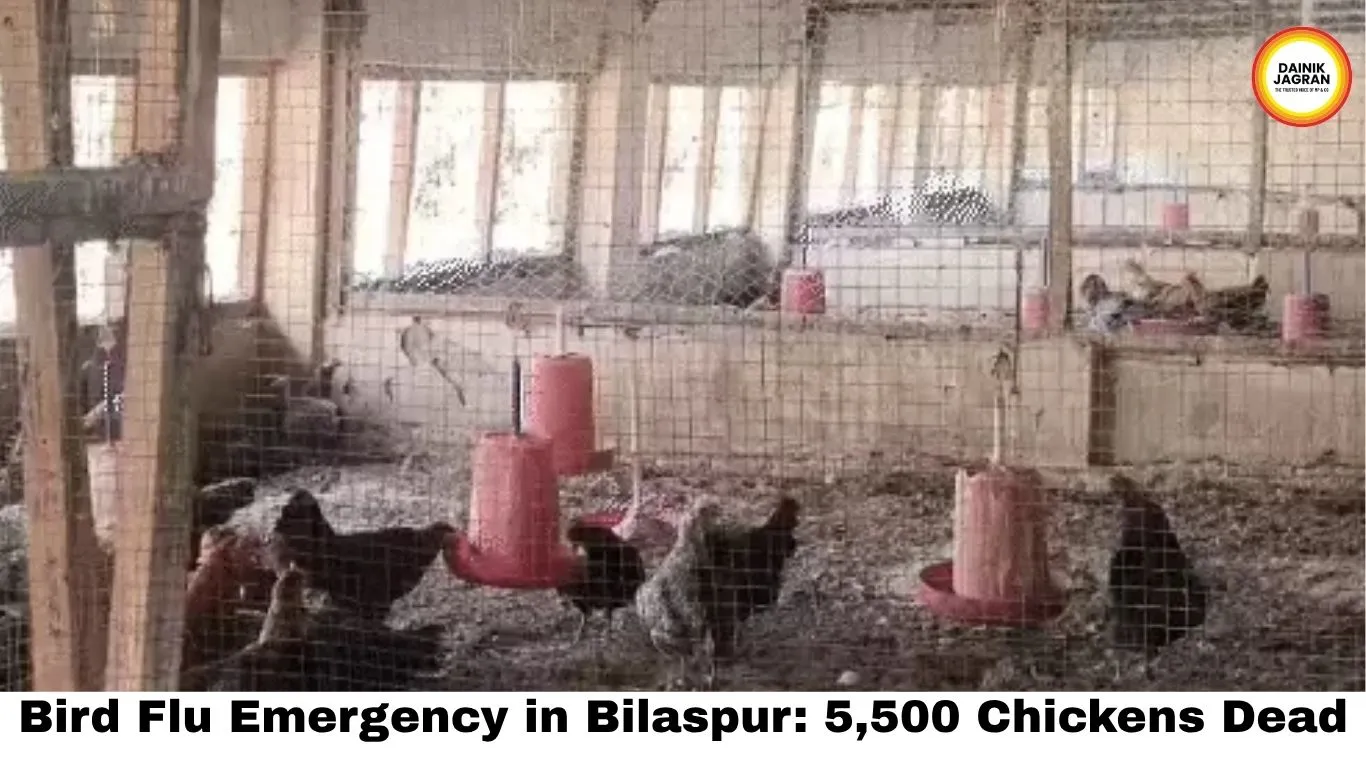
Bird Flu Emergency in Bilaspur: 5,500 Chickens Dead, 22,000 Birds Culled, Chicken & Egg Sales Banned in 10-km Zone
Digital Desk
H5N1 Bird Flu confirmed at Bilaspur's Koni government farm. 5,500 chickens dead, 22,808 birds culled. 10km ban on chicken & egg sales. Public advised to avoid poultry for 21 days.
A serious bird flu emergency has gripped Bilaspur district in Chhattisgarh after the deadly H5N1 strain of Avian Influenza was officially confirmed at a government-run poultry farm in the Koni area. In less than a week, over 5,500 chickens have died, more than 22,000 birds have been culled, and authorities have imposed a sweeping ban on the sale, transport, and delivery of chicken and eggs across a 10-kilometre radius of the affected site.
Health officials have begun antiviral treatment for farm workers and their families, a 24-hour control room has been activated, and the public has been urged to avoid consuming chicken for at least the next 21 days.
How It Started: Mystery Deaths at Koni Farm
The outbreak began quietly. Between March 19 and March 24, chickens at the government poultry farm in Koni, Bilaspur began dying in unusually large numbers. The farm housed a total of 5,037 birds. By the time authorities took notice, approximately 4,400 to 4,744 had already perished — an alarming mortality rate that triggered immediate alarm.
Samples from the dead birds were rushed to laboratories in Bhopal and Pune on Monday, March 24. By Tuesday night, the Bhopal lab confirmed what officials had feared: the highly contagious H5N1 strain of Avian Influenza was responsible for the mass deaths.
The confirmation set off a rapid and multi-departmental emergency response.
Immediate Response: Culling, Containment, Closure
Bilaspur District Collector Sanjay Agrawal moved swiftly. Acting under the Revised Action Plan for Prevention and Containment of Avian Influenza (2021), he issued a series of immediate directives.
The area within a 1-kilometre radius of the affected farm was declared an infected zone. The 1-to-10 km belt surrounding it was designated a surveillance zone. Within both zones, the sale, storage, transport, and door-to-door delivery of all poultry products — including live chickens and eggs — has been banned with immediate effect. All shops dealing in these items have been ordered to shut temporarily.
A rapid response team deployed by the Veterinary Department carried out scientific culling across infected and suspected areas. The scale of the operation was significant: a total of 22,808 birds, 25,896 eggs, and approximately 79 quintals of stored grain were destroyed in accordance with government biosecurity guidelines. All destroyed material was buried on-site following prescribed safety protocols.
Health Measures: Workers Treated, Public Surveyed
The Chief Medical and Health Officer of Bilaspur, Dr. Shubha Garewal, confirmed that antiviral treatment has been initiated for workers at the affected farm, as well as for their family members. Ongoing surveys in surrounding areas are identifying anyone showing symptoms, and medication is being provided immediately to those flagged during screening.
In an advisory to the general public, Dr. Garewal stated that residents should refrain from consuming chicken for the next 21 days as a precautionary measure. While there is no confirmed case of human infection at this time, H5N1 is classified as a zoonotic virus — one that can, under certain conditions, jump from birds to humans — making containment and public vigilance essential.
What is H5N1 and Why Does It Matter?
H5N1 is the most dangerous strain of Avian Influenza currently circulating globally. It has a very high mortality rate in infected bird populations, as seen in Bilaspur where virtually the entire flock perished in under a week. The virus is primarily transmitted between birds through direct contact with infected birds or contaminated surfaces, water, and feed.
Human infection is rare but has been documented in cases involving direct, prolonged contact with infected poultry or their droppings. The global concern around H5N1 has intensified in recent years because the virus has demonstrated the ability to evolve — and scientists monitor it closely for signs of mutations that could make human-to-human transmission possible.
For ordinary consumers, the risk from properly cooked poultry and eggs is negligible, as the virus is killed at standard cooking temperatures. The real concern is in farms, markets, and live poultry environments where direct contact with infected birds can occur.
Control Room Activated, Helpline Operational
The district administration has set up a dedicated bird flu control room at the Bilaspur Collectorate. A 24-hour helpline is now operational at 07752-251000. Residents can also contact the following officials directly for emergencies or to report suspicious poultry deaths:
Dr. G.S. Tanwar (In-charge): 88278 17931 Dr. Virendra Pillay (Deputy In-charge): 94061 58769
Collector Agrawal has warned that violations of containment rules — such as attempting to sell or transport poultry products from within the restricted zone — will attract stringent legal action. He has also urged residents to avoid spreading rumours and to rely only on official information.
Poultry Traders Bear the Brunt
For the hundreds of poultry traders, egg vendors, and small shop owners operating within the 10-km surveillance zone, the ban has meant an immediate and complete halt to their livelihoods. There is no official announcement yet of compensation or support for affected traders, though advocacy groups in the district have reportedly begun approaching the Collector's office to seek relief.
The broader poultry market in Bilaspur has also seen panic-driven declines in footfall and sales, extending well beyond the official surveillance zone. Consumer anxiety about bird flu tends to spread faster than the virus itself, and the administration faces the challenge of reassuring the wider public while maintaining strict containment.
A Broader Pattern: Bird Flu Spreading Across India
Bilaspur is not alone. In recent months, bird flu outbreaks have been reported in Bihar — where hundreds of crows were found dead across multiple districts — and at Guindy Children's Park in Chennai, which was temporarily closed following a scare. H5N1 has been detected in wild bird populations across multiple Indian states, and veterinary authorities nationwide are on heightened alert.
The Bilaspur outbreak at a government-run farm, in particular, raises questions about biosecurity protocols at state-owned poultry facilities. If the virus can establish itself in a controlled, government-managed environment, the vulnerability of thousands of smaller, less regulated private farms across the country becomes a serious concern.
What Should You Do Right Now?
If you live in or near the Koni area of Bilaspur, here is what you need to know. Do not purchase, consume, or handle poultry or eggs sourced from within the 10-km restricted zone. If you notice unusual or sudden deaths among birds in your neighbourhood or nearby farms, report it immediately to the helpline. Maintain good hand hygiene, particularly after handling raw poultry. Follow only official government advisories and do not share unverified information on social media.
For those outside the restricted zone, there is no need for alarm. Continue consuming properly cooked poultry and eggs from verified sources. The virus does not survive thorough cooking.
Swift Action, But Vigilance Needed
The speed with which Bilaspur authorities responded — confirming the outbreak, declaring zones, culling birds, activating a helpline, and beginning human treatment all within 48 hours — reflects a reasonably well-drilled public health response. The 2021 Avian Influenza Action Plan appears to be working as intended.
But the outbreak is not over. Surveillance must be maintained rigorously across the full 10-km zone. Compensation for affected farmers and traders must follow quickly. And the investigation into how H5N1 entered a government-managed farm in the first place must yield answers — not just for Bilaspur, but as a lesson for poultry biosecurity across Chhattisgarh and India.
Bird Flu Emergency in Bilaspur: 5,500 Chickens Dead, 22,000 Birds Culled, Chicken & Egg Sales Banned in 10-km Zone
Digital Desk
A serious bird flu emergency has gripped Bilaspur district in Chhattisgarh after the deadly H5N1 strain of Avian Influenza was officially confirmed at a government-run poultry farm in the Koni area. In less than a week, over 5,500 chickens have died, more than 22,000 birds have been culled, and authorities have imposed a sweeping ban on the sale, transport, and delivery of chicken and eggs across a 10-kilometre radius of the affected site.
Health officials have begun antiviral treatment for farm workers and their families, a 24-hour control room has been activated, and the public has been urged to avoid consuming chicken for at least the next 21 days.
How It Started: Mystery Deaths at Koni Farm
The outbreak began quietly. Between March 19 and March 24, chickens at the government poultry farm in Koni, Bilaspur began dying in unusually large numbers. The farm housed a total of 5,037 birds. By the time authorities took notice, approximately 4,400 to 4,744 had already perished — an alarming mortality rate that triggered immediate alarm.
Samples from the dead birds were rushed to laboratories in Bhopal and Pune on Monday, March 24. By Tuesday night, the Bhopal lab confirmed what officials had feared: the highly contagious H5N1 strain of Avian Influenza was responsible for the mass deaths.
The confirmation set off a rapid and multi-departmental emergency response.
Immediate Response: Culling, Containment, Closure
Bilaspur District Collector Sanjay Agrawal moved swiftly. Acting under the Revised Action Plan for Prevention and Containment of Avian Influenza (2021), he issued a series of immediate directives.
The area within a 1-kilometre radius of the affected farm was declared an infected zone. The 1-to-10 km belt surrounding it was designated a surveillance zone. Within both zones, the sale, storage, transport, and door-to-door delivery of all poultry products — including live chickens and eggs — has been banned with immediate effect. All shops dealing in these items have been ordered to shut temporarily.
A rapid response team deployed by the Veterinary Department carried out scientific culling across infected and suspected areas. The scale of the operation was significant: a total of 22,808 birds, 25,896 eggs, and approximately 79 quintals of stored grain were destroyed in accordance with government biosecurity guidelines. All destroyed material was buried on-site following prescribed safety protocols.
Health Measures: Workers Treated, Public Surveyed
The Chief Medical and Health Officer of Bilaspur, Dr. Shubha Garewal, confirmed that antiviral treatment has been initiated for workers at the affected farm, as well as for their family members. Ongoing surveys in surrounding areas are identifying anyone showing symptoms, and medication is being provided immediately to those flagged during screening.
In an advisory to the general public, Dr. Garewal stated that residents should refrain from consuming chicken for the next 21 days as a precautionary measure. While there is no confirmed case of human infection at this time, H5N1 is classified as a zoonotic virus — one that can, under certain conditions, jump from birds to humans — making containment and public vigilance essential.
What is H5N1 and Why Does It Matter?
H5N1 is the most dangerous strain of Avian Influenza currently circulating globally. It has a very high mortality rate in infected bird populations, as seen in Bilaspur where virtually the entire flock perished in under a week. The virus is primarily transmitted between birds through direct contact with infected birds or contaminated surfaces, water, and feed.
Human infection is rare but has been documented in cases involving direct, prolonged contact with infected poultry or their droppings. The global concern around H5N1 has intensified in recent years because the virus has demonstrated the ability to evolve — and scientists monitor it closely for signs of mutations that could make human-to-human transmission possible.
For ordinary consumers, the risk from properly cooked poultry and eggs is negligible, as the virus is killed at standard cooking temperatures. The real concern is in farms, markets, and live poultry environments where direct contact with infected birds can occur.
Control Room Activated, Helpline Operational
The district administration has set up a dedicated bird flu control room at the Bilaspur Collectorate. A 24-hour helpline is now operational at 07752-251000. Residents can also contact the following officials directly for emergencies or to report suspicious poultry deaths:
Dr. G.S. Tanwar (In-charge): 88278 17931 Dr. Virendra Pillay (Deputy In-charge): 94061 58769
Collector Agrawal has warned that violations of containment rules — such as attempting to sell or transport poultry products from within the restricted zone — will attract stringent legal action. He has also urged residents to avoid spreading rumours and to rely only on official information.
Poultry Traders Bear the Brunt
For the hundreds of poultry traders, egg vendors, and small shop owners operating within the 10-km surveillance zone, the ban has meant an immediate and complete halt to their livelihoods. There is no official announcement yet of compensation or support for affected traders, though advocacy groups in the district have reportedly begun approaching the Collector's office to seek relief.
The broader poultry market in Bilaspur has also seen panic-driven declines in footfall and sales, extending well beyond the official surveillance zone. Consumer anxiety about bird flu tends to spread faster than the virus itself, and the administration faces the challenge of reassuring the wider public while maintaining strict containment.
A Broader Pattern: Bird Flu Spreading Across India
Bilaspur is not alone. In recent months, bird flu outbreaks have been reported in Bihar — where hundreds of crows were found dead across multiple districts — and at Guindy Children's Park in Chennai, which was temporarily closed following a scare. H5N1 has been detected in wild bird populations across multiple Indian states, and veterinary authorities nationwide are on heightened alert.
The Bilaspur outbreak at a government-run farm, in particular, raises questions about biosecurity protocols at state-owned poultry facilities. If the virus can establish itself in a controlled, government-managed environment, the vulnerability of thousands of smaller, less regulated private farms across the country becomes a serious concern.
What Should You Do Right Now?
If you live in or near the Koni area of Bilaspur, here is what you need to know. Do not purchase, consume, or handle poultry or eggs sourced from within the 10-km restricted zone. If you notice unusual or sudden deaths among birds in your neighbourhood or nearby farms, report it immediately to the helpline. Maintain good hand hygiene, particularly after handling raw poultry. Follow only official government advisories and do not share unverified information on social media.
For those outside the restricted zone, there is no need for alarm. Continue consuming properly cooked poultry and eggs from verified sources. The virus does not survive thorough cooking.
Swift Action, But Vigilance Needed
The speed with which Bilaspur authorities responded — confirming the outbreak, declaring zones, culling birds, activating a helpline, and beginning human treatment all within 48 hours — reflects a reasonably well-drilled public health response. The 2021 Avian Influenza Action Plan appears to be working as intended.
But the outbreak is not over. Surveillance must be maintained rigorously across the full 10-km zone. Compensation for affected farmers and traders must follow quickly. And the investigation into how H5N1 entered a government-managed farm in the first place must yield answers — not just for Bilaspur, but as a lesson for poultry biosecurity across Chhattisgarh and India.


