


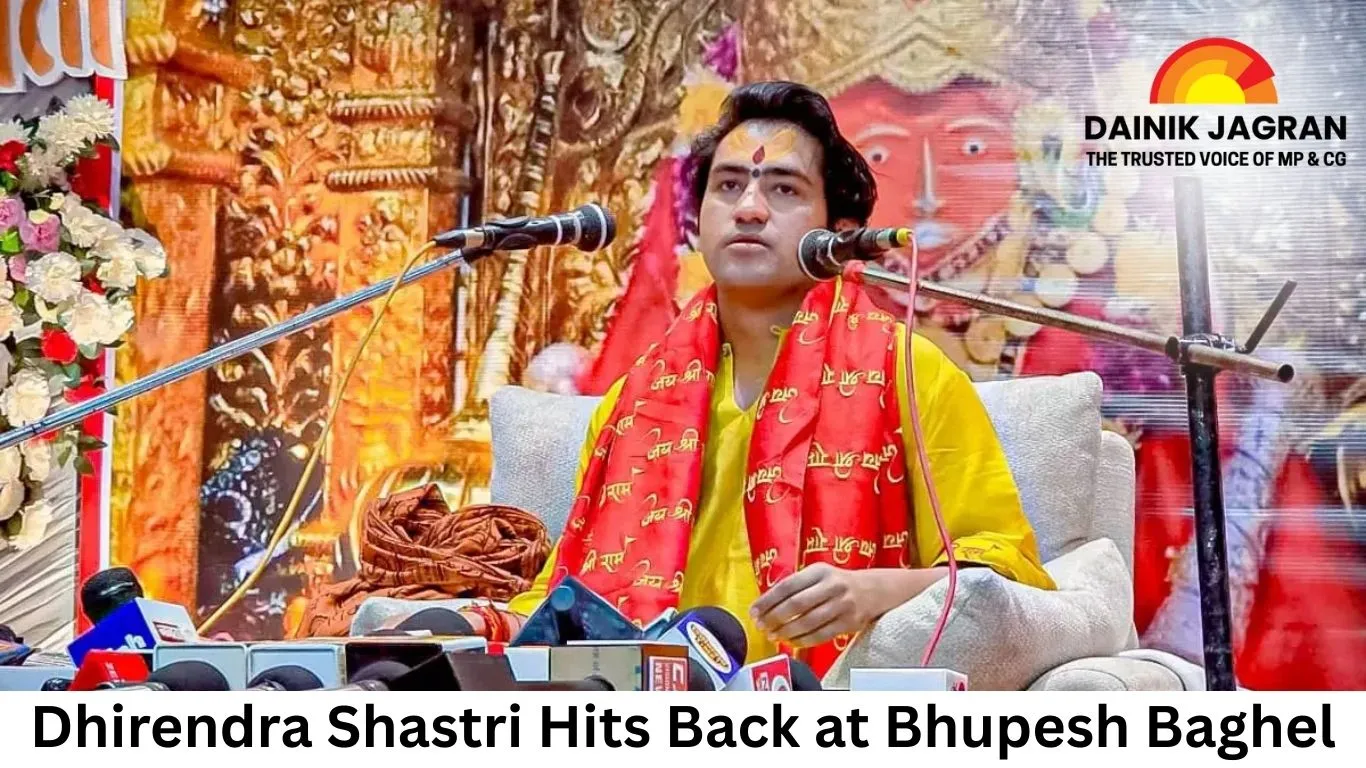
Dhirendra Shastri Hits Back at Bhupesh Baghel: Hindu Unity, Devotion, and Nationalism Are Not Blind Faith
Digital Desk
He stated that if efforts to unite Hindus, spread bhakti (devotion), and instill nationalism are labeled as superstition, then those who believe so ought to leave the country.
Shastri emphasized he is not a political figure and typically refrains from commenting on political remarks, but found it essential to respond here. He reiterated that bringing Hindus together, encouraging Hanuman worship, and nurturing patriotic sentiments cannot be dismissed as blind faith.
These comments were made during a media interaction on Thursday, just before the start of his Hanumant Katha in Bhilai.
Bangladesh Shows Being Hindu Can Be Criminalized; India Must Stay Alert
Referring to recent events in Bangladesh, Shastri highlighted that a Hindu was reportedly burned alive merely for his faith just days ago. In today's Bangladesh, simply being Hindu has turned into a punishable offense. He appealed to Indian Sanatanis to treat this as a grave warning.
He cautioned that India could soon face a similar scenario if complacency persists. Now is the moment to advocate strongly for Hindu solidarity and the concept of a Hindu Rashtra.
Hindus Now Minorities in 9 States; One Community Surged from 6% to 28%
Shastri pointed out demographic shifts: one group has expanded from 6% to 28%, while Hindus have dropped from around 90% to 80%. If this doesn't signal alarm, he suggested studying Bangladesh's situation closely.
Mentioning 'love jihad,' he warned that the real peril will hit home when daughters and sisters become victims. With Hindus already reduced to minorities in nine Indian states, unified Sanatan action is urgently needed.
Tackling Conversions: Affluent Hindus Must Support the Underprivileged
On religious conversions, Shastri observed that Chhattisgarh's Hindu community is gradually awakening. He frequently visits the state and plans a future Katha in Surguja-Jashpur, staging it directly opposite Asia's largest church.
He outlined three primary drivers of conversions:
- Illiteracy: Greater emphasis on education is crucial.
- Poverty: Prosperous Hindus should "adopt" poorer families and villages to provide support.
- Misplaced beliefs: He will persist with his divine courts to bolster unwavering faith in Lord Hanuman.
Voluntary Ghar Wapsi Planned During Katha
Regarding 'ghar wapsi' (reconversion to Hinduism), Shastri noted that interested individuals have voluntarily submitted forms. A special divine court on December 27 will facilitate returns for those drawn naturally to Sanatan Dharma—interested parties can reach out to organizers.
He also mentioned upcoming padyatras across Chhattisgarh, currently in planning. Thanking the Muslim community for their welcoming gestures, he affirmed that all born in India are inherently Sanatan and part of the broader Hindu fold.
Unwavering Loyalty to the Constitution
Addressing questions on constitutional adherence, Shastri affirmed complete devotion: his forebears embraced it, and he does too. He described his life philosophy as holding the Constitution in one hand and the Gita-Ramayana in the other. India's Constitution, which opens with an illustration of Ram Darbar, perfectly aligns with this vision.
Life, he said, balances order (via the Constitution) and belief (via Ram Darbar). A Hindu Rashtra, in his view, is not unconstitutional—it lives in hearts, not merely on documents.
Prefer Sanatan Board; Otherwise, Scrap Waqf Board
On Waqf Board expansions, Shastri advocated for a parallel Sanatan Board. Failing that, he argued, disbanding the Waqf Board would be the superior option.
He deplored lingering casteism and untouchability as tragedies for Hindus, insisting national advancement stems from nationalism, not divisive caste politics.
Recapping Bhupesh Baghel's Original Criticism
In Durg, the former CM had targeted the BJP, RSS, Pradeep Mishra, and Dhirendra Shastri, claiming the visiting "maharajs" focus solely on rituals and superstitions rather than genuine teachings on Shiva or Hanuman.
Baghel argued that rising education levels are paradoxically fueling greater superstition, with ordinary devotees often more knowledgeable about true worship.
No Threat to Hindus Historically, Says Baghel
Baghel maintained that Hindus faced no existential danger under Mughal, Sultanate, or even Muslim-led rule, nor during the independence movement or post-1947.
The narrative of "Hindus in peril," he alleged, emerged only after RSS and BJP ascended to power—a fear tactic to sustain rule. In a sarcastic jab, he noted how proponents now prefer "Sanatani" over plain "Hindu."




.jpg)




