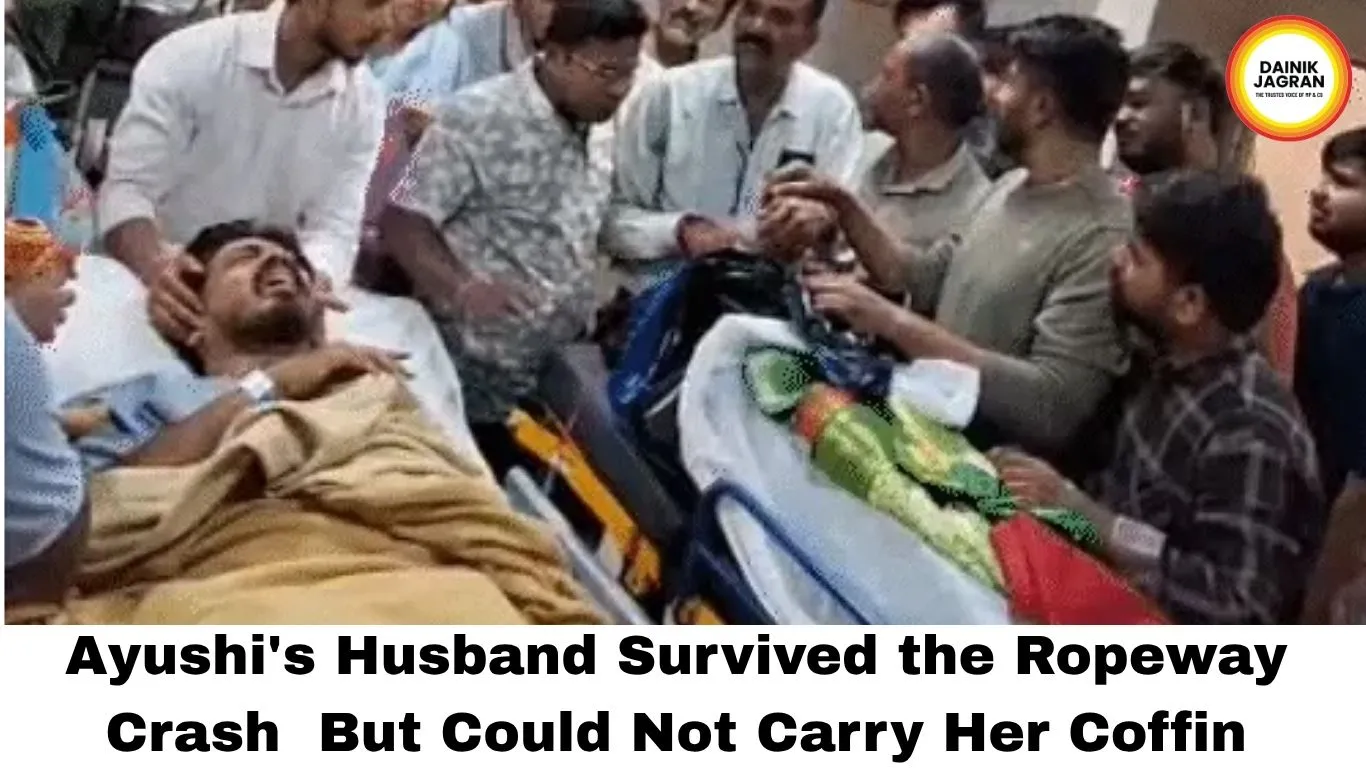
Navratri Tragedy: Ayushi's Husband Survived the Ropeway Crash — But Could Not Carry Her Coffin
Digital Desk
28-year-old Ayushi Satkar died in the Khallari Mata ropeway crash in Chhattisgarh. Her injured husband couldn't carry her coffin. Here's the full story.
Navratri Tragedy: Ayushi's Husband Survived the Ropeway Crash — But Could Not Carry Her Coffin
They went together to seek a goddess's blessings. Only one came home. And he was too broken — in body and soul — to carry her.
A Morning Prayer That Became a Funeral
The first Sunday of Chaitra Navratri 2026 was supposed to be auspicious.
Ayushi Satkar, 28, from Raipur, had come with her husband Rishabh Dhavre, 29, and a teenage relative to the Khallari Mata Temple in Mahasamund — a hilltop shrine sitting nearly 1,100 feet above the plains of Chhattisgarh. Thousands of devotees make this journey every Navratri, climbing 900 steps or riding the ropeway that carries pilgrims up and down the steep hillside.
At around 10 AM on March 22, as Ayushi's trolley descended the hillside carrying seven devotees, the main cable snapped. The trolley plunged nearly 200 to 300 feet.
Ayushi died on the spot. Her husband survived — injured, hospitalised, devastated.
And when it came time to carry her coffin home, Rishabh could not. His body, broken in the same fall that took his wife, would not allow it.
The Accident: What We Know
The Khallari Mata ropeway had undergone maintenance between March 16 and 18, just days before the accident, resuming operations right before the Navratri rush began. On the morning of the tragedy, the temple was packed — as it always is on the first Sunday of the nine-day festival.
The trolley was mid-descent when the cable gave way without warning. Passengers had no time to brace. The trolley overturned on impact, throwing devotees across the hillside.
Among the injured were Rishabh Dhavre, teenage relative Chhayansh Dhavre (16), Govind Swami (47), Namita Swami (48), and two children — Kushmita Swami (10) and Manshvi Godaria (12). Four of the critically injured were referred to hospitals in Raipur. At least one person remained in critical condition as of Sunday evening.
The ropeway service was immediately suspended and remains shut pending a full technical inspection.
The Grief Behind the Headline
Every news story about infrastructure failure carries a number — one dead, seven injured, seventeen wounded. But behind this particular number is a 29-year-old man who went to a temple with his wife on a festival morning and returned without her. A man whose injuries were severe enough that he could not perform the most final, most human act of grief — carrying her to her burial.
This is what negligence, if proven, actually looks like. Not just a snapped cable. A husband standing at a funeral, unable to lift the weight of what he lost.
The Larger Safety Failure
This is not the first time a ropeway has failed at a Chhattisgarh pilgrimage site. A similar accident occurred last year at a ropeway near the Bamleshwari Devi hill shrine in Rajnandgaon district. That incident injured a local politician. It made news for two days. Then everyone moved on.
Nothing changed. And so the cable snapped again.
Chief Minister Vishnu Deo Sai expressed grief and ordered a high-level inquiry. He stated that those found responsible would not be spared. These are the right words. But India has heard them before — at Morbi, at Vaishno Devi, at every pilgrimage site where infrastructure failed during peak festival load and families were destroyed.
The pattern is familiar: maintenance done in a hurry before a festival, capacity exceeded under religious rush, cable or structure failing under load it was never properly certified to carry.
What Must Change
Ropeway safety at Indian pilgrimage sites cannot remain a post-tragedy conversation. These systems carry elderly devotees, children, and families who physically cannot manage the alternative — in Khallari's case, 900 steps. They are not optional infrastructure. For many, they are the only way to reach their god.
Every ropeway at every major pilgrimage site in India must have independent third-party safety certification before each festival season — not just operator-reported maintenance. Load limits must be enforced. Inspections must be unannounced.
Ayushi Satkar went to Khallari Mata to pray. The goddess did not fail her. The system did.

Navratri Tragedy: Ayushi's Husband Survived the Ropeway Crash — But Could Not Carry Her Coffin
Digital Desk
Navratri Tragedy: Ayushi's Husband Survived the Ropeway Crash — But Could Not Carry Her Coffin
They went together to seek a goddess's blessings. Only one came home. And he was too broken — in body and soul — to carry her.
A Morning Prayer That Became a Funeral
The first Sunday of Chaitra Navratri 2026 was supposed to be auspicious.
Ayushi Satkar, 28, from Raipur, had come with her husband Rishabh Dhavre, 29, and a teenage relative to the Khallari Mata Temple in Mahasamund — a hilltop shrine sitting nearly 1,100 feet above the plains of Chhattisgarh. Thousands of devotees make this journey every Navratri, climbing 900 steps or riding the ropeway that carries pilgrims up and down the steep hillside.
At around 10 AM on March 22, as Ayushi's trolley descended the hillside carrying seven devotees, the main cable snapped. The trolley plunged nearly 200 to 300 feet.
Ayushi died on the spot. Her husband survived — injured, hospitalised, devastated.
And when it came time to carry her coffin home, Rishabh could not. His body, broken in the same fall that took his wife, would not allow it.
The Accident: What We Know
The Khallari Mata ropeway had undergone maintenance between March 16 and 18, just days before the accident, resuming operations right before the Navratri rush began. On the morning of the tragedy, the temple was packed — as it always is on the first Sunday of the nine-day festival.
The trolley was mid-descent when the cable gave way without warning. Passengers had no time to brace. The trolley overturned on impact, throwing devotees across the hillside.
Among the injured were Rishabh Dhavre, teenage relative Chhayansh Dhavre (16), Govind Swami (47), Namita Swami (48), and two children — Kushmita Swami (10) and Manshvi Godaria (12). Four of the critically injured were referred to hospitals in Raipur. At least one person remained in critical condition as of Sunday evening.
The ropeway service was immediately suspended and remains shut pending a full technical inspection.
The Grief Behind the Headline
Every news story about infrastructure failure carries a number — one dead, seven injured, seventeen wounded. But behind this particular number is a 29-year-old man who went to a temple with his wife on a festival morning and returned without her. A man whose injuries were severe enough that he could not perform the most final, most human act of grief — carrying her to her burial.
This is what negligence, if proven, actually looks like. Not just a snapped cable. A husband standing at a funeral, unable to lift the weight of what he lost.
The Larger Safety Failure
This is not the first time a ropeway has failed at a Chhattisgarh pilgrimage site. A similar accident occurred last year at a ropeway near the Bamleshwari Devi hill shrine in Rajnandgaon district. That incident injured a local politician. It made news for two days. Then everyone moved on.
Nothing changed. And so the cable snapped again.
Chief Minister Vishnu Deo Sai expressed grief and ordered a high-level inquiry. He stated that those found responsible would not be spared. These are the right words. But India has heard them before — at Morbi, at Vaishno Devi, at every pilgrimage site where infrastructure failed during peak festival load and families were destroyed.
The pattern is familiar: maintenance done in a hurry before a festival, capacity exceeded under religious rush, cable or structure failing under load it was never properly certified to carry.
What Must Change
Ropeway safety at Indian pilgrimage sites cannot remain a post-tragedy conversation. These systems carry elderly devotees, children, and families who physically cannot manage the alternative — in Khallari's case, 900 steps. They are not optional infrastructure. For many, they are the only way to reach their god.
Every ropeway at every major pilgrimage site in India must have independent third-party safety certification before each festival season — not just operator-reported maintenance. Load limits must be enforced. Inspections must be unannounced.
Ayushi Satkar went to Khallari Mata to pray. The goddess did not fail her. The system did.