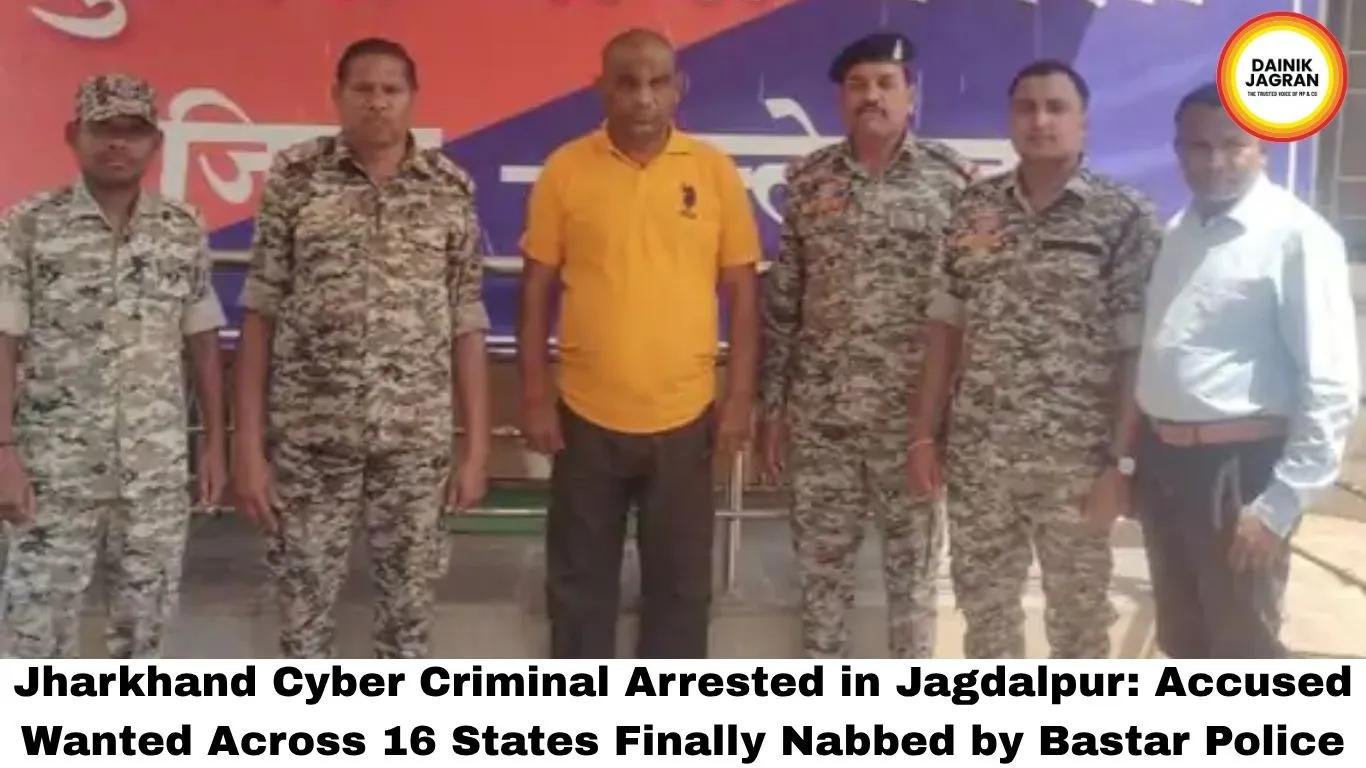
Jharkhand Cyber Criminal Arrested in Jagdalpur: Accused Wanted Across 16 States Finally Nabbed by Bastar Police
Digital Desk
Bastar Police arrest a Jharkhand-based cyber criminal wanted in 16 states. Here's how the inter-state cyber fraud network operated and what the arrest means.
Jharkhand Cyber Criminal Arrested in Jagdalpur: Accused Wanted Across 16 States Finally Nabbed by Bastar Police
A fugitive cyber fraudster, wanted by police across 16 states, has been tracked down and arrested in Jagdalpur — a significant breakthrough in one of India's most expansive digital fraud networks.
The Arrest That Took 16 States to Make Happen
Bastar Police have arrested a Jharkhand-based cyber criminal from Jagdalpur — a man reportedly wanted in connection with fraud cases spanning 16 states across India. The arrest marks a major breakthrough in the ongoing battle against organised digital crime networks that have plagued citizens from Chhattisgarh to the northern plains.
The accused, originally from Jharkhand — a state that has become synonymous with organised cyber fraud operations — had been evading multiple state police forces for an extended period. Jagdalpur, far from his base of operations, was being used as a hideout to escape the widening law enforcement net.
How These Networks Operate
Jharkhand-based cyber fraud syndicates are not random opportunists. They are highly structured criminal enterprises.
Investigators across the country have documented how these networks are divided into distinct modules — one team handling phone calls and impersonation, another managing SIM card procurement, a third controlling bank accounts, and a fourth responsible for layering and withdrawing funds before they can be traced or frozen.
The accused typically pose as bank officials, government representatives, or insurance agents to extract OTPs, banking credentials, and personal financial information from unsuspecting victims. Once money is transferred, it is rapidly moved through multiple accounts across different states — making it extraordinarily difficult to trace.
Across coordinated operations in recent months, police across India have recovered thousands of mobile phones, hundreds of SIM cards, dozens of ATM cards, and handwritten transaction registers that serve as the offline ledgers of a very online crime.
Why Chhattisgarh Is Emerging as a Cyber Crime Hotspot
The arrest in Jagdalpur is not an isolated incident. Chhattisgarh — particularly its tribal belt — is increasingly being used by inter-state criminal networks as a base of operations and a place to lie low after crimes committed elsewhere.
Poor digital literacy, limited banking awareness, and remote geography make both local residents easy victims and local terrain a convenient refuge for operatives fleeing more active investigations in other states.
Bastar Police deserve credit for maintaining active surveillance networks that caught a suspect wanted in 16 different jurisdictions. But the arrest also raises an uncomfortable question — how many more are using Chhattisgarh's remoteness as cover?
The 16-State Trail
Being wanted across 16 states is not a small matter. It means this individual — or the network he operated within — defrauded victims in nearly half of India's states. Each complaint represents a real person who lost real money, often life savings, to a phone call or a fake link.
The national scale of this network underlines why single-state policing of cyber crime is fundamentally inadequate. What Bastar Police caught was not just one man — they caught a thread that leads to a web of fraud stretching from the Northeast to the Northwest of India.
What Happens Next
The accused will now face coordinated interrogation — likely involving cyber crime units from multiple states. His digital devices, SIM cards, and bank account records will be forensically examined to map the full structure of the network he belonged to.
Crucially, investigators will try to identify the masterminds who sit above the foot soldiers. In most Jharkhand-origin cyber fraud cases, the people arrested are operators and callers — not the architects. Finding those architects, dismantling their financing, and prosecuting them under the IT Act and IPC together is the only way to actually slow this down.
One arrest, one hideout, one fugitive caught in Jagdalpur — it matters. But the war on cyber fraud in India has barely begun.
Jharkhand Cyber Criminal Arrested in Jagdalpur: Accused Wanted Across 16 States Finally Nabbed by Bastar Police
Digital Desk
Jharkhand Cyber Criminal Arrested in Jagdalpur: Accused Wanted Across 16 States Finally Nabbed by Bastar Police
A fugitive cyber fraudster, wanted by police across 16 states, has been tracked down and arrested in Jagdalpur — a significant breakthrough in one of India's most expansive digital fraud networks.
The Arrest That Took 16 States to Make Happen
Bastar Police have arrested a Jharkhand-based cyber criminal from Jagdalpur — a man reportedly wanted in connection with fraud cases spanning 16 states across India. The arrest marks a major breakthrough in the ongoing battle against organised digital crime networks that have plagued citizens from Chhattisgarh to the northern plains.
The accused, originally from Jharkhand — a state that has become synonymous with organised cyber fraud operations — had been evading multiple state police forces for an extended period. Jagdalpur, far from his base of operations, was being used as a hideout to escape the widening law enforcement net.
How These Networks Operate
Jharkhand-based cyber fraud syndicates are not random opportunists. They are highly structured criminal enterprises.
Investigators across the country have documented how these networks are divided into distinct modules — one team handling phone calls and impersonation, another managing SIM card procurement, a third controlling bank accounts, and a fourth responsible for layering and withdrawing funds before they can be traced or frozen.
The accused typically pose as bank officials, government representatives, or insurance agents to extract OTPs, banking credentials, and personal financial information from unsuspecting victims. Once money is transferred, it is rapidly moved through multiple accounts across different states — making it extraordinarily difficult to trace.
Across coordinated operations in recent months, police across India have recovered thousands of mobile phones, hundreds of SIM cards, dozens of ATM cards, and handwritten transaction registers that serve as the offline ledgers of a very online crime.
Why Chhattisgarh Is Emerging as a Cyber Crime Hotspot
The arrest in Jagdalpur is not an isolated incident. Chhattisgarh — particularly its tribal belt — is increasingly being used by inter-state criminal networks as a base of operations and a place to lie low after crimes committed elsewhere.
Poor digital literacy, limited banking awareness, and remote geography make both local residents easy victims and local terrain a convenient refuge for operatives fleeing more active investigations in other states.
Bastar Police deserve credit for maintaining active surveillance networks that caught a suspect wanted in 16 different jurisdictions. But the arrest also raises an uncomfortable question — how many more are using Chhattisgarh's remoteness as cover?
The 16-State Trail
Being wanted across 16 states is not a small matter. It means this individual — or the network he operated within — defrauded victims in nearly half of India's states. Each complaint represents a real person who lost real money, often life savings, to a phone call or a fake link.
The national scale of this network underlines why single-state policing of cyber crime is fundamentally inadequate. What Bastar Police caught was not just one man — they caught a thread that leads to a web of fraud stretching from the Northeast to the Northwest of India.
What Happens Next
The accused will now face coordinated interrogation — likely involving cyber crime units from multiple states. His digital devices, SIM cards, and bank account records will be forensically examined to map the full structure of the network he belonged to.
Crucially, investigators will try to identify the masterminds who sit above the foot soldiers. In most Jharkhand-origin cyber fraud cases, the people arrested are operators and callers — not the architects. Finding those architects, dismantling their financing, and prosecuting them under the IT Act and IPC together is the only way to actually slow this down.
One arrest, one hideout, one fugitive caught in Jagdalpur — it matters. But the war on cyber fraud in India has barely begun.