


Indore 'Putra Hanta' Holika Sparks Debate: Effigy of Suchana Seth, 10 Other Accused Mothers to Be Burned on March 2
Digital Desk
A men's rights group in Indore plans a symbolic 'Putra Hanta' Holika Dahan featuring the faces of 11 women accused of child murder, reigniting discussions about vigilante justice and legal due process.
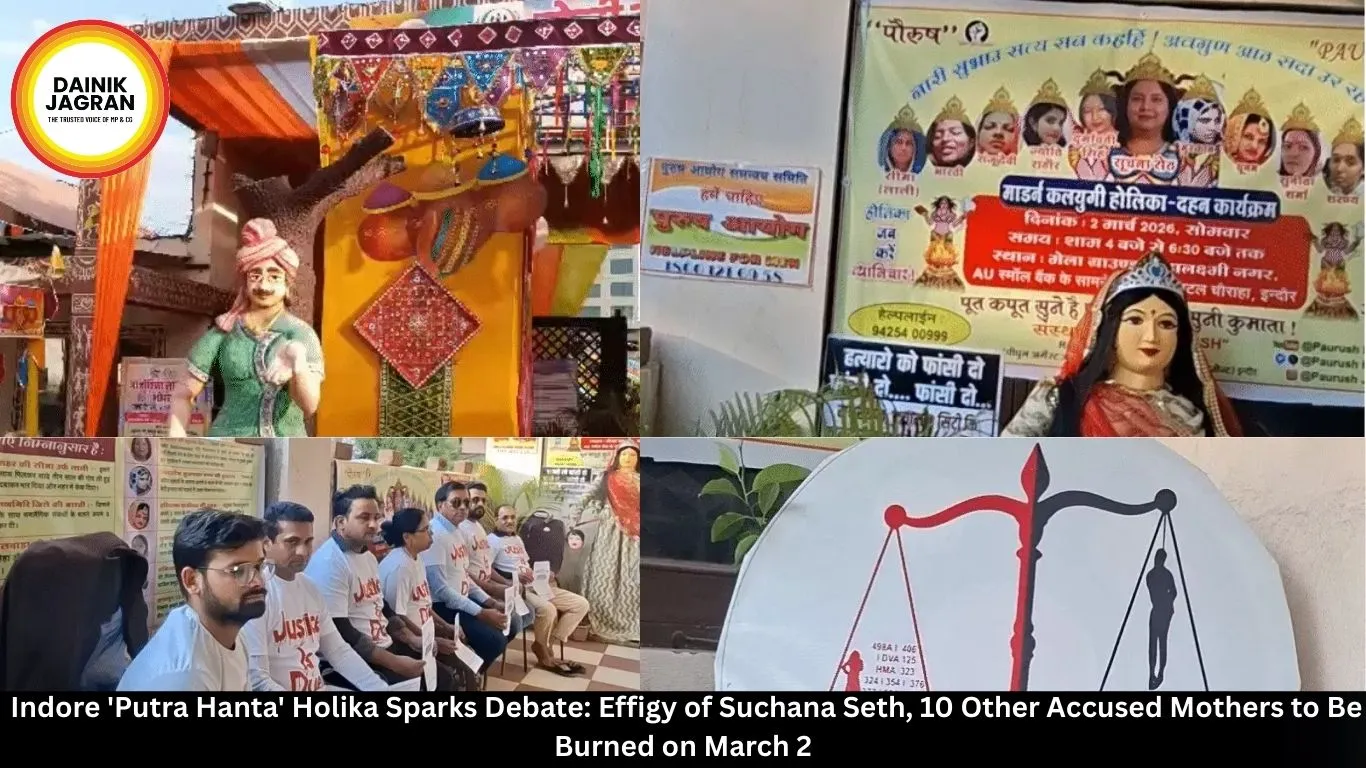
In a controversial pre-Holi development, a men's rights organization in Indore has announced a symbolic 'Putra hanta' (son-killer) Holika Dahan scheduled for March 2, featuring the effigies of 11 women accused in high-profile child murder cases across India . The event, planned by the Indore-based group Paurush, places Bengaluru AI CEO Suchana Seth at the center of the effigy, alongside ten other accused mothers from various states .
The 'Putra Hanta' Concept: Mythological Twist with Modern Accusations
The organization plans to burn the effigy at 4 PM on March 2 at the Mahalakshmi Nagar Mela Ground. Drawing from the mythological story of Hiranyakashipu and Holika, where the demon king's sister perished in fire while trying to kill devotee Prahlad, this symbolic version reverses the narrative to target accused mothers .
According to Paurush president Advocate Ashok Dashora, the effigy will prominently feature Suchana Seth's face at the center. Seth, a Bengaluru-based AI startup CEO, is currently on trial for the alleged murder of her four-year-old son in Goa in January 2024 .
"The central face in the effigy will be that of Suchana Seth," Dashora stated, alleging that she had refused to allow her son to meet his father despite court directions . Seth's estranged husband, Venkataraman, is an Indonesian national of Indian origin.
The Horrific Cases Behind the Effigy
The organization has compiled a list of 11 accused women from across India, with two already sentenced to death by lower courts while others face ongoing trials .
The accused women featured include:
- Suchana Seth (Bengaluru/Goa): Accused of killing her four-year-old son in a Goa hotel, allegedly dismembering the body and packing remains in a suitcase
- Seema, Muskan, Priyanka, Durgavati: From Uttar Pradesh in various child murder cases
- Bharti and Sharanya: From Tamil Nadu; notably, Sharanya was recently convicted by a Kerala court for throwing her one-and-a-half-year-old child into the sea
- Sanju: From Rajasthan
- Jyoti Rathore: From Gwalior
- Poonam: From Haryana
- Sunita Sharma: From Gujarat
In Seth's case, police allege she gave her son an overdose of cough syrup and smothered him before attempting to transport the body in a trolley bag from Goa to Bengaluru . The case, which completed two years in January 2026, has seen slow trial progress with only two witnesses examined so far .
Organization's Rationale: Social Awareness or Sensationalism?
Milind Agarwal, a member of Paurush, defended the event as an attempt to expose "harmful social attitudes" and draw attention to cases involving accused mothers .
"We are doing this for social awakening and to highlight family issues," Agarwal said, urging families affected by legal disputes, particularly those involving child custody and visitation, to participate in the programme .
The organization also used the platform to criticize existing child custody laws, claiming that some fathers receive only three hours per month to meet their children, with several unable to see their children for five to seven years due to legal disputes .
Paurush, active in Indore since 2011 and formally registered in 2018, claims to provide counseling and free legal assistance to families affected by dowry cases, domestic violence disputes, maintenance claims, and child custody matters .
Legal Context: High Court Precedent Raises Questions
This is not the organization's first attempt at such symbolic burning. During Dussehra last year, Paurush had proposed burning the effigy of Sonam Raghuwanshi, a woman accused of murder. However, Raghuwanshi's mother approached the Madhya Pradesh High Court, which stayed the event .
The High Court had observed that such acts are "not acceptable in a democratic society" and emphasized the importance of due process and legal principles, noting that actions should not be allowed until guilt is established by a court of law .
This legal precedent raises questions about the proposed 'Putra hanta' Holika, particularly since several of the women featured, including Suchana Seth, are still undergoing trial and have not been finally convicted .
The Broader Debate: Vigilante Justice vs. Expression
The event has drawn attention ahead of Holi celebrations, with the sensitive theme likely to attract both support and criticism. While the organization frames it as a social awareness initiative, critics may view it as undermining the presumption of innocence—a fundamental principle of criminal jurisprudence.
Legal experts point out that in Seth's case, she has denied murder, claiming the child "died suddenly" and blaming circumstances surrounding her estranged marriage . The trial continues, with key witnesses including the investigating officer and autopsy doctor yet to testify .
What Happens Next?
As March 2 approaches, all eyes are on whether the Madhya Pradesh High Court's previous observations will impact this year's event or if the 'Putra hanta' Holika will proceed as planned. The organization remains firm in its commitment, having already prepared the effigy and decorated the venue at Mahalakshmi Nagar Mela Ground .
For now, Indore awaits a Holika Dahan that promises to be anything but traditional—one that places accused mothers, rather than mythological demons, at the center of the fire.



.jpg)




