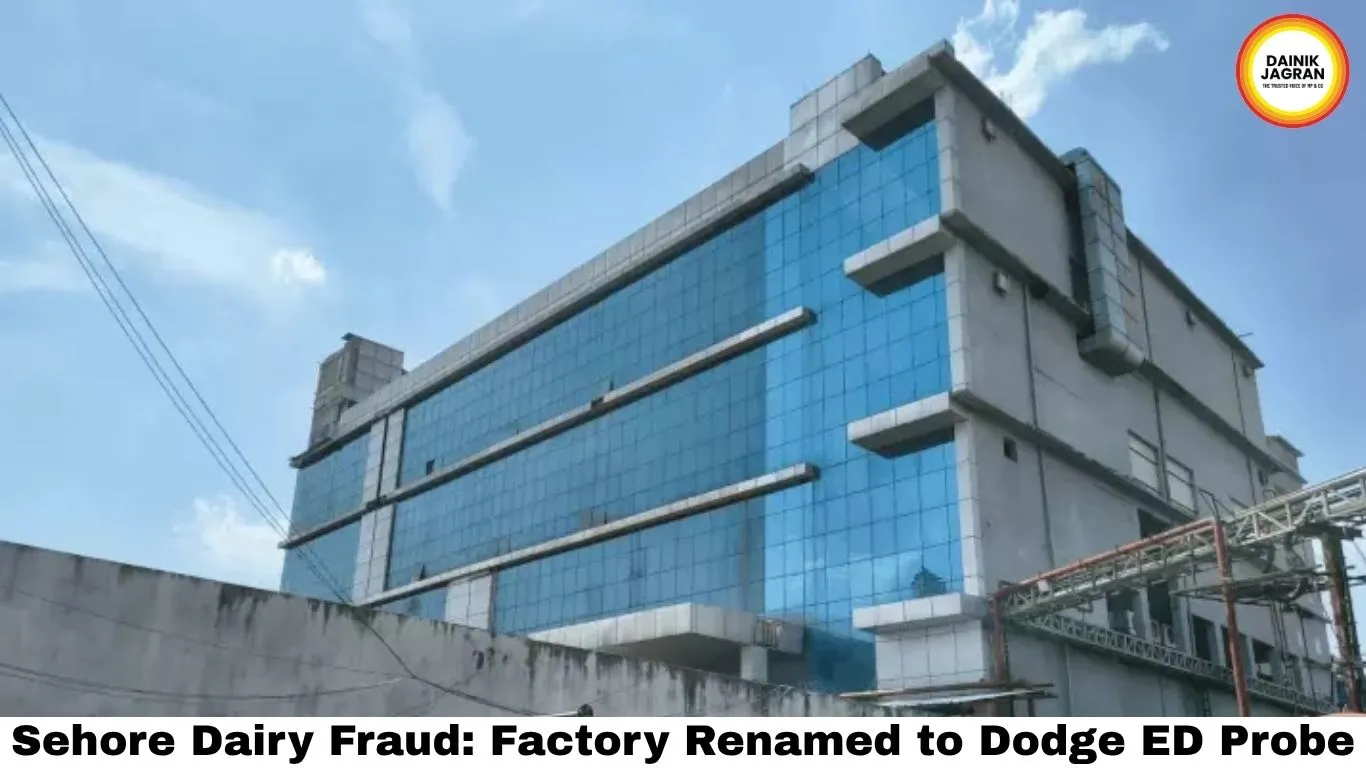
Sehore Dairy Fraud: Factory Renamed to Dodge ED Probe, But "Milk Magic" Scam Runs Deeper Than a Rebrand

Digital Desk

Sehore Dairy Fraud: Factory Renamed to Dodge ED Probe, But

Sehore's Jayshri Gayatri Food factory renamed operations amid ED probe. 63 forged certificates, ₹20.59 cr foreign fraud — the Milk Magic dairy scandal explained.

When a Name Change Is Not Enough: Inside the Sehore Dairy Factory Scandal

A factory under active investigation by the Enforcement Directorate. Its director arrested and produced before a special court. Sixty-three forged laboratory certificates uncovered. Foreign exchange fraud worth nearly ₹21 crore. And yet — the production line keeps running, this time under a new name.

This is not a plot from a crime thriller. This is the on-ground reality unfolding at a dairy factory in Sehore, Madhya Pradesh, and it raises an urgent question that goes far beyond one company: when institutions look the other way, can simply renaming a business be enough to beat the law?


The Factory, the Brand, and the Fraud

The Enforcement Directorate conducted searches at nine locations across Madhya Pradesh linked to Jayshri Gayatri Food Products Pvt. Ltd. — a private firm accused of producing and distributing adulterated milk products both domestically and internationally, using forged laboratory certificates to pass off substandard goods as certified quality produce.

Better known by its retail brand "Milk Magic," the company initially positioned itself as a business-to-business exporter, dealing in paneer, cheese, butter, curd, flavoured milk, and pure milk. It claimed to export to more than 28 countries including the US, UAE, Bahrain, Oman, Qatar, Saudi Arabia, Singapore, Hong Kong, Japan, and New Zealand.

On paper, a thriving export success story. In reality, a carefully constructed facade built on falsified paperwork.


63 Forged Certificates and ₹20.59 Crore in Illicit Foreign Exchange

ED investigation revealed that Jayshri Gayatri Food Products manufactured adulterated milk products and used falsified laboratory certificates — purportedly issued by BIS/NABL recognised labs — to secure export certification from the Export Inspection Agency (EIA) in Indore. Verification showed that these certificates were either originally issued to other companies, outright forged, or fraudulently obtained. During the course of the investigation, 63 such forged lab certificates were identified.

The company exported dairy products using fake laboratory test reports and earned foreign exchange worth ₹20.59 crore through this fraudulent channel. Following arrest, director Kishan Modi was produced before a special PMLA court in Bhopal, which remanded him to ED custody for further questioning.

The scale of deception is staggering. These were not minor clerical errors — this was a systematic, multi-year criminal enterprise that put adulterated food on plates across the Gulf, Southeast Asia, and beyond.


The Rebrand Trick: India's Oldest Corporate Escape Route

What makes the Sehore case especially alarming is what came next. Instead of shutting down during the ED probe, the factory reportedly changed its name and continued operations — producing and supplying as if nothing had happened. This tactic is neither new nor unique to this case. It is a well-worn playbook: dissolve or rename the entity, argue that the new legal name bears no connection to the accused firm, and continue business as usual while courts and agencies play catch-up.

The entire investigation was originally triggered by a complaint from Bhagwan Singh Rajput, a former ABVP member and RTI activist, who approached the Madhya Pradesh Economic Offences Wing alleging large-scale adulteration, forgery of certificates, and the accumulation of properties by the firm's directors in the names of their employees.

That a single whistleblower's persistence triggered this entire investigation is both inspiring and damning — inspiring because civil accountability still works, and damning because it took a citizen activist to force the system into motion.


Who Else Was Affected?

The ripple effects of this fraud reach far beyond Sehore's industrial belt. Reports indicate that Jubilant FoodWorks — the operator of the Domino's India franchise — rejected quintals of frozen paneer supplied by Jayshri Gayatri Food Products on grounds of substandard quality. Similarly, Keventer Agro Limited had rejected a consignment of 25 tonnes of skimmed milk powder due to unacceptably high ash content.

These are not minor quality complaints. These are red flags that, had they been escalated and investigated earlier, might have stopped years of fraudulent exports and domestic distribution.


What This Means for Food Safety in India

The Sehore dairy fraud exposes a dangerous gap at the heart of India's food safety ecosystem. Export Inspection Agencies rely heavily on lab certificates submitted by companies. If those certificates are forged, the entire verification chain collapses. The result: adulterated products labelled as premium quality reach households in India and consumers in over two dozen countries — with no one the wiser.

Renaming a factory does not erase its machinery, its workforce, its supply chain, or its criminal liability under PMLA. The law is clear. What is needed now is equally clear:

  • Immediate sealing of premises linked to accused entities under investigation
  • Cross-agency coordination between ED, FSSAI, and Export Inspection Agencies
  • Mandatory disclosure when a company under investigation changes its legal name
  • Faster trial timelines so that arrests translate into genuine accountability

A Name Change Is Not a Clean Slate

Fraud cases of this magnitude rarely exist in a vacuum. They survive because of institutional gaps, delayed enforcement, and the ease with which accused entities can reinvent themselves on paper.

The consumers who bought "Milk Magic" products trusted a brand. That trust was betrayed systematically, over years, across borders. A factory that simply hangs a new nameplate over its gate is not a reformed business. It is the same fraud, wearing a new disguise.

India's food safety and financial crime enforcement must move faster — and smarter — than the criminals they pursue.
--------

🚨 Beat the News Rush – Join Now!

Get breaking alerts, hot exclusives, and game-changing stories instantly on your phone. No delays, no fluff – just the edge you need. ⚡

Tap to join: 

🟢 WhatsApp Channel: Dainik Jagran MP CG

Crave more?

🅕 Facebook: Dainik Jagran MP CG English

🅧 Twitter (X): Dainik Jagran MP CG

🅘 Instagram: Dainik Jagran MP CG

Share the fire – keep your crew ahead! 🗞️🔥

english.dainikjagranmpcg.com
27 Mar 2026 By Jiya.S

Sehore Dairy Fraud: Factory Renamed to Dodge ED Probe, But "Milk Magic" Scam Runs Deeper Than a Rebrand

Digital Desk

When a Name Change Is Not Enough: Inside the Sehore Dairy Factory Scandal

A factory under active investigation by the Enforcement Directorate. Its director arrested and produced before a special court. Sixty-three forged laboratory certificates uncovered. Foreign exchange fraud worth nearly ₹21 crore. And yet — the production line keeps running, this time under a new name.

This is not a plot from a crime thriller. This is the on-ground reality unfolding at a dairy factory in Sehore, Madhya Pradesh, and it raises an urgent question that goes far beyond one company: when institutions look the other way, can simply renaming a business be enough to beat the law?


The Factory, the Brand, and the Fraud

The Enforcement Directorate conducted searches at nine locations across Madhya Pradesh linked to Jayshri Gayatri Food Products Pvt. Ltd. — a private firm accused of producing and distributing adulterated milk products both domestically and internationally, using forged laboratory certificates to pass off substandard goods as certified quality produce.

Better known by its retail brand "Milk Magic," the company initially positioned itself as a business-to-business exporter, dealing in paneer, cheese, butter, curd, flavoured milk, and pure milk. It claimed to export to more than 28 countries including the US, UAE, Bahrain, Oman, Qatar, Saudi Arabia, Singapore, Hong Kong, Japan, and New Zealand.

On paper, a thriving export success story. In reality, a carefully constructed facade built on falsified paperwork.


63 Forged Certificates and ₹20.59 Crore in Illicit Foreign Exchange

ED investigation revealed that Jayshri Gayatri Food Products manufactured adulterated milk products and used falsified laboratory certificates — purportedly issued by BIS/NABL recognised labs — to secure export certification from the Export Inspection Agency (EIA) in Indore. Verification showed that these certificates were either originally issued to other companies, outright forged, or fraudulently obtained. During the course of the investigation, 63 such forged lab certificates were identified.

The company exported dairy products using fake laboratory test reports and earned foreign exchange worth ₹20.59 crore through this fraudulent channel. Following arrest, director Kishan Modi was produced before a special PMLA court in Bhopal, which remanded him to ED custody for further questioning.

The scale of deception is staggering. These were not minor clerical errors — this was a systematic, multi-year criminal enterprise that put adulterated food on plates across the Gulf, Southeast Asia, and beyond.


The Rebrand Trick: India's Oldest Corporate Escape Route

What makes the Sehore case especially alarming is what came next. Instead of shutting down during the ED probe, the factory reportedly changed its name and continued operations — producing and supplying as if nothing had happened. This tactic is neither new nor unique to this case. It is a well-worn playbook: dissolve or rename the entity, argue that the new legal name bears no connection to the accused firm, and continue business as usual while courts and agencies play catch-up.

The entire investigation was originally triggered by a complaint from Bhagwan Singh Rajput, a former ABVP member and RTI activist, who approached the Madhya Pradesh Economic Offences Wing alleging large-scale adulteration, forgery of certificates, and the accumulation of properties by the firm's directors in the names of their employees.

That a single whistleblower's persistence triggered this entire investigation is both inspiring and damning — inspiring because civil accountability still works, and damning because it took a citizen activist to force the system into motion.


Who Else Was Affected?

The ripple effects of this fraud reach far beyond Sehore's industrial belt. Reports indicate that Jubilant FoodWorks — the operator of the Domino's India franchise — rejected quintals of frozen paneer supplied by Jayshri Gayatri Food Products on grounds of substandard quality. Similarly, Keventer Agro Limited had rejected a consignment of 25 tonnes of skimmed milk powder due to unacceptably high ash content.

These are not minor quality complaints. These are red flags that, had they been escalated and investigated earlier, might have stopped years of fraudulent exports and domestic distribution.


What This Means for Food Safety in India

The Sehore dairy fraud exposes a dangerous gap at the heart of India's food safety ecosystem. Export Inspection Agencies rely heavily on lab certificates submitted by companies. If those certificates are forged, the entire verification chain collapses. The result: adulterated products labelled as premium quality reach households in India and consumers in over two dozen countries — with no one the wiser.

Renaming a factory does not erase its machinery, its workforce, its supply chain, or its criminal liability under PMLA. The law is clear. What is needed now is equally clear:

  • Immediate sealing of premises linked to accused entities under investigation
  • Cross-agency coordination between ED, FSSAI, and Export Inspection Agencies
  • Mandatory disclosure when a company under investigation changes its legal name
  • Faster trial timelines so that arrests translate into genuine accountability

A Name Change Is Not a Clean Slate

Fraud cases of this magnitude rarely exist in a vacuum. They survive because of institutional gaps, delayed enforcement, and the ease with which accused entities can reinvent themselves on paper.

The consumers who bought "Milk Magic" products trusted a brand. That trust was betrayed systematically, over years, across borders. A factory that simply hangs a new nameplate over its gate is not a reformed business. It is the same fraud, wearing a new disguise.

India's food safety and financial crime enforcement must move faster — and smarter — than the criminals they pursue.

https://english.dainikjagranmpcg.com/states/madhya-pradesh/69c51dbd6fad7/article-16042

Advertisement

Latest News