

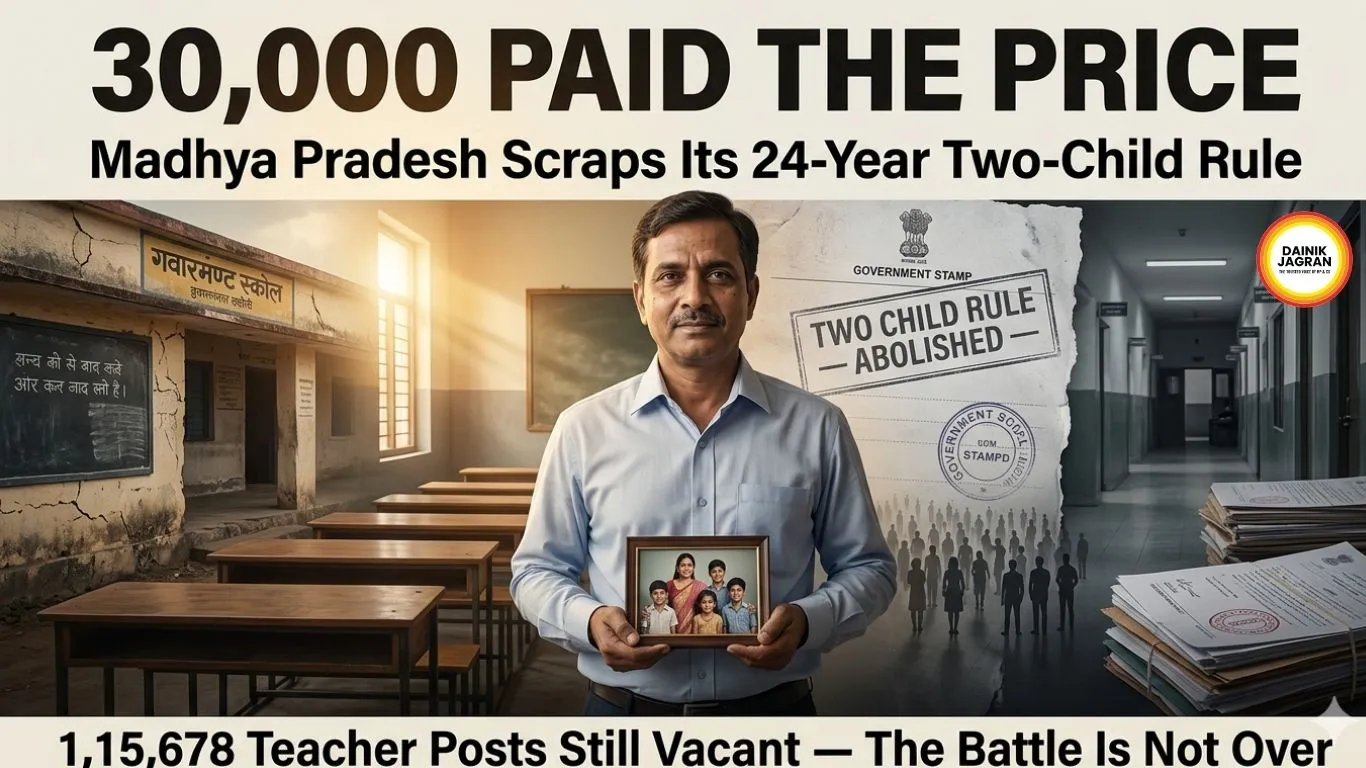
MP's 24-Year-Old Two-Child Rule Is Finally Ending — But 30,000 Teachers Already Paid the Price

Digital Desk

MP's 24-Year-Old Two-Child Rule Is Finally Ending — But 30,000 Teachers Already Paid the Price

Madhya Pradesh scraps its 24-year two-child rule for govt employees. 30,000 teachers affected, 1.15 lakh posts vacant. What changes, what doesn't, and why it matters.

MP's 24-Year-Old Two-Child Rule Is Finally Ending — But 30,000 Teachers Already Paid the Price

For 24 years, a rule hung over the heads of every government employee in Madhya Pradesh like a sword waiting to fall. Have a third child — whether planned or unplanned, whether twins arrived unexpectedly, whether life simply didn't go according to plan — and you would lose your government job. No appeal. No grace period. No second chance.

That rule is now on its way out. The Mohan Yadav government has directed the General Administration Department (GAD) to prepare a formal proposal abolishing the two-child policy for state government employees — a decision that will benefit thousands across departments including school education, higher education, and medical education. Cabinet approval is the final step, and it is expected soon.

For tens of thousands of MP's government teachers and employees, it is long-overdue relief. But for those who already lost their jobs under this very rule, the announcement carries the bittersweet sting of a door closing just after you walked through it.


What Was the Two-Child Rule — and Why Did It Exist?

The two-child policy for government employees was introduced across several Indian states in the late 1990s and early 2000s as part of a broader population control push. In Madhya Pradesh, the rule came into force in January 2001. Under it, any government employee who had a third child born after the rule's implementation date would be deemed "ineligible" for continued government service and could be dismissed.

The intent was to lead by example — to use the government workforce as a visible instrument of family planning. In theory, it made a certain sense in an era when population growth was considered the primary threat to development. In practice, it became one of the cruellest provisions in the state service rulebook, punishing employees for the most private of life decisions and showing no mercy for circumstances — a third pregnancy that was unplanned, a twin birth that pushed a family from two children to three overnight, or cultural and religious family pressures that individual employees had little power to resist.

Over 24 years, this rule cost an estimated 30,000 government employees — a significant proportion of them teachers — their livelihoods.


Who Will Benefit From This Change?

The abolition of the two-child rule, once formalised by Cabinet, will benefit employees across the state's school education, higher education, medical education, and other government departments who currently have more than two children but whose jobs have remained under threat or who have been living in fear of action being initiated against them.

Crucially, however, the government has made clear that the decision will not have retrospective effect. This means that employees who were already dismissed under the two-child rule before this order comes into force will not be reinstated and will receive no compensation. The relief is forward-looking only — a lifeline for those still employed, and a closed door for those who lost everything years ago.

This is a significant limitation, and one that teachers' unions have already flagged. Madhya Pradesh will not be the first state to take this step — Rajasthan abolished its two-child limit for government employees in 2016 and Chhattisgarh in 2017. Both those states also declined retrospective application. MP is simply arriving late to a reform its neighbours have already implemented.


The Bigger Crisis: 1.15 Lakh Teacher Posts Lying Vacant

The two-child rule reform, welcome as it is, arrives against a backdrop of a far deeper crisis in Madhya Pradesh's education system. According to figures presented in the state assembly, out of a total of 2,89,005 sanctioned teacher posts in government schools, only 1,74,419 are currently filled. That leaves a staggering 1,15,678 posts vacant — nearly 40 percent of the entire sanctioned teaching strength.

These are not abstract numbers. They translate into classrooms without teachers, students sharing one teacher across multiple grade levels, and schools where the curriculum cannot be completed because the human resource simply is not there. In districts across MP, it is common to find primary schools with a single teacher managing classes one through five simultaneously.

Teacher recruitment candidates — who have now taken to the streets of Bhopal four times in four months — are demanding that the state government increase the number of posts being filled in the ongoing Grade 2 and Grade 3 teacher recruitment drives. In the Grade 3 recruitment, candidates are demanding a minimum of 25,000 posts. Their protests have, so far, been met with assurances rather than action.


Guest Teachers: A Symptomatic Fix for a Structural Problem

Into this gap, Madhya Pradesh has deployed guest teachers — contractual educators who serve at daily wages and are renewed session by session. The government recently extended the services of existing guest teachers until April 30, 2026, while also increasing their monthly honorarium to ₹18,000 — a welcome step, but one that exposes rather than solves the underlying problem.

Guest teachers are not a solution. They are a symptom management tool — a way of keeping classrooms nominally functional while the deeper structural failure of under-recruitment goes unaddressed. Teachers serving on short-term contracts with no job security, no pension, and no guarantee of renewal cannot deliver the quality and consistency that students in government schools deserve.

The two-child rule reform will help retain some employees who might otherwise have faced dismissal. But it will not fill the 1.15 lakh vacant posts. It will not replace the 30,000 employees already dismissed. And it will not fix a teacher recruitment pipeline that candidates describe as deliberately slow and inadequate.


What CM Mohan Yadav Has Promised — and What Remains Undelivered

Chief Minister Mohan Yadav has made a number of significant announcements for the teaching community in recent months. On Teachers' Day in September 2025, he announced the introduction of a fourth pay scale for assistant teachers and primary and secondary education cadre teachers — a benefit expected to come into effect from the 2025-26 financial year at an additional annual cost of ₹117 crore to the state exchequer. He also transferred ₹330 crore directly to the accounts of 55 lakh students from classes 1 to 8 for purchasing school uniforms.

These are meaningful gestures. But they coexist with an education system that has over a lakh vacancies, teacher candidates who have protested four times without resolution, and a policy reform that helps current employees but offers nothing to those who bore the full force of the old rule.


A Step Forward That Should Have Come 10 Years Ago

The abolition of Madhya Pradesh's two-child rule for government employees is the right decision. It recognises that family planning is a personal matter, that punishing employees for having children is both inhumane and legally questionable, and that MP was an outlier in a national trend that had long since moved on.

But right decisions that arrive 24 years late carry a particular kind of injustice. The 30,000 employees — teachers, health workers, administrative staff — who lost their jobs under this rule will not get them back. Their families absorbed those losses years ago. For them, this announcement is not relief. It is a reminder.

Going forward, the Mohan Yadav government's real test on education is not the two-child rule — it is the 1.15 lakh empty classrooms that no policy announcement has yet filled.


--------

🚨 Beat the News Rush – Join Now!

Get breaking alerts, hot exclusives, and game-changing stories instantly on your phone. No delays, no fluff – just the edge you need. ⚡

Tap to join: 

🟢 WhatsApp Channel: Dainik Jagran MP CG

Crave more?

🅕 Facebook: Dainik Jagran MP CG English

🅧 Twitter (X): Dainik Jagran MP CG

🅘 Instagram: Dainik Jagran MP CG

Share the fire – keep your crew ahead! 🗞️🔥

english.dainikjagranmpcg.com
27 Mar 2026 By Jiya.S

MP's 24-Year-Old Two-Child Rule Is Finally Ending — But 30,000 Teachers Already Paid the Price

Digital Desk

MP's 24-Year-Old Two-Child Rule Is Finally Ending — But 30,000 Teachers Already Paid the Price

For 24 years, a rule hung over the heads of every government employee in Madhya Pradesh like a sword waiting to fall. Have a third child — whether planned or unplanned, whether twins arrived unexpectedly, whether life simply didn't go according to plan — and you would lose your government job. No appeal. No grace period. No second chance.

That rule is now on its way out. The Mohan Yadav government has directed the General Administration Department (GAD) to prepare a formal proposal abolishing the two-child policy for state government employees — a decision that will benefit thousands across departments including school education, higher education, and medical education. Cabinet approval is the final step, and it is expected soon.

For tens of thousands of MP's government teachers and employees, it is long-overdue relief. But for those who already lost their jobs under this very rule, the announcement carries the bittersweet sting of a door closing just after you walked through it.


What Was the Two-Child Rule — and Why Did It Exist?

The two-child policy for government employees was introduced across several Indian states in the late 1990s and early 2000s as part of a broader population control push. In Madhya Pradesh, the rule came into force in January 2001. Under it, any government employee who had a third child born after the rule's implementation date would be deemed "ineligible" for continued government service and could be dismissed.

The intent was to lead by example — to use the government workforce as a visible instrument of family planning. In theory, it made a certain sense in an era when population growth was considered the primary threat to development. In practice, it became one of the cruellest provisions in the state service rulebook, punishing employees for the most private of life decisions and showing no mercy for circumstances — a third pregnancy that was unplanned, a twin birth that pushed a family from two children to three overnight, or cultural and religious family pressures that individual employees had little power to resist.

Over 24 years, this rule cost an estimated 30,000 government employees — a significant proportion of them teachers — their livelihoods.


Who Will Benefit From This Change?

The abolition of the two-child rule, once formalised by Cabinet, will benefit employees across the state's school education, higher education, medical education, and other government departments who currently have more than two children but whose jobs have remained under threat or who have been living in fear of action being initiated against them.

Crucially, however, the government has made clear that the decision will not have retrospective effect. This means that employees who were already dismissed under the two-child rule before this order comes into force will not be reinstated and will receive no compensation. The relief is forward-looking only — a lifeline for those still employed, and a closed door for those who lost everything years ago.

This is a significant limitation, and one that teachers' unions have already flagged. Madhya Pradesh will not be the first state to take this step — Rajasthan abolished its two-child limit for government employees in 2016 and Chhattisgarh in 2017. Both those states also declined retrospective application. MP is simply arriving late to a reform its neighbours have already implemented.


The Bigger Crisis: 1.15 Lakh Teacher Posts Lying Vacant

The two-child rule reform, welcome as it is, arrives against a backdrop of a far deeper crisis in Madhya Pradesh's education system. According to figures presented in the state assembly, out of a total of 2,89,005 sanctioned teacher posts in government schools, only 1,74,419 are currently filled. That leaves a staggering 1,15,678 posts vacant — nearly 40 percent of the entire sanctioned teaching strength.

These are not abstract numbers. They translate into classrooms without teachers, students sharing one teacher across multiple grade levels, and schools where the curriculum cannot be completed because the human resource simply is not there. In districts across MP, it is common to find primary schools with a single teacher managing classes one through five simultaneously.

Teacher recruitment candidates — who have now taken to the streets of Bhopal four times in four months — are demanding that the state government increase the number of posts being filled in the ongoing Grade 2 and Grade 3 teacher recruitment drives. In the Grade 3 recruitment, candidates are demanding a minimum of 25,000 posts. Their protests have, so far, been met with assurances rather than action.


Guest Teachers: A Symptomatic Fix for a Structural Problem

Into this gap, Madhya Pradesh has deployed guest teachers — contractual educators who serve at daily wages and are renewed session by session. The government recently extended the services of existing guest teachers until April 30, 2026, while also increasing their monthly honorarium to ₹18,000 — a welcome step, but one that exposes rather than solves the underlying problem.

Guest teachers are not a solution. They are a symptom management tool — a way of keeping classrooms nominally functional while the deeper structural failure of under-recruitment goes unaddressed. Teachers serving on short-term contracts with no job security, no pension, and no guarantee of renewal cannot deliver the quality and consistency that students in government schools deserve.

The two-child rule reform will help retain some employees who might otherwise have faced dismissal. But it will not fill the 1.15 lakh vacant posts. It will not replace the 30,000 employees already dismissed. And it will not fix a teacher recruitment pipeline that candidates describe as deliberately slow and inadequate.


What CM Mohan Yadav Has Promised — and What Remains Undelivered

Chief Minister Mohan Yadav has made a number of significant announcements for the teaching community in recent months. On Teachers' Day in September 2025, he announced the introduction of a fourth pay scale for assistant teachers and primary and secondary education cadre teachers — a benefit expected to come into effect from the 2025-26 financial year at an additional annual cost of ₹117 crore to the state exchequer. He also transferred ₹330 crore directly to the accounts of 55 lakh students from classes 1 to 8 for purchasing school uniforms.

These are meaningful gestures. But they coexist with an education system that has over a lakh vacancies, teacher candidates who have protested four times without resolution, and a policy reform that helps current employees but offers nothing to those who bore the full force of the old rule.


A Step Forward That Should Have Come 10 Years Ago

The abolition of Madhya Pradesh's two-child rule for government employees is the right decision. It recognises that family planning is a personal matter, that punishing employees for having children is both inhumane and legally questionable, and that MP was an outlier in a national trend that had long since moved on.

But right decisions that arrive 24 years late carry a particular kind of injustice. The 30,000 employees — teachers, health workers, administrative staff — who lost their jobs under this rule will not get them back. Their families absorbed those losses years ago. For them, this announcement is not relief. It is a reminder.

Going forward, the Mohan Yadav government's real test on education is not the two-child rule — it is the 1.15 lakh empty classrooms that no policy announcement has yet filled.

https://english.dainikjagranmpcg.com/states/madhya-pradesh/69c62361c1d01/article-16075

Advertisement

Latest News


