

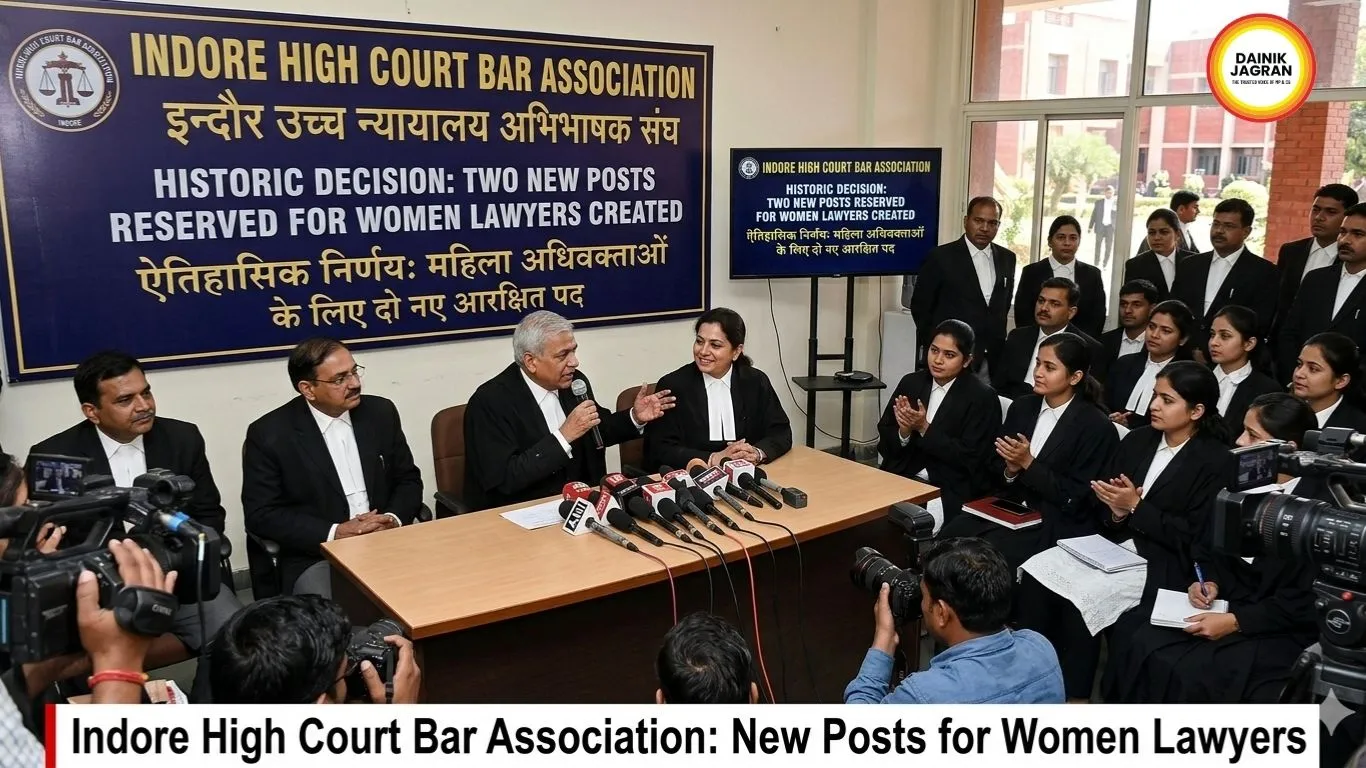
Indore High Court Bar Association Creates Two New Posts Reserved for Women Lawyers
Digital Desk
Following Supreme Court's 30% reservation directive, High Court Bar Association Indore reserves four posts for women, including two newly created positions of treasurer and library secretary
Indore High Court Bar Association Creates Two New Posts Reserved for Women Lawyers
Following Supreme Court's 30% reservation directive, High Court Bar Association Indore reserves four posts for women, including two newly created positions of treasurer and library secretary
In a significant step towards gender inclusion within the legal fraternity, the High Court Bar Association in Indore has decided to reserve four posts for women lawyers in its executive committee — acting on a directive issued by the Supreme Court of India. Of these four, two are entirely new positions being created for the first time: treasurer and library secretary. The remaining two posts will be reserved for women executive committee members.
Supreme Court Directive Drives Change
The decision comes directly in response to the Supreme Court's mandate requiring bar associations across the country to implement 30 per cent reservation for women in their executive bodies. Compliance with this directive has been gathering momentum across bar associations in Madhya Pradesh, with Indore's High Court Bar Association now formally informing the High Court Registrar of the steps it has taken.
The information was submitted in response to a query raised by the High Court Registrar, who had sought details from affiliated bar associations about how they intend to implement women's reservation in their governing structures.
Two Brand New Posts Created
Bar Association President Manish Yadav confirmed that the posts of treasurer and library secretary do not currently exist in the High Court Bar's organisational structure. Since these positions are not part of the existing framework, the association will formally create them — and both will be reserved exclusively for women lawyers from the outset.
This is a notable aspect of the decision. Rather than simply designating existing posts as reserved, the association has chosen to expand its executive committee by creating new positions, ensuring that women's representation becomes an additive gain rather than a redistributive adjustment that might displace male incumbents.
1,165 Women Among 6,000 Members
Yadav also shared the membership composition of the High Court Bar Association, providing important context to the reservation decision. Out of approximately 6,000 total members, 1,165 are women lawyers — accounting for roughly 19 per cent of the overall membership. The Supreme Court's 30 per cent reservation mandate at the executive level is therefore designed to provide women with representation that exceeds their current membership share, recognising the structural barriers that have historically limited their participation in bar leadership.
Indore Abhivakta Sangh Also Acts
In a parallel development, the Indore Abhivakta Sangh — another prominent lawyers' body in the city — has also moved towards compliance. According to sources, an agreement was reached within the Sangh to reserve the post of treasurer and three executive committee seats for women lawyers. This indicates that the ripple effect of the Supreme Court's order is being felt across multiple bar bodies in Indore simultaneously, rather than being limited to the High Court Bar Association alone.
State Bar Council Polls on May 12
The broader context of these developments is the upcoming State Bar Council election scheduled for May 12, in which 25 seats are to be contested. In keeping with the Supreme Court's reservation directive, seven of these 25 seats have been reserved for women lawyers — marking a concrete institutional shift in how legal bodies in Madhya Pradesh approach gender representation in their governance.
The election will be closely watched as a litmus test for whether the reservation framework translates into meaningful participation or remains a procedural checkbox.
A Step Forward for Women in Law
Taken together, these developments represent a meaningful structural shift within Madhya Pradesh's legal community. Women lawyers in Indore — many of whom have practised for years without proportionate representation in bar leadership — stand to gain from both newly created posts and reserved seats across multiple organisations.
Bar Association President Manish Yadav's statement framing the creation of new posts as a proactive step — rather than a reluctant redistribution — signals at least an intent to move beyond tokenism. How swiftly these posts are operationalised, and whether women candidates are genuinely encouraged to contest and lead, will determine whether the Supreme Court's directive achieves its intended purpose on the ground.
With elections at the State Bar Council level approaching in May, the coming weeks will offer an early read on whether inclusion in Madhya Pradesh's legal bodies is becoming a matter of genuine institutional will or remains driven solely by judicial compulsion.
--------
🚨 Beat the News Rush – Join Now!
Get breaking alerts, hot exclusives, and game-changing stories instantly on your phone. No delays, no fluff – just the edge you need. ⚡
Tap to join:
🟢 WhatsApp Channel: Dainik Jagran MP CG
Crave more?
🅕 Facebook: Dainik Jagran MP CG English
🅧 Twitter (X): Dainik Jagran MP CG
🅘 Instagram: Dainik Jagran MP CG
Share the fire – keep your crew ahead! 🗞️🔥
Indore High Court Bar Association Creates Two New Posts Reserved for Women Lawyers
Digital Desk
Indore High Court Bar Association Creates Two New Posts Reserved for Women Lawyers
Following Supreme Court's 30% reservation directive, High Court Bar Association Indore reserves four posts for women, including two newly created positions of treasurer and library secretary
In a significant step towards gender inclusion within the legal fraternity, the High Court Bar Association in Indore has decided to reserve four posts for women lawyers in its executive committee — acting on a directive issued by the Supreme Court of India. Of these four, two are entirely new positions being created for the first time: treasurer and library secretary. The remaining two posts will be reserved for women executive committee members.
Supreme Court Directive Drives Change
The decision comes directly in response to the Supreme Court's mandate requiring bar associations across the country to implement 30 per cent reservation for women in their executive bodies. Compliance with this directive has been gathering momentum across bar associations in Madhya Pradesh, with Indore's High Court Bar Association now formally informing the High Court Registrar of the steps it has taken.
The information was submitted in response to a query raised by the High Court Registrar, who had sought details from affiliated bar associations about how they intend to implement women's reservation in their governing structures.
Two Brand New Posts Created
Bar Association President Manish Yadav confirmed that the posts of treasurer and library secretary do not currently exist in the High Court Bar's organisational structure. Since these positions are not part of the existing framework, the association will formally create them — and both will be reserved exclusively for women lawyers from the outset.
This is a notable aspect of the decision. Rather than simply designating existing posts as reserved, the association has chosen to expand its executive committee by creating new positions, ensuring that women's representation becomes an additive gain rather than a redistributive adjustment that might displace male incumbents.
1,165 Women Among 6,000 Members
Yadav also shared the membership composition of the High Court Bar Association, providing important context to the reservation decision. Out of approximately 6,000 total members, 1,165 are women lawyers — accounting for roughly 19 per cent of the overall membership. The Supreme Court's 30 per cent reservation mandate at the executive level is therefore designed to provide women with representation that exceeds their current membership share, recognising the structural barriers that have historically limited their participation in bar leadership.
Indore Abhivakta Sangh Also Acts
In a parallel development, the Indore Abhivakta Sangh — another prominent lawyers' body in the city — has also moved towards compliance. According to sources, an agreement was reached within the Sangh to reserve the post of treasurer and three executive committee seats for women lawyers. This indicates that the ripple effect of the Supreme Court's order is being felt across multiple bar bodies in Indore simultaneously, rather than being limited to the High Court Bar Association alone.
State Bar Council Polls on May 12
The broader context of these developments is the upcoming State Bar Council election scheduled for May 12, in which 25 seats are to be contested. In keeping with the Supreme Court's reservation directive, seven of these 25 seats have been reserved for women lawyers — marking a concrete institutional shift in how legal bodies in Madhya Pradesh approach gender representation in their governance.
The election will be closely watched as a litmus test for whether the reservation framework translates into meaningful participation or remains a procedural checkbox.
A Step Forward for Women in Law
Taken together, these developments represent a meaningful structural shift within Madhya Pradesh's legal community. Women lawyers in Indore — many of whom have practised for years without proportionate representation in bar leadership — stand to gain from both newly created posts and reserved seats across multiple organisations.
Bar Association President Manish Yadav's statement framing the creation of new posts as a proactive step — rather than a reluctant redistribution — signals at least an intent to move beyond tokenism. How swiftly these posts are operationalised, and whether women candidates are genuinely encouraged to contest and lead, will determine whether the Supreme Court's directive achieves its intended purpose on the ground.
With elections at the State Bar Council level approaching in May, the coming weeks will offer an early read on whether inclusion in Madhya Pradesh's legal bodies is becoming a matter of genuine institutional will or remains driven solely by judicial compulsion.


