


Indore LPG Crisis 2026: Chappan Dukan Goes Electric, Tea Stalls Switch to Coal — India's Cleanest City Fights Its Dirtiest Crisis
Digital Desk
Indore's Streets Are Still Cooking — But Not on Gas
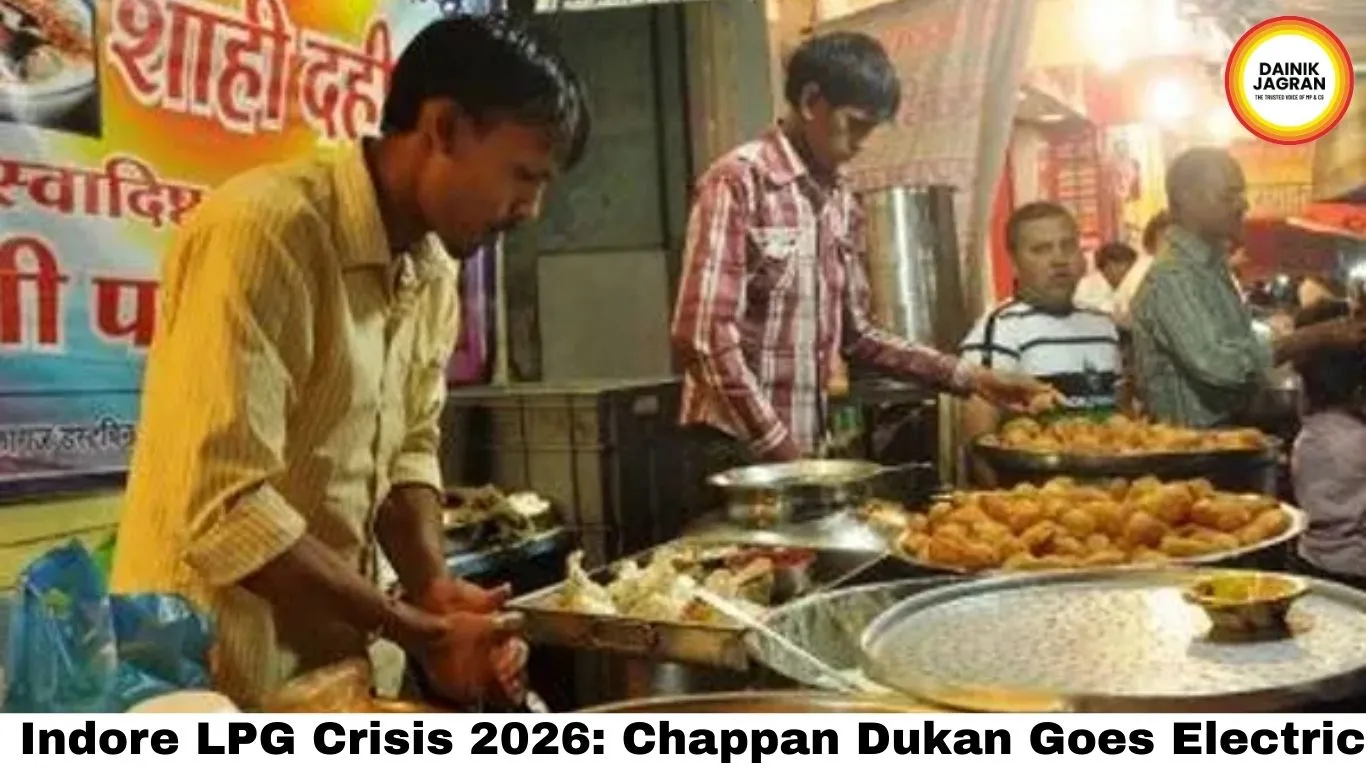
Indore has always worn its identity as India's cleanest city with pride. Its streets are swept, its drains are clear, and its food culture — centred around the legendary Chappan Dukan — is the soul of the city. But this week, for the first time in living memory, the aroma of poha, jalebi and chaat on those 56 famous stalls is being produced not by the familiar blue flame of LPG — but by electric coils, coal fires, and sheer stubborn determination.
At the famous Chappan Dukan street food hub in Indore, vendors have begun swapping traditional gas burners for electric appliances to keep the city's food culture alive. The shopkeepers say they will also consider adopting solar-powered appliances if the situation persists.
This is the human story of the 2026 LPG crisis — and Indore is living it more vividly than almost anywhere else in India.
What Triggered This: A War, an Order, and an 80% Cut
The chain of events that emptied Indore's commercial LPG pipelines did not begin in Madhya Pradesh. It began in the Strait of Hormuz, where the Iran-Israel-US conflict disrupted one of the world's most critical energy corridors.
On March 8, 2026, the Union Ministry of Petroleum and Natural Gas issued the LPG Control Order 2026, directing all refineries to maximise LPG yields exclusively for domestic household use. Under this order, commercial LPG supply has been capped at just 20 per cent of the average monthly requirement to prevent hoarding and black marketing.
For Indore's restaurants, dhabas, tea stalls, and wedding caterers — all running at peak season load — that 80 per cent cut in available commercial gas has been nothing short of devastating.
District Supply Controller ML Maru confirmed that oil marketing companies have suspended commercial LPG cylinder supply to hotels, restaurants, and catering businesses so that common people do not face difficulty in obtaining domestic cylinders. Twitter A logical decision from a supply-management perspective — but one that has landed like a hammer blow on thousands of small business owners who had no warning, no buffer stock, and no alternative plan.
Voice From the Street: "We Cannot Rely on Coal Forever"
The statistics of the LPG crisis tell one story. The voices from Indore's streets tell another — and it is more powerful.
"I run a tea and poha shop here. We are unable to get commercial cylinders due to the shortage. Now, I bought coal on which we are currently operating. We will see for a day or two, or else we will shut it down. We cannot rely on coal for a long time," said Anil, a local shop owner.
Anil's words carry the weight of hundreds of thousands of small vendors across India who are caught in a crisis they did not create and cannot afford to absorb. He sells tea and poha — food that costs ₹10 to ₹20 a plate. His customers are daily wage workers, students, and office-goers. He cannot raise prices. He cannot absorb fuel costs. And coal — while available — is physically punishing, environmentally damaging, and operationally impractical for a small urban food stall.
Meanwhile, larger restaurants have shifted to traditional tandoors and furnaces for most food items, pausing tawa cooking entirely. Operators say service quality and preparation speed have both been affected — making customers wait longer for food that costs the restaurant more to make.
Chappan Dukan's Response: Innovation Under Pressure
While some vendors are struggling, Indore's iconic 56-stall Chappan Dukan food street has responded with a spirit that the city's reputation for enterprise would predict.
Gunjan Sharma, president of the 56 Dukan Chaat Chowpatty Traders Association, confirmed that commercial LPG cylinder supply has been halted. "Therefore, we have purchased electric appliances and started using them," he said. "If necessary, we will consider using solar-powered cooking equipment."
The Chappan Dukan area has been recognised by FSSAI as a Clean Street Food Hub for its compliance with food safety and hygiene standards. That reputation — built over years — is now being defended with induction cooktops and sheer resilience.
This is Indore at its best: adaptive, entrepreneurial, and unwilling to let a global energy crisis shut down its beloved food culture. But resilience has limits — and those limits will be tested if the crisis extends beyond a few weeks.
Beyond Food: Industry and Workers Feel the Burn Too
The LPG crisis is not confined to kitchens. In Indore, industries have reported that both gas cylinders and pipeline gas supplies have been affected, reducing production capacity in several industrial units. The price of gas supplied to industries has been increased by ₹6 per unit — the first such hike in six months — and businesses have been instructed to reduce consumption. Earlier permitted to use up to 20 units of gas, industries are now restricted to around 13 units.
The people most invisibly hurt are the migrant workers and daily wage earners. Street vendors who serve low-cost meals to migrant workers are shutting down because they cannot pass rising fuel costs on to customers who simply cannot afford to pay more. As Sandeep Verma of the Indian Hawkers Alliance put it, this is a double hit — on the livelihoods of vendors and on the food security of the migrant workers who depend on them.
Black market commercial LPG cylinders that were priced at ₹1,750 per cylinder in February 2026 are being sold for ₹1,883 officially in March — and in grey market transactions, premiums of ₹400 to ₹500 per cylinder have been reported across cities. Business Standard For small vendors already operating on paper-thin margins, this is simply not viable.
The Administration Responds — But Is It Enough?
Indore's district administration has launched a dedicated control room to tackle black marketing and monitor LPG distribution. The administration has advised hotels, restaurants, and catering businesses to use alternative fuel sources including electricity and diesel-powered equipment.
At the national level, the Ministry of Petroleum and Natural Gas has confirmed that domestic LPG production has increased by approximately 25 per cent, with the entire output directed toward household consumers. The Home Affairs Ministry has strengthened a round-the-clock control room.
Families are facing refill delays of up to 25 days, with induction stoves now out of stock across many cities as the rush to find alternatives has stripped retail shelves bare.
A control room and a 25% production increase are useful measures — but they are reactive, not structural. The crisis has exposed something far deeper than a temporary supply disruption.
India's Real Problem: 62% Dependence Cannot Survive a War
The LPG crisis of 2026 is not just about fuel — it is about survival, affordability, and the urgent need for stability in energy supply. It shows how deeply India is dependent on imported fuel and emphasises the urgent need for sustainable alternatives.
Here is what must change structurally — and urgently:
- Accelerate PNG network expansion in Indore and all Tier-1 and Tier-2 cities: piped gas is far more resilient to import disruption than cylinder-dependent supply chains.
- Subsidise commercial induction equipment for small vendors: a one-time government scheme to help tea stall and food cart operators transition to electric cooking would reduce LPG dependence permanently.
- Build strategic commercial LPG reserves: India has approximately 22 days of total supply buffer — dangerously thin for a country of 1.4 billion people. Underground cavern storage must be fast-tracked.
- Protect street vendor livelihoods during crisis periods: the Natural Gas Supply Regulation Order must include a specific carve-out or support mechanism for low-margin food vendors who cannot absorb fuel cost shocks.
Indore Will Cook Through This — But India Must Learn From It
Indore's food vendors are a tough, inventive lot. The man selling poha on coal, the Chappan Dukan stall owner firing up an induction cooktop, the restaurant manager rerouting his entire menu through a tandoor — they will find a way through this crisis. Indore always does.
But the 2026 LPG shortage must not be allowed to pass as a temporary inconvenience to be forgotten once the war in West Asia cools and tankers start moving again. It is a loud, visible, undeniable proof that India's energy infrastructure is not built to absorb shocks of this magnitude.
India's Natural Gas Supply Regulation Order of 2026 left a critical gap — the food access of millions of migrant workers who depend on low-cost dhabas and street stalls for their daily meals. That gap cannot appear again.
The flame on Indore's streets may be electric for now. But the urgency of fixing India's energy vulnerability must burn permanently — in every ministry, every policy document, and every infrastructure plan going forward.
Chappan Dukan will survive. The question is whether India's energy policy will finally learn the lesson it is being taught.
.jpg)




