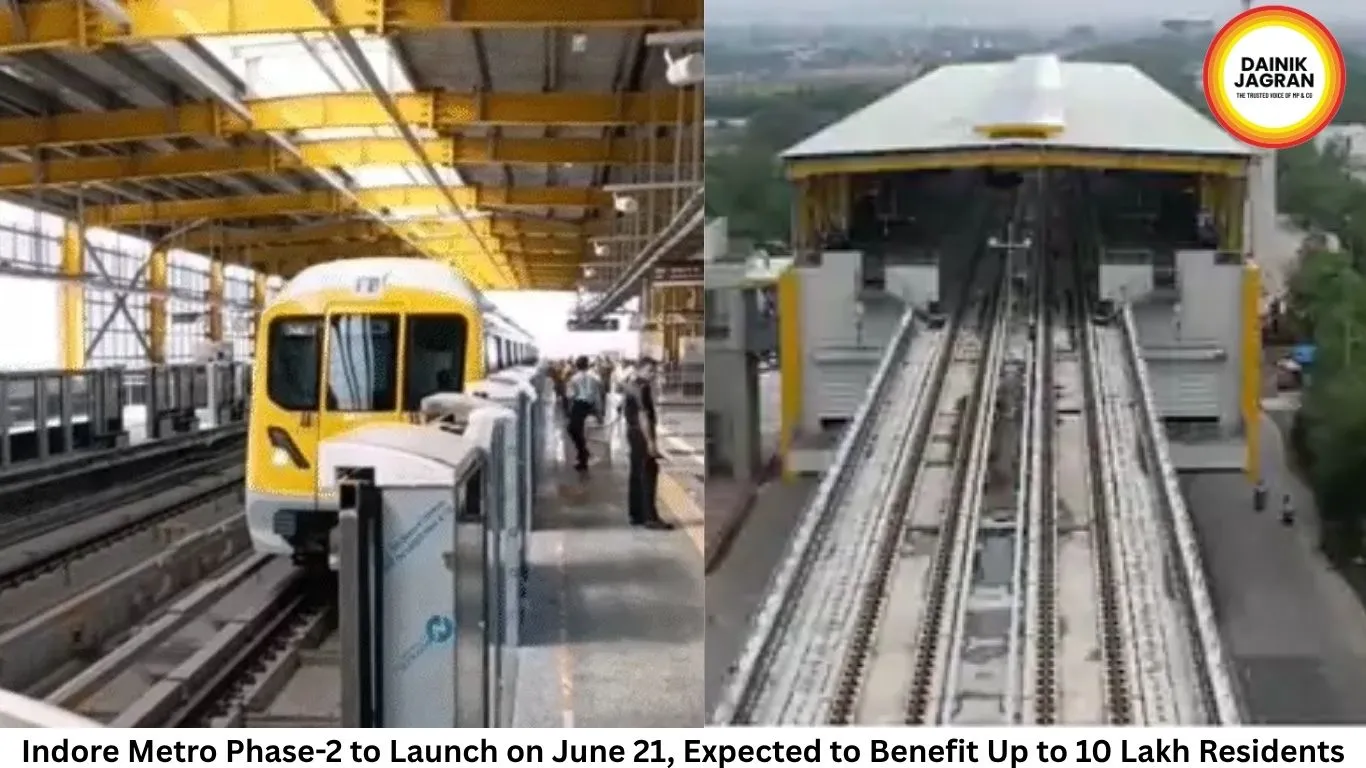
Indore Metro Phase-2 to Launch on June 21, Expected to Benefit Up to 10 Lakh Residents
Digital Desk
The expansion marks a major milestone for urban transport in Madhya Pradesh. Officials expect the new corridor to significantly improve connectivity between the city's airport zone, IT parks, business districts and residential neighborhoods.
The second phase of Indore Metro's Yellow Line is set to become operational from June 21, following its inauguration by Chief Minister Dr. Mohan Yadav and Union Housing and Urban Affairs Minister Manohar Lal Khattar on June 20. The newly approved stretch between Super Corridor-2 and Radisson Square is expected to emerge as the busiest section of the metro network, serving a population base that could eventually reach nearly 10 lakh people.
According to officials, the new corridor will provide direct connectivity to several high-density residential and commercial areas, including Super Corridor, Gandhi Nagar, Lavkush, Sukhliya, Vijay Nagar, Scheme-78, Scheme-54 and Radisson Square. These locations witness heavy daily movement of office-goers, students and business travelers.
Metro authorities estimate that around 4 to 6 lakh residents will directly benefit from the corridor. When feeder bus services and other public transport connections are integrated, the reach of the network could expand to nearly 8 to 10 lakh commuters.
IT Hub and Airport Connectivity
One of the key highlights of the new route is its connectivity to Indore's growing information technology ecosystem. The corridor passes through areas housing major technology companies, including TCS, Infosys and Yash Technologies, along with the Special Economic Zone (SEZ), IT Park and several corporate offices.
The route also improves access to educational institutions, hotels and the airport area, making it a strategically important transit corridor. Industry experts believe the presence of thousands of employees working in these business districts will contribute significantly to metro ridership.
Officials estimate that daily passenger numbers may initially range between 25,000 and 40,000. As development along the Super Corridor accelerates, daily ridership could increase to between 60,000 and one lakh passengers.
Fare and Schedule Under Review
Ahead of the launch, the Madhya Pradesh Metro Rail Corporation Limited (MPMRCL) is finalizing operational details, including fares, train frequency and service timings. Senior officials are holding regular review meetings in Bhopal to ensure readiness before the public rollout.
The complete operational schedule for the expanded corridor is expected to be announced shortly. Once operational, the metro will run across approximately 17 kilometers and serve a total of 16 stations between Gandhi Nagar and Radisson Square.
Metro management sources said the inauguration was initially planned for June 15 but was rescheduled due to the Rajya Sabha election process. June 20 has now been finalized for the official launch ceremony.
Indore Ahead of Bhopal
The latest expansion further strengthens Indore's lead over Bhopal in metro development. Indore Metro's first phase was inaugurated on May 31, 2025, while Bhopal Metro's priority corridor between Subhash Nagar and AIIMS opened nearly seven months later in December 2025.
Metro officials attribute the faster pace in Indore to the fully elevated design of its corridors. In contrast, Bhopal's second phase includes a 3.39-kilometer underground tunnel section, requiring more complex engineering work.
Construction of Bhopal Metro's underground corridor is expected to continue until 2028. The project includes two underground stations at Bhopal and Nadra and will eventually connect key areas through the Orange and Blue Lines.
Future of Urban Transit
Urban transport experts view the Indore Metro expansion as a crucial step toward reducing road congestion and improving mobility in one of Madhya Pradesh's fastest-growing cities. With daily traffic volumes on the corridor already estimated at nearly 10 lakh commuters through private and public transport, the metro is expected to provide a faster and more sustainable alternative.
As the network expands further, authorities hope the project will encourage greater use of public transportation while supporting the city's long-term economic and infrastructure growth plans.
--------
๐จ Beat the News Rush โ Join Now!
Get breaking alerts, hot exclusives, and game-changing stories instantly on your phone. No delays, no fluff โ just the edge you need. โก
Tap to join:ย
๐ข WhatsApp Channel: Dainik Jagran MP CG
Crave more?
๐ Facebook: Dainik Jagran MP CG English
๐ ง Twitter (X): Dainik Jagran MP CG
๐ Instagram: Dainik Jagran MP CG
Share the fire โ keep your crew ahead! ๐๏ธ๐ฅ
Indore Metro Phase-2 to Launch on June 21, Expected to Benefit Up to 10 Lakh Residents
Digital Desk
The second phase of Indore Metro's Yellow Line is set to become operational from June 21, following its inauguration by Chief Minister Dr. Mohan Yadav and Union Housing and Urban Affairs Minister Manohar Lal Khattar on June 20. The newly approved stretch between Super Corridor-2 and Radisson Square is expected to emerge as the busiest section of the metro network, serving a population base that could eventually reach nearly 10 lakh people.
According to officials, the new corridor will provide direct connectivity to several high-density residential and commercial areas, including Super Corridor, Gandhi Nagar, Lavkush, Sukhliya, Vijay Nagar, Scheme-78, Scheme-54 and Radisson Square. These locations witness heavy daily movement of office-goers, students and business travelers.
Metro authorities estimate that around 4 to 6 lakh residents will directly benefit from the corridor. When feeder bus services and other public transport connections are integrated, the reach of the network could expand to nearly 8 to 10 lakh commuters.
IT Hub and Airport Connectivity
One of the key highlights of the new route is its connectivity to Indore's growing information technology ecosystem. The corridor passes through areas housing major technology companies, including TCS, Infosys and Yash Technologies, along with the Special Economic Zone (SEZ), IT Park and several corporate offices.
The route also improves access to educational institutions, hotels and the airport area, making it a strategically important transit corridor. Industry experts believe the presence of thousands of employees working in these business districts will contribute significantly to metro ridership.
Officials estimate that daily passenger numbers may initially range between 25,000 and 40,000. As development along the Super Corridor accelerates, daily ridership could increase to between 60,000 and one lakh passengers.
Fare and Schedule Under Review
Ahead of the launch, the Madhya Pradesh Metro Rail Corporation Limited (MPMRCL) is finalizing operational details, including fares, train frequency and service timings. Senior officials are holding regular review meetings in Bhopal to ensure readiness before the public rollout.
The complete operational schedule for the expanded corridor is expected to be announced shortly. Once operational, the metro will run across approximately 17 kilometers and serve a total of 16 stations between Gandhi Nagar and Radisson Square.
Metro management sources said the inauguration was initially planned for June 15 but was rescheduled due to the Rajya Sabha election process. June 20 has now been finalized for the official launch ceremony.
Indore Ahead of Bhopal
The latest expansion further strengthens Indore's lead over Bhopal in metro development. Indore Metro's first phase was inaugurated on May 31, 2025, while Bhopal Metro's priority corridor between Subhash Nagar and AIIMS opened nearly seven months later in December 2025.
Metro officials attribute the faster pace in Indore to the fully elevated design of its corridors. In contrast, Bhopal's second phase includes a 3.39-kilometer underground tunnel section, requiring more complex engineering work.
Construction of Bhopal Metro's underground corridor is expected to continue until 2028. The project includes two underground stations at Bhopal and Nadra and will eventually connect key areas through the Orange and Blue Lines.
Future of Urban Transit
Urban transport experts view the Indore Metro expansion as a crucial step toward reducing road congestion and improving mobility in one of Madhya Pradesh's fastest-growing cities. With daily traffic volumes on the corridor already estimated at nearly 10 lakh commuters through private and public transport, the metro is expected to provide a faster and more sustainable alternative.
As the network expands further, authorities hope the project will encourage greater use of public transportation while supporting the city's long-term economic and infrastructure growth plans.