


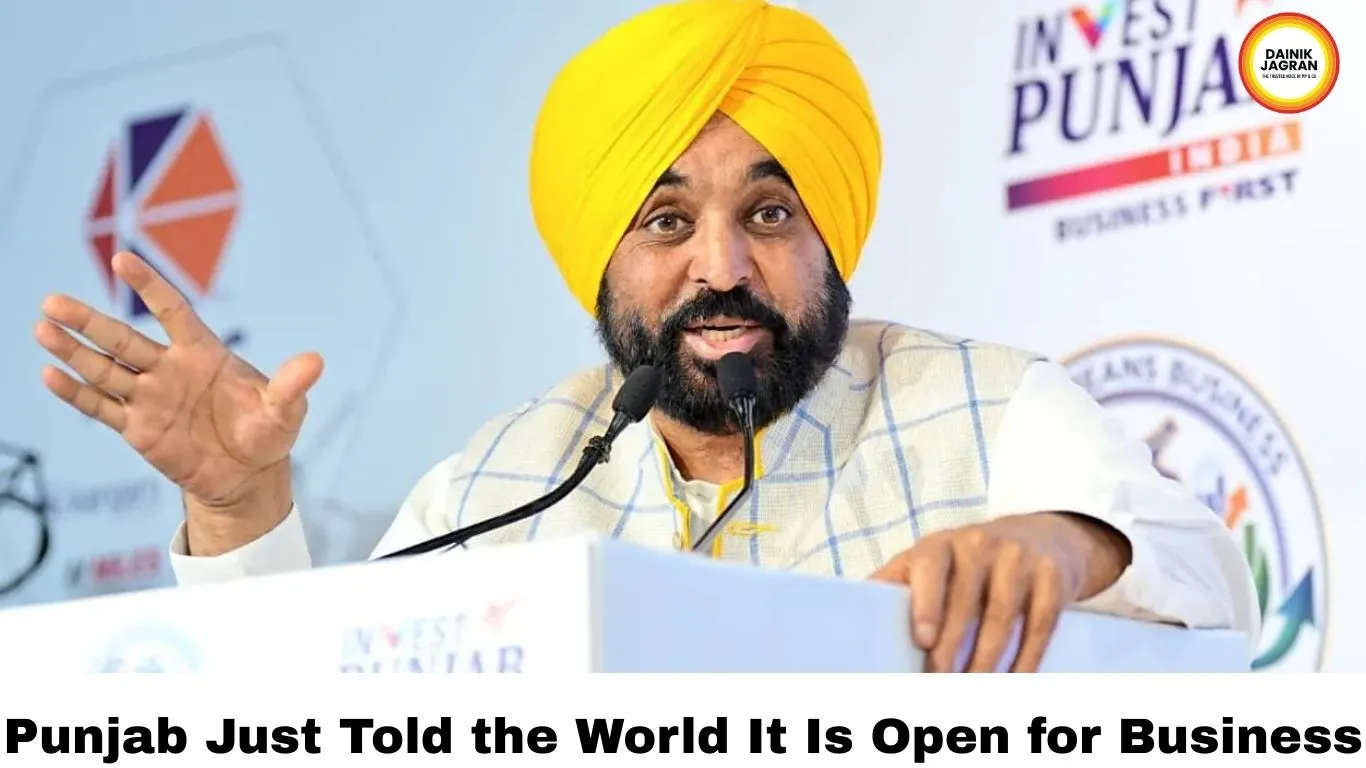
Punjab Just Told the World It Is Open for Business — and Industry Listened
Digital Desk
Three Days in Mohali That Changed Punjab's Economic Story
When the Bhagwant Mann government announced it would host a major investors summit at Plaksha University in Mohali from March 13 to 15, sceptics had a ready list of reasons to doubt: a state wrestling with farm debt, migration pressures, a drug crisis that has defined its public image for a decade, and the general perception that industrial investment follows infrastructure-rich states like Gujarat, Maharashtra, and Karnataka — not Punjab.
Three days later, that scepticism had been considerably quieted. The Progressive Punjab Investors Summit 2026 concluded on March 15 with investment commitments totalling ₹1.58 lakh crore since 2022 — a cumulative figure that the state government says is generating employment for over 5.5 lakh youth. On the opening day alone, fresh commitments worth over ₹10,000 crore were secured from some of India's largest industrial names. The summit was not just an event. It was a statement.
Who Showed Up — And What They Promised
The quality of the corporate commitment at PPIS 2026 matters as much as its quantity. When HMEL, Tata Steel, JSW Group, Trident Group, and Hero Industries collectively announce expansion plans in your state on a single day, you are no longer pitching Punjab as an emerging option. You are confirming it as an established one.
HMEL — Hindustan Mittal Energy Limited, the Bhatinda-based refinery that is already one of Punjab's most significant industrial anchors — announced further capacity expansion, deepening its long-term commitment to the state. Tata Steel's announcement to expand in Punjab connects India's largest steel producer to a state that has historically been stronger in agriculture and light manufacturing than in heavy industry. JSW Group's commitment follows a pattern of the conglomerate identifying state governments that can move quickly on industrial approvals — and Punjab's 45-day single-window clearance system has evidently passed that test.
Trident Group, which already has a substantial textile and paper manufacturing presence in Punjab, announced further investment — a reconfirmation by an existing major player that the business environment has improved rather than deteriorated since their initial commitment. Hero Industries' announcement adds the two-wheeler and components sector to a portfolio of commitments that now spans steel, petrochemicals, textiles, and technology.
Beyond the big industrial names, the technology sector session generated what organisers described as an overwhelming response. Punjab's offer to the IT and ITeS sector — structured around the theme of promoting Global Capability Centres with speed, clarity, and aftercare — drew significant interest from firms looking for alternatives to saturated Bengaluru, Hyderabad, and Pune markets. The state's incentive package for GCCs is specific and substantial: an employment generation subsidy of ₹7,500 per employee per month for five years for the first ten GCC units, alongside 75 percent SGST reimbursement for ten to fifteen years, a capital subsidy of up to 20 percent of Fixed Capital Investment capped at ₹10 crore, and 100 percent electricity duty exemption for up to fifteen years.
The ambition, clearly articulated by the Punjab Development Commission and the Additional Chief Secretary for IT, is to develop Mohali as a Tier 1 city in the IT sector — placing it in the same category as the established tech capitals rather than accepting its current status as a secondary destination.
Plaksha's 35 Startups: The Summit's Most Forward-Looking Story
The most compelling narrative from PPIS 2026 was not the marquee industrial commitments — important as those are. It was the showcase of 35 startups from Plaksha University's innovation ecosystem, presented at the very venue that hosted the summit.
Plaksha University — founded through a unique collective philanthropy model by over 130 business leaders and entrepreneurs — has built, in a remarkably short time, an incubation ecosystem where over 60 percent of startups are focused on AI and deep technology. Collectively, startups from the Plaksha community have raised over ₹25 crore in external funding. Alumni-led ventures like Marbles Health are already delivering real-world applications.
The decision to host a summit of this ambition at a technology university campus rather than at a conventional convention centre was itself a signal — an assertion that Punjab's economic future runs through innovation and human capital, not just agricultural output or heavy industry. Neeraj Aggarwal, Chair of the Board of Trustees at Plaksha, articulated the vision precisely: universities must not merely support innovative ideas but become platforms for those ideas to become ventures that solve real problems.
When industrial giants from Tata and JSW sit in the same campus as 35 young startups building AI and deep-tech ventures — and both groups find compelling reasons to be in Punjab — you are witnessing an economic ecosystem beginning to cohere.
Kejriwal and Mann: The Political Economy of the Summit
Both Chief Minister Bhagwant Mann and AAP National Convenor Arvind Kejriwal addressed the summit — and their messages, while complementary, had distinct audiences.
Mann spoke in the language of pride and possibility: Punjabis are entrepreneurial by nature, the investment commitments since 2022 prove the state's potential, and the summit marks the beginning of a new phase of economic growth. His message was directed at investors present in the room: Punjab has earned your trust, and here is the tangible evidence.
Kejriwal spoke in the language of systemic contrast: for 75 years, governance systems failed to give people the opportunity to grow, but the AAP model — transparent, fast, corruption-reduced — is changing that environment. He promised every facility needed for Punjab industries to compete globally, including with China. His 45-day clearance system has already attracted ₹1.50 lakh crore in four years, he told investors. The implicit message: the governance model is the product, and the investment numbers are the proof of concept.
Together, the two messages construct a political economy narrative that the AAP government is betting its 2027 re-election campaign on: that good governance produces economic outcomes, that economic outcomes are visible and measurable, and that voters will reward the party that delivered them.
Whether the commitments signed at PPIS 2026 translate into factories built, jobs created, and payslips issued before the next Punjab election is the test of that narrative — and it is a test that investors, workers, and voters will all be watching.
The Cultural Evening: Punjab Remembered to Be Itself
One of the summit's most memorable moments was entirely unrelated to investment commitments. On the closing evening, delegates were taken to the Mohali Golf Range for a cultural evening featuring Punjabi folk dance by the Jugni Cultural Group and performances by singers Ranjit Bawa and Harjit Harman.
Investors who had spent three days in sessions on GCC policy and steel capacity expansion watched a Bhangra performance, ate authentic Punjabi food, and left with an experience of Punjab's living culture rather than just its industrial data. Multiple international delegates specifically praised this aspect of the summit in their public remarks.
It is a small thing — a cultural evening at an investment summit. But it reflects an understanding that investment decisions are not made on spreadsheets alone. They are made by people who form impressions of places, communities, and governments. Punjab chose to remind its guests that the state is not only a policy package. It is a civilisation with warmth, energy, and the particular irreplaceable quality of knowing how to celebrate.
Opinion: ₹1.58 Lakh Crore Is a Number. Jobs Are the Test.
The Progressive Punjab Investors Summit 2026 has produced impressive numbers, genuine corporate commitments from credible industrial names, and a technology investment narrative centred on Mohali that has real substance behind it. The 45-day single-window clearance system — if it works as described — is exactly the kind of structural improvement that separates states that attract investment from those that merely announce it.
But investment commitments and investment delivered are different things. The ₹1.58 lakh crore in commitments since 2022 represents the pipeline, not the output. The 5.5 lakh jobs expected from those commitments represent the promise, not the payslip. Punjab's youth — the generation that the summit was ultimately about — will judge this government not on the commitments signed in a room at Plaksha University but on the jobs available when they graduate.
The summit was a good three days. Now comes the hard part: making sure every commitment becomes a project, every project becomes a factory, and every factory becomes a job. Punjab has earned the attention of industrial India. Converting that attention into durable prosperity for its people is the work that starts on Monday morning.
.jpg)




