


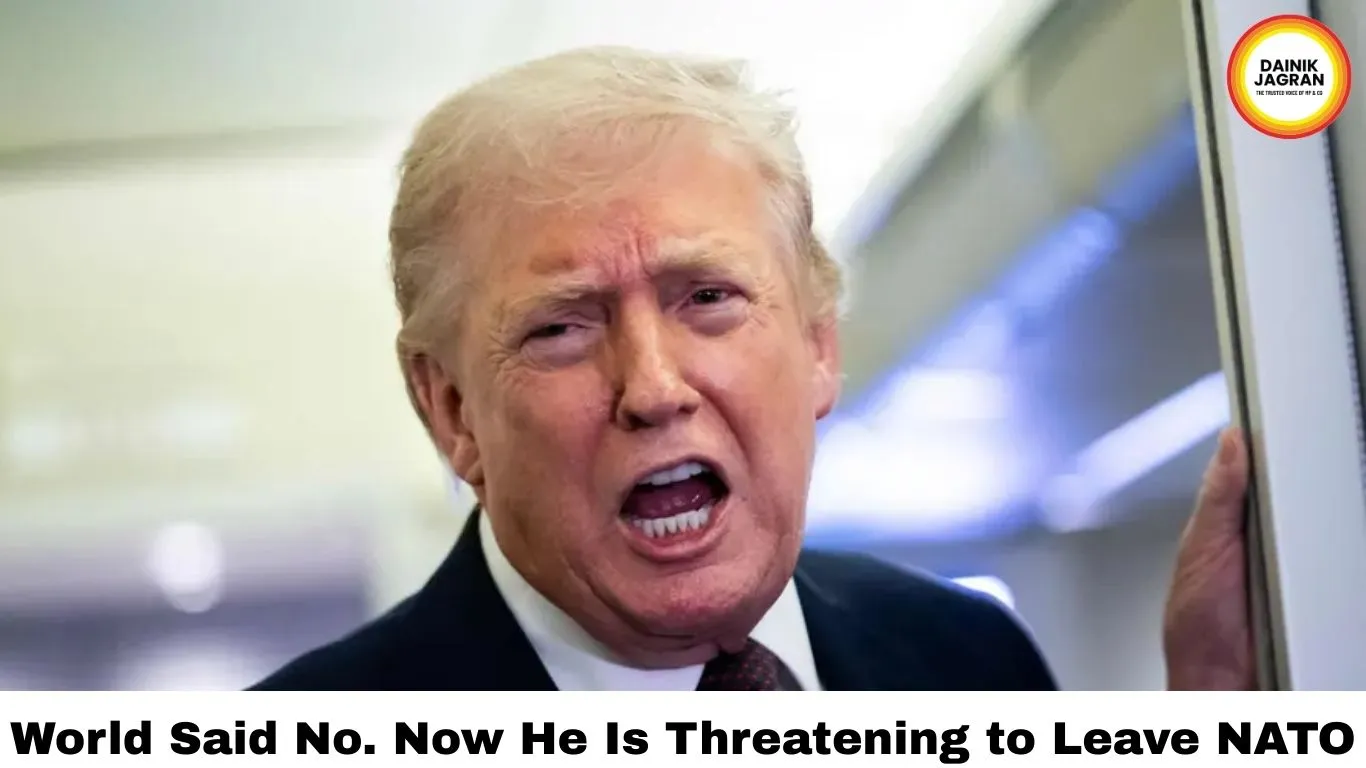
Trump Wanted the World to Open Hormuz. The World Said No. Now He Is Threatening to Leave NATO.
Digital Desk
The Alliance That Was Not There When Trump Needed It
Three weeks ago, Donald Trump launched a war he did not consult his allies about. This week, he asked those same allies to help him clean it up. Their answer, delivered in the chancelleries of Berlin, the parliament buildings of Tokyo, the cabinet rooms of Canberra, and the briefing rooms of Brussels, was essentially the same across every capital: no.
The collapse of Trump's attempt to build a naval coalition to reopen the Strait of Hormuz is now the defining diplomatic story of the West Asia war — and it has produced a cascade of consequences that nobody, including the Trump administration, appears to have fully anticipated. Oil is back above $103 per barrel. Iran's new Supreme Leader has publicly rejected de-escalation. The highest-ranking Trump administration official to resign in protest has done so. And Trump, apparently stunned by the breadth of the allied refusal, has now threatened to leave NATO entirely.
The war that began with missiles is increasingly being fought with isolation.
How the Coalition Collapsed: Country by Country
The sequence of refusals, played out over four days from March 14 to 17, was remarkable in its consistency and its bluntness.
Germany moved first and hardest. The spokesperson for Chancellor Friedrich Merz stated flatly that as long as the war continues, there would be no German involvement — not even an option to keep the Strait of Hormuz open by military means. The spokesperson added a pointed observation: the United States and Israel did not consult Germany before the war, and Washington explicitly stated at the start of hostilities that European assistance was neither necessary nor desired. The implicit question — why should Germany now be expected to help manage consequences of a war it was told it was not needed for — was not subtle.
Japan's Prime Minister ruled out sending naval vessels. Australia's government confirmed it would not participate. Italy's Foreign Minister backed reinforcing EU naval missions in the Red Sea but explicitly ruled out expanding them to the Strait of Hormuz. Poland, Sweden, and Spain similarly declined. South Korea said it was reviewing the situation — diplomatic language that, combined with every other signal, reads as a polite no in the process of being formalised.
The United Kingdom occupied the most complicated position. Prime Minister Keir Starmer told reporters he was working with allies on a plan to reopen the Strait, but explicitly said it would not be a NATO mission and that Britain would not be drawn into the wider war. Britain has provided access to its military bases for what it called limited defensive action, has discussed mine-hunting drone options, and has drafted a coalition plan shared with the United States and several other countries. The UK plan — built around the framework of Operation Aspides, the EU's existing naval mission — represents the only serious allied proposal on the table. But it is a proposal, not a commitment, and several nations it was shared with have responded with scepticism ranging to outright rejection.
The EU's foreign policy chief acknowledged that all member states would need to agree before Aspides operations could be expanded, describing the political geography of that consensus as deeply uncertain.
Trump's Escalating Response: Threats, Then Retreat
Trump's reaction to the coalition's collapse moved through three stages with unusual speed.
First came pressure: he called the Hormuz coalition a test for NATO countries and warned publicly that those who refused would be remembered. He argued the effort was a very small endeavour — merely keeping a shipping lane open — and criticised the alliance he has long described as a one-way street, noting that the US had always been there for NATO on Ukraine, on defence spending, on security guarantees. He also claimed, on Monday, that numerous countries had told him privately they were on their way, while declining to name any of them. Secretary of State Marco Rubio was said to be preparing an official announcement on coalition members — an announcement that has not materialised publicly.
Then came the pivot: by Tuesday, Trump announced that the United States had been informed by most NATO allies they did not want to get involved in the military operation against Iran. His tone shifted from demanding to dismissive — he no longer needed their help, he said. He would work with Israel and Gulf countries instead.
Then came the threat that sent European diplomatic circles into genuine alarm: Trump stated publicly that he was thinking about leaving NATO. It was not an off-hand comment. It was a prepared statement on social media, directly connected to the Hormuz refusal, in the middle of an active war.
Whether Trump will follow through on a NATO exit threat — an action that would require Congressional involvement and would face massive institutional resistance — is a separate question from whether the threat itself has already done damage. It has. Every NATO member that refused the Hormuz coalition request is now publicly associated with a threat to the alliance's existence by its most powerful member. The political costs of that association, across domestic European political landscapes already under pressure from right-wing nationalist movements, are not trivial.
Iran's New Supreme Leader: No De-escalation, No Negotiations
The allied refusal to help open the Strait of Hormuz matters most because of what Iran's new leadership has said it means for the war's trajectory.
Mojtaba Khamenei — the son of the assassinated Supreme Leader, who assumed power after his father's death on February 28 — has now made his first substantive policy statements, and they contain nothing that suggests a man preparing for compromise. He has rejected de-escalation proposals conveyed to Tehran by intermediaries, demanding that Israel and the United States first be brought to their knees. He has stated that the Strait of Hormuz will remain closed as leverage for Iran during the conflict. Iranian Foreign Minister Araghchi has simultaneously maintained that the Strait is open to everyone except US, Israeli, and allied vessels — a distinction that preserves legal cover while achieving the same practical chokehold.
Iran has now conducted 21 confirmed attacks on merchant ships since the conflict began. Brent crude has risen more than 40 percent since February 28 and was trading near $103 on Tuesday as Iran stepped up attacks on Gulf energy infrastructure. A drone struck a fuel tank at Dubai International Airport, causing a fire. Further strikes have been reported at ports and energy facilities across the Gulf. The UAE, Saudi Arabia, Kuwait, and Qatar have all reported Iranian attacks on their territory — a widening of the conflict's geographic footprint that makes the Hormuz coalition question more urgent with each passing day.
Iran's top official summary of the new Supreme Leader's position is not ambiguous: the Strait stays closed until the enemy is brought to its knees or a satisfactory agreement is reached. No intermediary proposal has met that bar. None appears likely to in the near term.
The Internal Crack: A Resignation That Changes the Story
In the middle of the coalition collapse and the NATO threat, a detail emerged from inside the Trump administration that deserves more attention than it has received.
The director of the United States National Counterterrorism Centre publicly announced his resignation — largely attributing his decision to what he described as Israeli influence in the decision to launch Operation Epic Fury against Iran. He became the highest-ranking Trump administration official to publicly disavow the decision to attack Iran.
A resignation of this nature — from the head of the counterterrorism function, citing concern about the decision-making process that produced the war — is not a routine departure. It is a signal that the intelligence and national security apparatus contains significant internal disagreement about whether this war was the right call, whether its objectives are achievable, and whether the path currently being followed leads to the outcome the administration claims to want.
That signal has been largely buried under the noise of the coalition diplomacy. It should not be.
What This Means for India: Navigating the Wreckage
India's position in this rapidly evolving landscape is one of the most delicate it has occupied in decades. Three Indian LPG tankers have successfully traversed the Strait through bilateral diplomatic arrangements with Tehran. The Indian Navy has been deployed in escort capacity for Indian-flagged vessels. PM Modi has spoken with Iranian President Pezeshkian. External Affairs Minister Jaishankar has maintained direct channels with Tehran.
This approach — direct, bilateral, non-confrontational, and entirely separate from the collapsing US-led coalition — is India's only viable path. India cannot join a military coalition against a country it imports 40 percent of its LPG from, whose passage India just negotiated for its own tankers. It also cannot publicly refuse Trump's coalition demand in the same way that Germany has, given the India-US strategic partnership and India's broader foreign policy equities.
India's answer, expressed through action rather than statement, has been to build a parallel track: negotiate with Tehran directly, deploy naval assets quietly, secure passage for Indian vessels without making it a geopolitical statement, and let the results — three ships docked in Gujarat — speak for themselves. It is, under the circumstances, exactly the right approach.
When You Start a War, You Own the Consequences
The image of Donald Trump demanding that Germany, Japan, Australia, and the UK send warships to clean up a maritime crisis created by a war he launched without consulting them — and then threatening to leave NATO when they declined — is one of the most extraordinary diplomatic sequences in the post-war international order.
It is worth stating plainly: Trump started this war without allied consultation, told European partners explicitly that their help was neither necessary nor desired, and now needs their naval assets to manage its consequences. The German government's response — pointing out precisely this contradiction in public — was not petulance. It was an accurate statement of the situation.
The Strait of Hormuz will not remain closed indefinitely. No economic pressure of this scale is sustainable for any of the parties involved. Iran's economy is being decimated. Global energy markets cannot absorb $150 oil without triggering recessions across multiple major economies. The pressure for some form of negotiated exit from this crisis is building from every direction.
But the path to that exit has been made significantly harder by the collapse of the coalition, the hardening of Iran's new leadership position, and the damage to the US alliance architecture that the past four days have inflicted. The world that emerges from this crisis — whenever it ends — will not look quite the same as the world that entered it on February 28.
Trump wanted the world to open the Strait. The world said no. And in that refusal, something significant about the architecture of the international order — and America's place within it — has shifted. Whether temporarily or permanently, only the next chapter will tell.
.jpg)




