


How Section 25 of the Electricity Act 2003 Is Reshaping India's Power Politics — And Why States Are Pushing Back
Digital Desk
Every time your electricity bill goes up, or your state struggles to buy cheaper power from a neighbouring region, there is a good chance Section 25 of the Electricity Act, 2003 has something to do with it. It is one of the most consequential — and least discussed — provisions in Indian energy law. And right now, it sits at the centre of a major policy battle between the Union government and state governments.
What Section 25 Actually Does
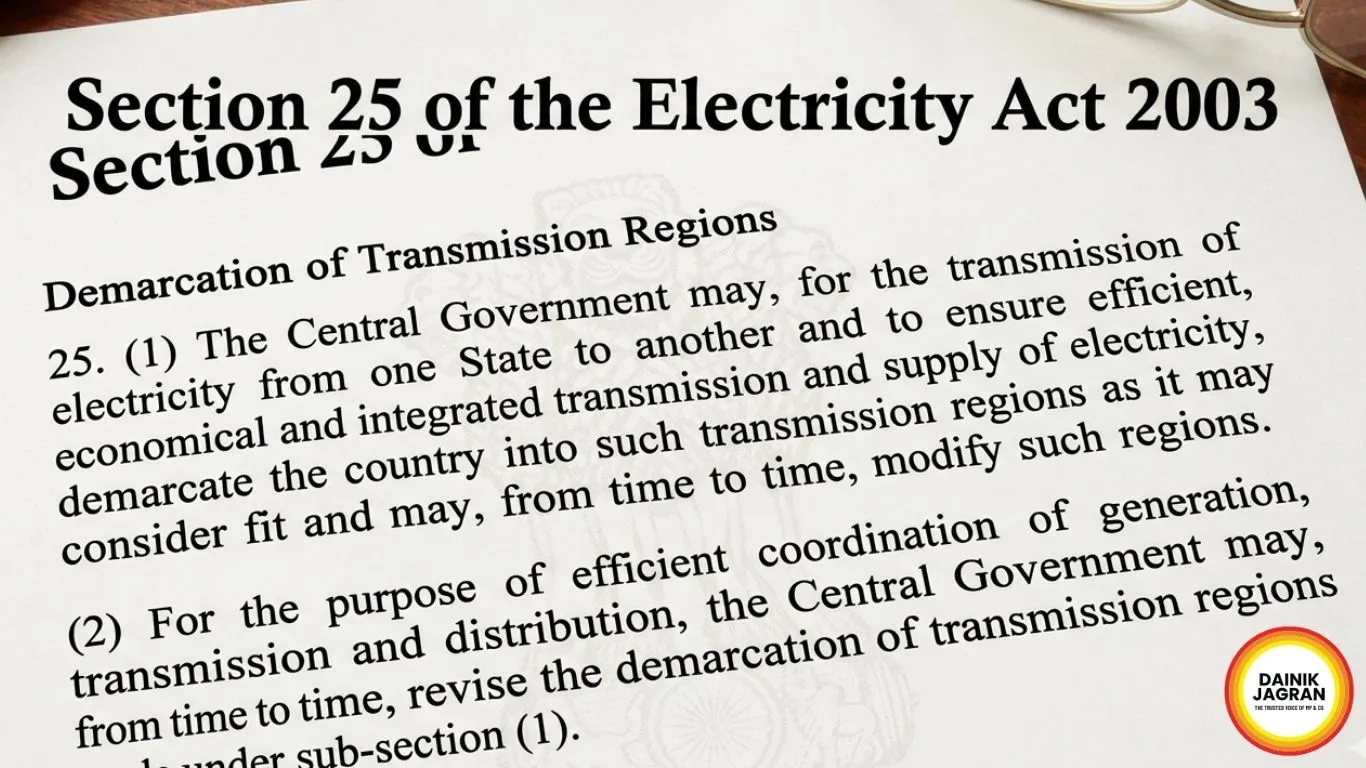
Section 25 of the Electricity Act empowers the Central Government to make region-wise demarcation of the country and to modify such demarcations as it considers necessary for the efficient, economical, and integrated transmission and supply of electricity — and to facilitate voluntary interconnections and co-ordination of facilities for inter-state, regional, and inter-regional generation and transmission. Prayaspune
In plain language: the Centre decides which states belong to which power region — North, South, East, West, and North-East — and it sets the rules for how power moves between them. States have little say in this arrangement.
Why States Are Increasingly Frustrated
The five-region model made sense in the 1990s when power grids were fragmented. But India's energy landscape has changed dramatically. The country has achieved decentralisation and diversification in electricity generation and consumption, and the electricity grid has now transformed into one national grid, making regional grids practically obsolete. Many states that form the boundary of a region are unable to draw or export cheaper power from adjoining regions due to regional bias and differentiation. Cercind
This is not a small inconvenience. It means a state sitting next to a surplus power region can still face shortages — not because electricity is unavailable, but because the regional rules get in the way.
The 2025 Amendment: A Turning Point for Section 25
The Union government introduced the draft Electricity Amendment Bill 2025 in October, described as the first major overhaul of the Electricity Act 2003 in almost two decades, seeking to reform the Indian power sector to make it financially resilient, environmentally sustainable, and capable of supporting globally competitive industries. Power Ministry
Crucially, the Amendment Bill proposes adding a proviso to Section 25, empowering the Appropriate Government to prescribe the manner of approval and implementation of both Inter-State Transmission Systems and Intra-State Transmission Systems — providing an explicit legal basis for the delegation of powers with respect to transmission projects. MNRE
This sounds technical, but the implications are significant. It means states could gain more direct say in how transmission projects within their borders are planned and approved — something they have long demanded.
States Push Back — And the Centre Is Listening
The Union government is recalibrating key provisions of the Electricity Amendment Bill 2025 after receiving extensive feedback from regulators, consumer groups, and state governments, even as it signals intent to move ahead with legislation aimed at opening up power distribution and enforcing greater financial discipline among utilities. Py
State governments — particularly those with surplus renewable energy capacity like Rajasthan, Gujarat, and Tamil Nadu — argue that the current framework unfairly restricts their ability to sell power across regional boundaries at market rates. They want to be treated as independent entities within a national grid, not as sub-units of an artificially drawn regional bloc.
What Needs to Change
Energy policy analysts broadly agree on three things:
- The five-region model must be replaced with a state-as-unit model for commercial settlements within the national grid.
- Transmission approval processes under Section 25 must be faster and more transparent, with clear timelines.
- States must be given genuine consultation rights — not just feedback windows — before the Centre alters regional boundaries.
The Centre has already notified the Electricity Amendment Rules 2026, introducing changes to the framework governing captive power generation, aimed at reducing regulatory ambiguity and supporting India's push toward cleaner, more reliable energy for industry. India Code This is a step forward — but Section 25 reform remains the bigger prize.
The Bottom Line
Section 25 of the Electricity Act 2003 was designed for a different era of Indian power infrastructure. Today, with a unified national grid, booming renewable energy, and states demanding competitive access to cheaper electricity, the provision has become a pressure point in Centre-state relations. The Electricity Amendment Bill 2025 opens the door to meaningful reform — but only if the government goes beyond cosmetic changes and gives states the structural autonomy they need. The lights may be on across India, but the real power struggle is just getting started.
.jpg)




