


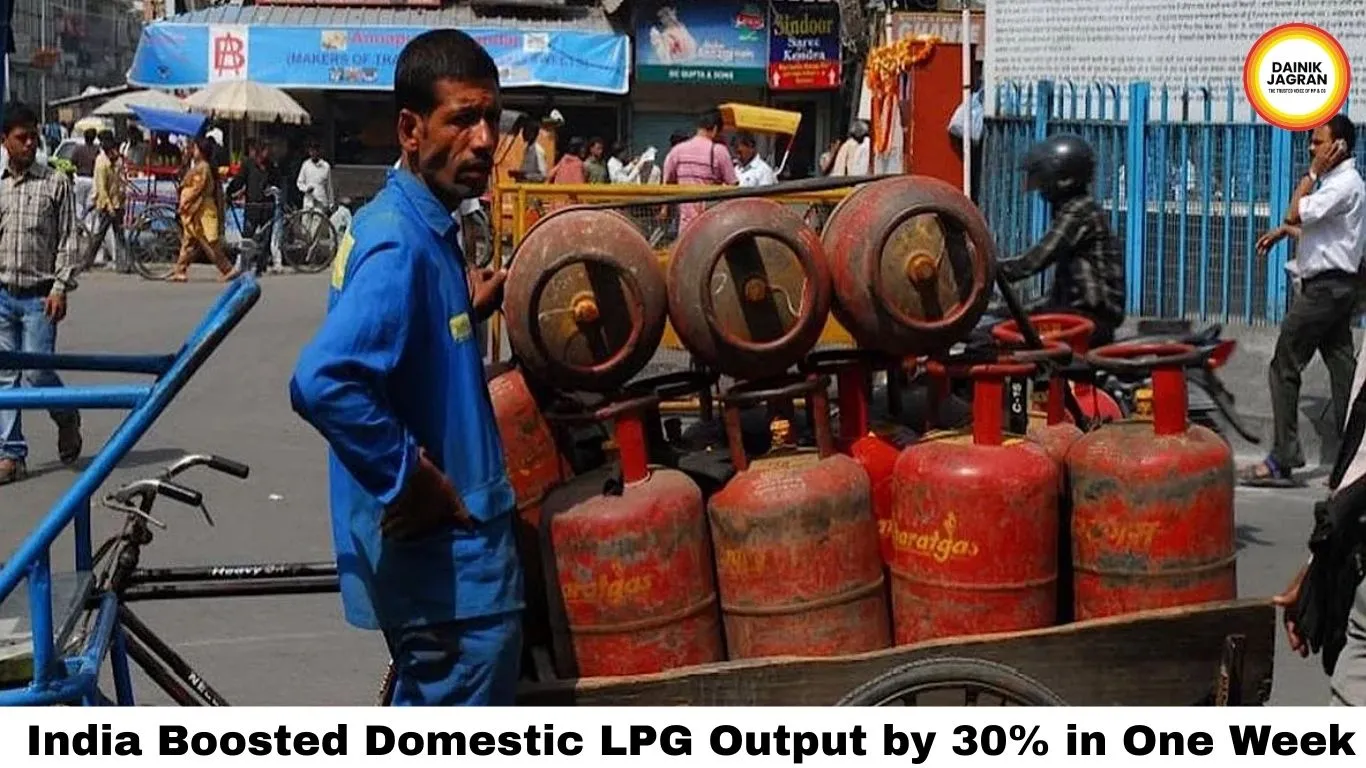
India LPG Production Up 30% in 7 Days: How Refineries Are Filling the Hormuz Gap — Full Explainer on What Changed, How It Works, and Why It Still May Not Be Enough
Digital Desk
When the Strait of Hormuz effectively closed on February 28, 2026, India was suddenly cut off from approximately 60 percent of its LPG supply. The government's response — rapid, technical, and unprecedented in peacetime — managed to ramp up domestic production by 30 percent within seven days. It is an impressive engineering achievement. It is also, by itself, nowhere near enough. Here is the full story of how India turned its refineries into emergency LPG factories — and why the deficit remains dangerously wide.
The Numbers: From 10% to 30% in Seven Days
The trajectory of India's domestic LPG production increase tells the story of a government acting in escalating urgency:
By March 10 — two days after the Control Order — domestic output had risen by approximately 10 percent above baseline levels. By March 12, Joint Secretary Sujata Sharma at the Ministry of Petroleum and Natural Gas confirmed at an inter-ministerial briefing that the increase had reached 25 percent. By March 13, the government was reporting a 28 to 30 percent increase in domestic LPG production compared to March 5 levels — the baseline week before the Hormuz closure began to bite.
The entire production surge was achieved in approximately seven days, without building any new capacity, without importing additional feedstock, and without disrupting petrol or diesel supply.
The Legal Instrument: LPG Control Order, March 8
The legal foundation for this rapid production increase was the LPG Control Order issued on March 8, 2026 — a sweeping directive under the Essential Commodities Act, one of India's most powerful economic emergency statutes. The order contained three binding instructions:
First, all oil refining companies — including their petrochemical complexes — were directed to maximise LPG yields from their refinery streams. Second, all output of C3 and C4 hydrocarbon streams — comprising propane, butane, propylene, and butenes — was to be channelled exclusively to the three Oil Marketing Companies for domestic cooking gas. Third, refineries were prohibited from diverting, utilising, cracking, converting, or otherwise employing these streams for the manufacture of petrochemical products or downstream derivatives.
The third instruction is the most consequential. In normal times, propylene and butenes are enormously valuable petrochemical feedstocks — raw material for plastics, synthetic rubbers, and industrial chemicals. Diverting them entirely to the LPG pool costs India's petrochemical industry significantly. The government made that trade-off deliberately and without hesitation.
The Chemistry: How Refineries Made More LPG
Understanding what the 30 percent increase actually means requires a brief look at how LPG is produced in a refinery.
Every barrel of crude oil that enters a refinery produces a range of hydrocarbon outputs — from heavy fuel oil at the bottom of the barrel to lighter fractions at the top. LPG — propane and butane — sits near the lighter end of this spectrum. In a normal refinery operation, the exact proportion of LPG produced depends on the crude oil blend being processed and the configuration of downstream units such as the Fluid Catalytic Cracker and the Naphtha Cracker.
By instructing refineries to redirect all propane, butane, propylene, and butylene streams into the LPG pool — rather than sending them to petrochemical units — the government effectively reconfigured India's refinery output mix overnight. India has a crude oil refining capacity of 258 million metric tonnes and its refineries were already operating at full capacity. The Control Order did not require them to process more crude; it required them to extract more LPG from the same amount of crude.
The Hard Mathematics: Why 30% Is Still Not Enough
Here is the fundamental problem. India consumes approximately 31.3 million metric tonnes of LPG annually — about 2.6 million tonnes per month. Domestically, Indian refineries produce roughly 40 percent of that demand. The remaining 60 percent is imported — and approximately 80 to 90 percent of those imports normally travel through the Strait of Hormuz.
A 30 percent increase in domestic production means output has risen from roughly 1.04 million tonnes per month to approximately 1.35 million tonnes. That additional 310,000 tonnes per month is real and meaningful — it directly reduces the import gap. But even with that increase, domestic production now covers only around 52 percent of total demand, leaving a deficit of approximately 1.25 million tonnes per month that must still be met through alternative import routes.
Market analyst Sumit Ritolia has made the arithmetic plain: even if refineries manage a 10 to 20 percent increase above current domestic production, domestic supply would only rise to roughly 47 to 50 percent of total demand, leaving a significant gap that must still be filled through imports. The government's own 30 percent increase confirms this arithmetic — it narrows the gap substantially, but does not close it.
Where the Extra Production Is Going
The government has been explicit about the priority sequence for all additional domestic production. Households, hospitals, and educational institutions have been designated the top-tier recipients — with the entire incremental output directed exclusively toward domestic cooking gas consumers. Commercial establishments — hotels, restaurants, catering operations — continue to receive only the 20 percent of average monthly requirement that the government has authorised Oil Marketing Companies to release.
This priority sequencing has a direct consequence for the commercial sector, which remains in genuine distress. The 30 percent production increase has not meaningfully eased the crisis for hotels, dhabas, caterers, and food vendors. It has, however, created a buffer that prevents the domestic household situation from deteriorating further — a critical objective for any government facing the political heat of five state elections in April.
What the Government Has Said
Joint Secretary Sujata Sharma stated clearly: "The government is making continuous efforts to ensure that households and essential institutions receive uninterrupted supplies of cooking gas. LPG supplies are being prioritised for households, hospitals, and educational institutions." She also flagged the PNG alternative — urging the six million families near existing gas pipeline infrastructure to switch to Piped Natural Gas, which would reduce pressure on cylinder demand. Currently around 15 million households in India are connected to PNG networks.
Petroleum Minister Hardeep Singh Puri told Parliament that energy imports into India were continuing from all non-Hormuz routes and that further procurement was actively underway. The government also confirmed that India's crude oil refining capacity and domestic fuel inventories are sufficient — there is no reported shortage of petrol or diesel at retail outlets, and the supply of CNG and PNG remains stable.
The Remaining Gap: Alternative Routes and New Suppliers
The government's import diversification strategy is running in parallel with the domestic production push. Procurement from the United States, Norway, Canada, Algeria, and Russia is being scaled up. Two LPG tankers — Nanda Devi and Shivalik — carrying a combined 92,700 metric tonnes docked at Kandla and Mundra ports on March 16 and 17, the first significant non-Hormuz cargo to arrive since the crisis began.
India has also concluded a 2.2 million tonne per annum US LPG deal for 2026, equivalent to roughly 10 percent of annual imports. Underground storage at Mangaluru and Visakhapatnam is being fast-tracked. Russian crude imports have been increased by 50 percent to maximise domestic refinery LPG output from non-Gulf feedstock.
The Bottom Line
Thirty percent more domestic LPG in seven days is a genuine achievement — a demonstration of the speed and authority with which India's petroleum ministry can act when a genuine emergency strikes. But it is a partial solution to a structural problem. India's LPG dependency on a single geopolitically fragile import corridor was not built in a week and cannot be unwound in one either. The domestic production surge buys time. It protects households. It prevents a complete supply collapse. What it does not do — and cannot do alone — is substitute for the 60 percent of India's LPG needs that still, every single month, depends on ships passing safely through someone else's waters.
.jpg)




