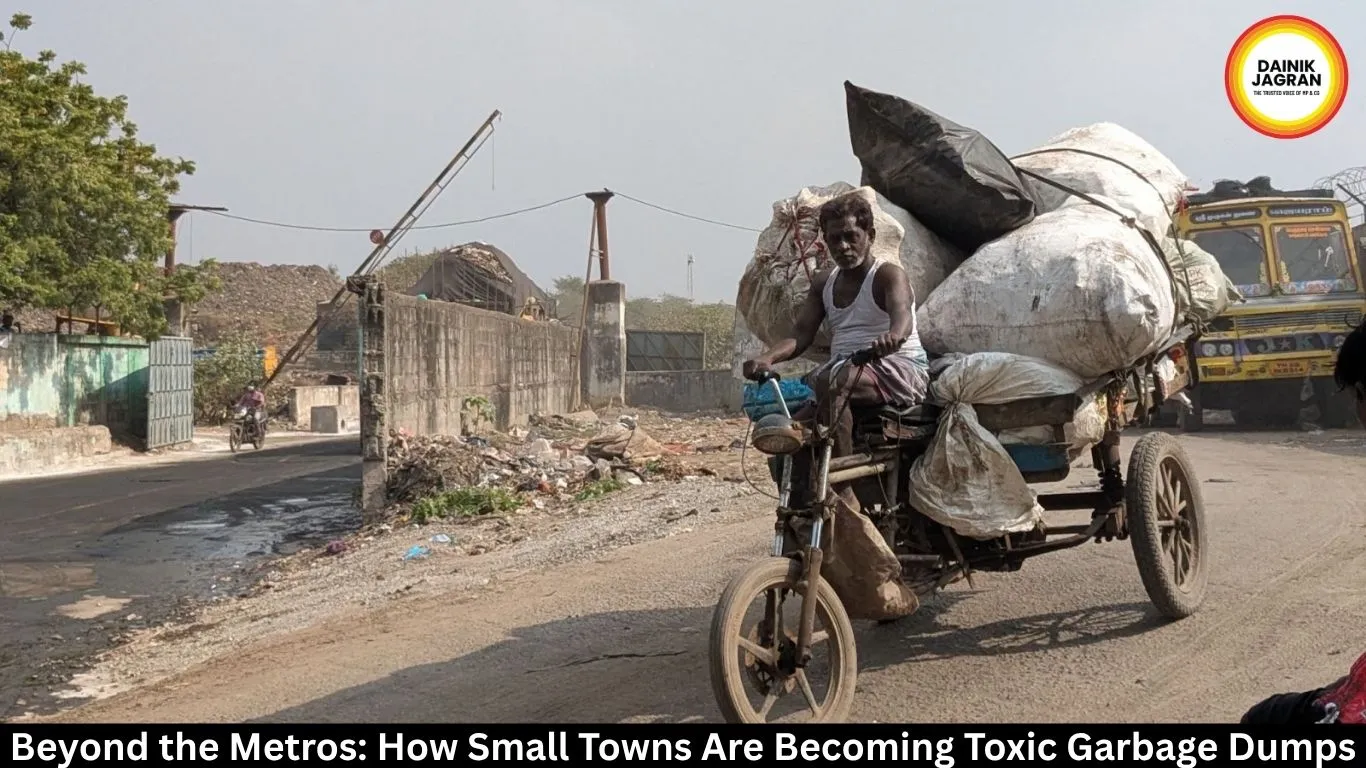
Beyond the Metros: Why India's Small Towns Are Becoming Toxic Garbage Dumps
Digital desk
India's smaller towns face a growing waste management crisis as inadequate infrastructure, poor segregation and rapid urbanisation turn emerging urban centres into toxic garbage dumps.
For years, India's waste management crisis has largely been viewed through the lens of its biggest cities. Images of overflowing landfills in Delhi, Mumbai or Bengaluru often dominate headlines, creating the impression that garbage is primarily a metropolitan problem. Yet, away from the spotlight, a far more alarming crisis is unfolding across India's small towns and semi-urban centres.
From Madhya Pradesh and Uttar Pradesh to Bihar, Rajasthan and Odisha, hundreds of municipalities are struggling to cope with rapidly increasing volumes of solid waste. What were once relatively clean towns are gradually transforming into sprawling garbage hotspots, with overflowing dumping grounds, clogged drains and polluted water bodies becoming part of everyday life.
The irony is striking. Many of these towns have grown economically, but their waste management systems have barely evolved. Population growth, rising incomes, changing consumption patterns and increasing use of plastic packaging have dramatically increased waste generation, while civic infrastructure has failed to keep pace.
Unlike metropolitan cities, most smaller municipalities lack engineered landfills, modern waste processing plants or efficient door-to-door waste segregation systems. Garbage is frequently dumped in open fields, near rivers, on village outskirts or even inside abandoned quarries. During the monsoon, rainwater carries untreated waste into ponds and streams, contaminating drinking water sources and agricultural land.
The environmental consequences extend far beyond unpleasant sights and smells. Open dumping releases methane—a greenhouse gas significantly more potent than carbon dioxide—while frequent garbage fires emit toxic pollutants that affect air quality. Plastic waste breaks down into microplastics, eventually entering soil, groundwater and food chains.
Public health is perhaps the biggest casualty. Unscientific waste disposal creates breeding grounds for mosquitoes, flies, rodents and stray animals. Residents living near dumping sites often report respiratory illnesses, skin infections and gastrointestinal diseases. Children, sanitation workers and elderly citizens remain particularly vulnerable.
One of the biggest gaps lies in waste segregation. Despite years of awareness campaigns, mixed waste continues to dominate municipal collection systems. Organic waste, recyclable materials, biomedical waste and hazardous household waste often end up in the same dumping sites. Once mixed, recycling becomes difficult and composting almost impossible.
Financial constraints compound the problem. Smaller urban local bodies often operate with limited budgets and manpower. Waste collection vehicles are inadequate, processing facilities remain underfunded, and scientific landfill development is frequently delayed. Municipalities are expected to handle increasing waste volumes without proportional growth in financial resources or technical expertise.
However, the problem is not solely administrative. Citizens also share responsibility. Disposable culture has rapidly expanded into smaller towns, while awareness about segregation, composting and responsible disposal remains limited. Plastic carry bags, single-use packaging and littering continue despite existing regulations.
The solution demands a shift from reactive garbage disposal to proactive waste management. Segregation at source must become non-negotiable. Households, institutions and commercial establishments need to separate biodegradable, recyclable and hazardous waste before collection. Municipalities should invest in decentralised composting units, material recovery facilities and scientific landfills rather than relying on open dumping.
Technology can also play a meaningful role. GPS-enabled waste collection, digital monitoring of landfill sites and data-driven municipal planning can improve operational efficiency. Equally important is empowering sanitation workers through better equipment, safety standards and formal recognition of their contribution.
Government initiatives such as the Swachh Bharat Mission have significantly improved sanitation awareness and municipal cleanliness in many areas. Yet, sustaining these gains now requires deeper investment in waste processing infrastructure, especially outside major cities. Small towns cannot remain an afterthought in India's urban development strategy.
India's urban future will not be shaped by metros alone. Hundreds of emerging towns are becoming engines of economic growth, attracting industries, educational institutions and new residents. If waste management continues to lag behind development, these growth centres risk becoming environmental liabilities rather than models of sustainable urbanisation.
Garbage is not merely a sanitation issue—it reflects governance, planning, environmental responsibility and public behaviour. The challenge before India is not simply collecting waste but managing it scientifically, sustainably and inclusively.
The country's small towns deserve clean streets, healthy neighbourhoods and environmentally secure futures. Preventing them from becoming tomorrow's toxic garbage dumps requires action today—from governments, local bodies, businesses and every citizen.
Beyond the Metros: Why India's Small Towns Are Becoming Toxic Garbage Dumps
Digital desk
For years, India's waste management crisis has largely been viewed through the lens of its biggest cities. Images of overflowing landfills in Delhi, Mumbai or Bengaluru often dominate headlines, creating the impression that garbage is primarily a metropolitan problem. Yet, away from the spotlight, a far more alarming crisis is unfolding across India's small towns and semi-urban centres.
From Madhya Pradesh and Uttar Pradesh to Bihar, Rajasthan and Odisha, hundreds of municipalities are struggling to cope with rapidly increasing volumes of solid waste. What were once relatively clean towns are gradually transforming into sprawling garbage hotspots, with overflowing dumping grounds, clogged drains and polluted water bodies becoming part of everyday life.
The irony is striking. Many of these towns have grown economically, but their waste management systems have barely evolved. Population growth, rising incomes, changing consumption patterns and increasing use of plastic packaging have dramatically increased waste generation, while civic infrastructure has failed to keep pace.
Unlike metropolitan cities, most smaller municipalities lack engineered landfills, modern waste processing plants or efficient door-to-door waste segregation systems. Garbage is frequently dumped in open fields, near rivers, on village outskirts or even inside abandoned quarries. During the monsoon, rainwater carries untreated waste into ponds and streams, contaminating drinking water sources and agricultural land.
The environmental consequences extend far beyond unpleasant sights and smells. Open dumping releases methane—a greenhouse gas significantly more potent than carbon dioxide—while frequent garbage fires emit toxic pollutants that affect air quality. Plastic waste breaks down into microplastics, eventually entering soil, groundwater and food chains.
Public health is perhaps the biggest casualty. Unscientific waste disposal creates breeding grounds for mosquitoes, flies, rodents and stray animals. Residents living near dumping sites often report respiratory illnesses, skin infections and gastrointestinal diseases. Children, sanitation workers and elderly citizens remain particularly vulnerable.
One of the biggest gaps lies in waste segregation. Despite years of awareness campaigns, mixed waste continues to dominate municipal collection systems. Organic waste, recyclable materials, biomedical waste and hazardous household waste often end up in the same dumping sites. Once mixed, recycling becomes difficult and composting almost impossible.
Financial constraints compound the problem. Smaller urban local bodies often operate with limited budgets and manpower. Waste collection vehicles are inadequate, processing facilities remain underfunded, and scientific landfill development is frequently delayed. Municipalities are expected to handle increasing waste volumes without proportional growth in financial resources or technical expertise.
However, the problem is not solely administrative. Citizens also share responsibility. Disposable culture has rapidly expanded into smaller towns, while awareness about segregation, composting and responsible disposal remains limited. Plastic carry bags, single-use packaging and littering continue despite existing regulations.
The solution demands a shift from reactive garbage disposal to proactive waste management. Segregation at source must become non-negotiable. Households, institutions and commercial establishments need to separate biodegradable, recyclable and hazardous waste before collection. Municipalities should invest in decentralised composting units, material recovery facilities and scientific landfills rather than relying on open dumping.
Technology can also play a meaningful role. GPS-enabled waste collection, digital monitoring of landfill sites and data-driven municipal planning can improve operational efficiency. Equally important is empowering sanitation workers through better equipment, safety standards and formal recognition of their contribution.
Government initiatives such as the Swachh Bharat Mission have significantly improved sanitation awareness and municipal cleanliness in many areas. Yet, sustaining these gains now requires deeper investment in waste processing infrastructure, especially outside major cities. Small towns cannot remain an afterthought in India's urban development strategy.
India's urban future will not be shaped by metros alone. Hundreds of emerging towns are becoming engines of economic growth, attracting industries, educational institutions and new residents. If waste management continues to lag behind development, these growth centres risk becoming environmental liabilities rather than models of sustainable urbanisation.
Garbage is not merely a sanitation issue—it reflects governance, planning, environmental responsibility and public behaviour. The challenge before India is not simply collecting waste but managing it scientifically, sustainably and inclusively.
The country's small towns deserve clean streets, healthy neighbourhoods and environmentally secure futures. Preventing them from becoming tomorrow's toxic garbage dumps requires action today—from governments, local bodies, businesses and every citizen.

Recommended For You
--------
🚨 Beat the News Rush – Join Now!
Get breaking alerts, hot exclusives, and game-changing stories instantly on your phone. No delays, no fluff – just the edge you need. ⚡
Tap to join:
🟢 WhatsApp Channel: Dainik Jagran MP CG
Crave more?
🅕 Facebook: Dainik Jagran MP CG English
🅧 Twitter (X): Dainik Jagran MP CG
🅘 Instagram: Dainik Jagran MP CG
Share the fire – keep your crew ahead! 🗞️🔥