

Akhtar’s interaction at the SOA Literary Festival 2025 has gone viral, showing him questioning the rationale behind women covering their faces. Responding to a student’s query, Akhtar challenged whether such practices stem from individual choice or from social conditioning. “Why should anyone be ashamed of their face?” he asked, arguing that dignity lies in decency, not concealment, and that similar standards should apply to both men and women.
Akhtar suggested that decisions around face-covering are often shaped by societal expectations rather than free will. He described the practice as driven by peer pressure and questioned its emotional and psychological implications, asking why a woman would feel compelled to hide her face in the absence of external pressure.
The renewed attention to Akhtar’s remarks comes amid widespread criticism of Nitish Kumar, who was accused of pulling down a woman doctor’s hijab during a public event. The incident drew sharp reactions from opposition leaders and civil rights groups, who described it as intrusive and disrespectful, further intensifying the national conversation around religious freedom and personal autonomy.
Clarifying his position after the video resurfaced, Akhtar took to social media to distance his critique of patriarchal practices from any form of coercion. While reiterating his opposition to the concept of parda, he strongly condemned the Bihar Chief Minister’s conduct. “I condemn it in very strong words. Mr Nitish Kumar owes an unconditional apology to the lady,” he said.
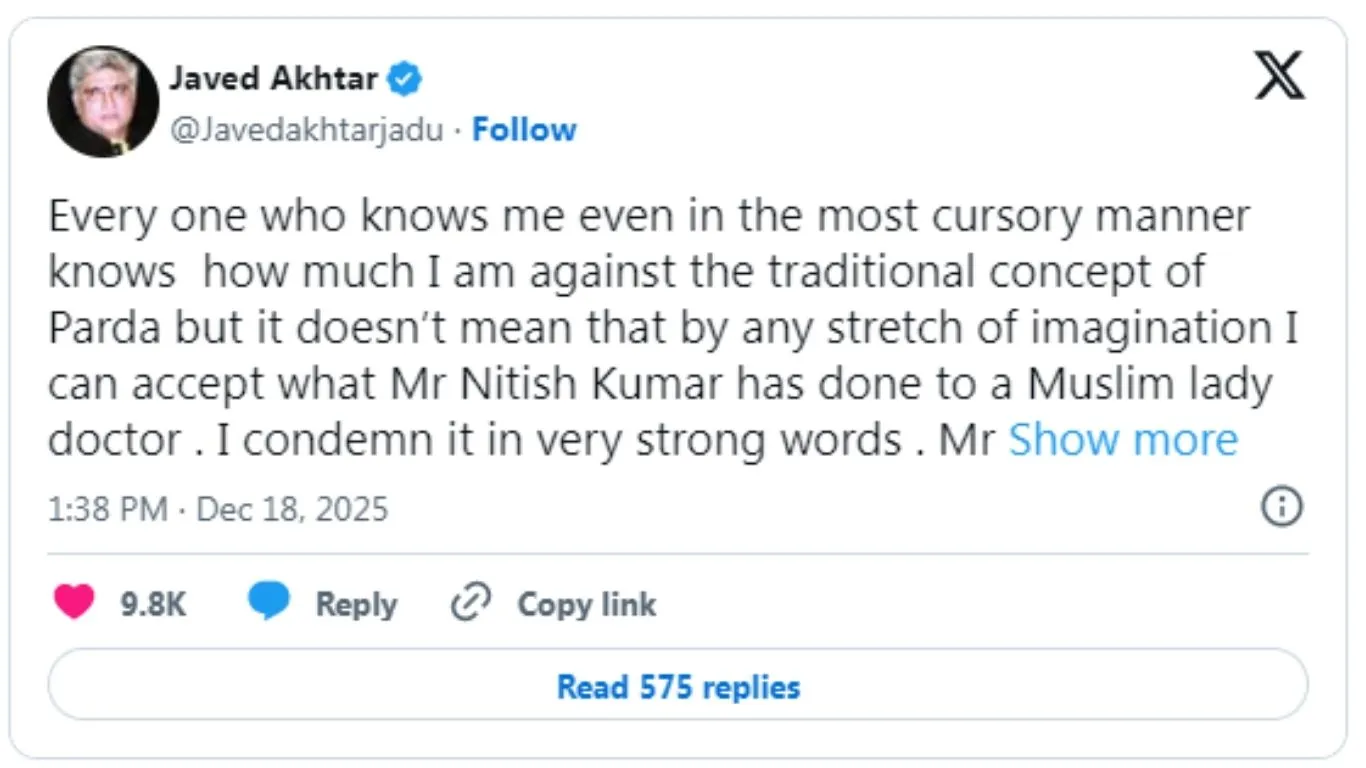
Akhtar’s clarification underscored a consistent stance he has articulated over the years: questioning social and religious norms, he argues, must never translate into violating a woman’s dignity or agency.
The convergence of these events has reopened a sensitive debate on where the line lies between critique and compulsion, highlighting the ongoing tension between cultural practices, personal freedom and respect for individual choice in public life.

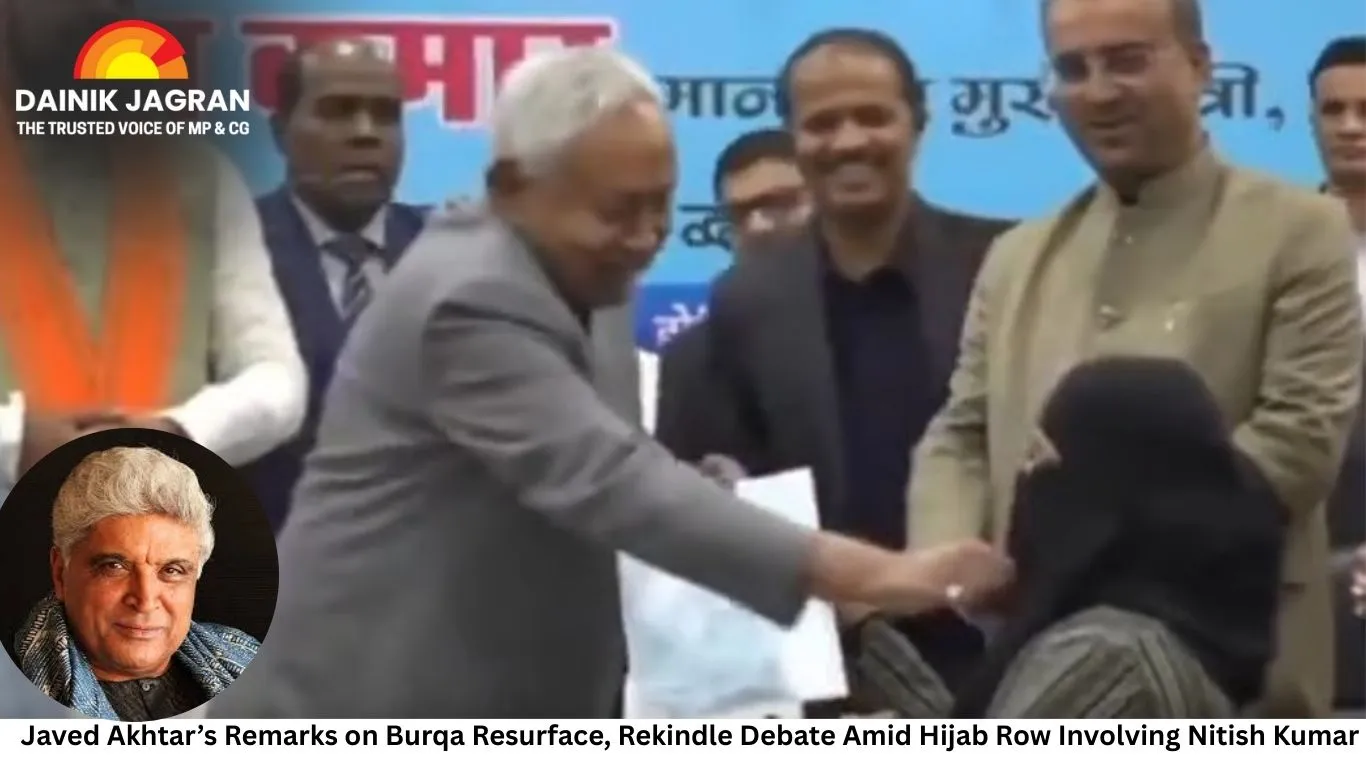
Javed Akhtar’s Remarks on Burqa Resurface, Rekindle Debate Amid Hijab Row Involving Nitish Kumar
Digital Desk
Akhtar’s interaction at the SOA Literary Festival 2025 has gone viral, showing him questioning the rationale behind women covering their faces. Responding to a student’s query, Akhtar challenged whether such practices stem from individual choice or from social conditioning. “Why should anyone be ashamed of their face?” he asked, arguing that dignity lies in decency, not concealment, and that similar standards should apply to both men and women.
Akhtar suggested that decisions around face-covering are often shaped by societal expectations rather than free will. He described the practice as driven by peer pressure and questioned its emotional and psychological implications, asking why a woman would feel compelled to hide her face in the absence of external pressure.
The renewed attention to Akhtar’s remarks comes amid widespread criticism of Nitish Kumar, who was accused of pulling down a woman doctor’s hijab during a public event. The incident drew sharp reactions from opposition leaders and civil rights groups, who described it as intrusive and disrespectful, further intensifying the national conversation around religious freedom and personal autonomy.
Clarifying his position after the video resurfaced, Akhtar took to social media to distance his critique of patriarchal practices from any form of coercion. While reiterating his opposition to the concept of parda, he strongly condemned the Bihar Chief Minister’s conduct. “I condemn it in very strong words. Mr Nitish Kumar owes an unconditional apology to the lady,” he said.
Akhtar’s clarification underscored a consistent stance he has articulated over the years: questioning social and religious norms, he argues, must never translate into violating a woman’s dignity or agency.
The convergence of these events has reopened a sensitive debate on where the line lies between critique and compulsion, highlighting the ongoing tension between cultural practices, personal freedom and respect for individual choice in public life.



.jpg)




