


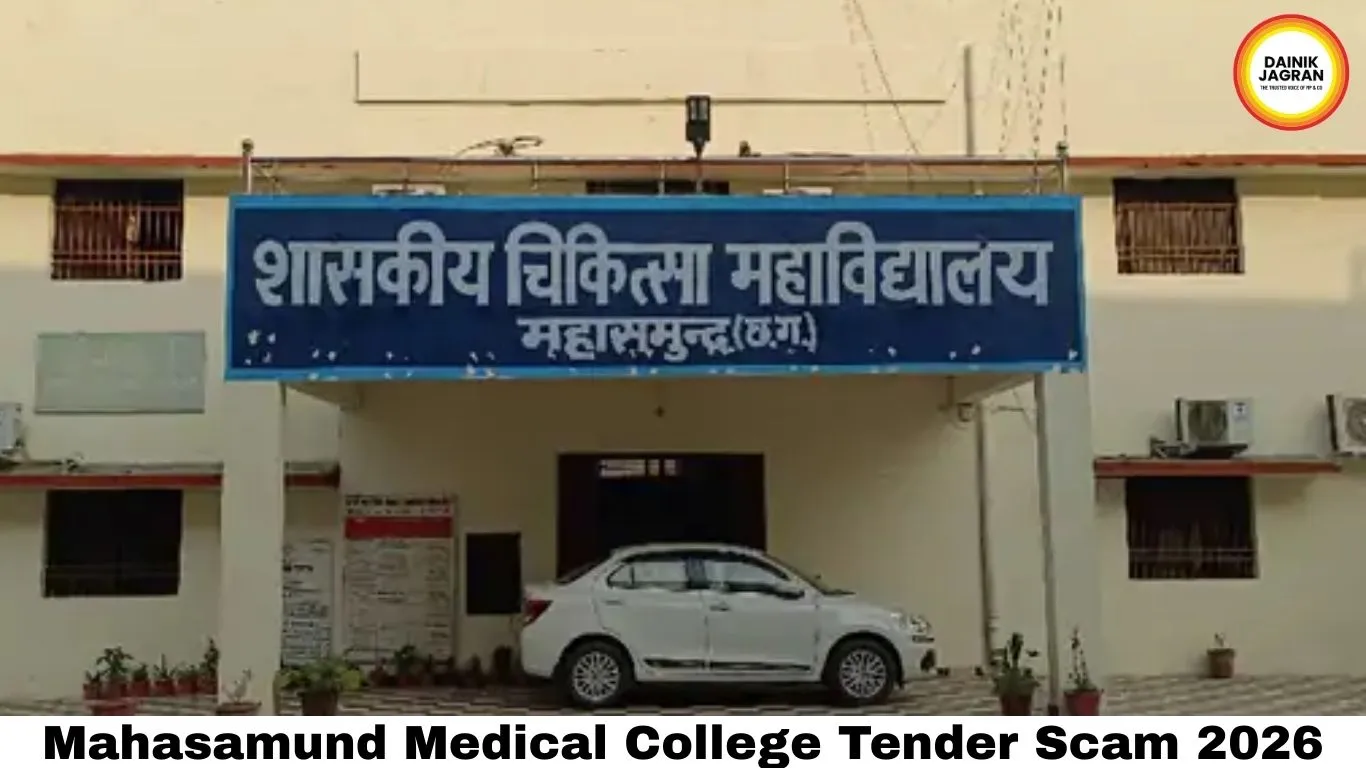
Mahasamund Medical College Tender Scam 2026: ₹1.5 Crore Contract Bypasses GeM Portal, Awarded Offline Without Dean's Approval — RTI Exposes Cover-Up
Digital Desk
A damaging procurement scandal has emerged at the Government Medical College in Mahasamund, Chhattisgarh, after a Right to Information (RTI) inquiry revealed that a contract worth over ₹1.5 crore — covering housekeeping and security guard services — was awarded through a completely offline, manual process, in deliberate bypass of the Government e-Marketplace (GeM) portal that is mandatory under Chhattisgarh's public procurement rules. The scam was executed in the absence of the college's Dean, raising serious questions about institutional accountability, possible collusion, and whether public funds have been siphoned through a rigged process.
What RTI Documents Revealed
The RTI documents paint a clear and damning picture. On January 15 and 20, 2025, members of the college's purchase committee — including its chairman, members, and clerical staff — conducted and completed the entire tender process in the absence of the Dean. Under Chhattisgarh Bhandar Kray Rules, all government procurement for services including housekeeping and manpower supply must mandatorily be routed through the GeM portal.
According to the documents, the committee did open the technical evaluation and financial bids on the GeM portal — but then abruptly exited the system within approximately half an hour, taking printouts and leaving without placing the contract order through the portal. Instead, on May 26 and June 26, 2025, offline contracts were executed — bypassing the platform entirely and issuing the work orders through manual, paper-based agreements.
Two Contracts, Two Companies, One Formula
The offline contracts were split between two private firms, each awarded an identical amount — a pattern that itself raises red flags in procurement circles:
Housekeeping contract: Awarded to Metaas Security and Fire Service Private Limited for ₹75,09,007.
Security guard contract: Awarded to Bundela Security and Consultants Private Limited for ₹75,09,007.
Combined, the two contracts total approximately ₹1.50 crore — just under thresholds that would typically trigger higher-level scrutiny or mandatory Finance Department approval.
Security Deposit Missing — FDR Not Submitted
The irregularities do not stop at the procurement process itself. RTI documents also reveal a serious lapse in the mandatory security deposit mechanism:
Metaas Security did submit a Fixed Deposit Receipt (FDR) of ₹3,20,000 from Union Bank as a security deposit against its contract.
Bundela Security's contract documents mention a security deposit of ₹2,40,000 — but there is no evidence of an FDR having been submitted. The document simply records the obligation; the money appears to have never actually been deposited.
This discrepancy suggests that even the safeguards designed to protect public funds in the event of contract default were not properly enforced.
The Smoking Gun: GeM Portal Records Deleted
The most alarming detail in the RTI response is what came next. When the RTI applicant specifically requested hard copies of documents related to the GeM portal process, the medical college administration responded in writing that the contract order copy is not available on the GeM portal.
In other words: the digital trail on the government's own procurement platform — which should contain a permanent, tamper-proof record of every step in a GeM-based procurement — has gone missing. This is not a technical glitch. Government procurement experts note that GeM portal records are maintained by the National Informatics Centre and are not deletable at the institution level without deliberate intervention. The absence of records on the portal deepens suspicion that the process was deliberately structured to avoid a digital paper trail.
Congress MLA Demands Action, Dean Defends Process
Khallar constituency MLA and Congress district president Dwarkadhish Yadav has demanded immediate administrative action. He said the matter is extremely serious, the tender was issued outside the authorised jurisdiction, and procurement rules were violated at every stage. He specifically pointed out that the in-charge Dean has no authority to exceed his or her delegated powers, and that conducting a procurement of this scale without the substantive Dean's presence and approval is itself a violation.
College Dean Dr. Renuka Gahane has pushed back, stating that rules were followed in issuing the tender and that the matter had been sent to the Health Commissioner for approval. She did not address the specific allegation that the final contract order was not placed through the GeM portal, or explain why portal records are now unavailable.
Why GeM Portal Bypass Is a Serious Offence
The Government e-Marketplace was launched by the Central Government precisely to eliminate the opacity, discretion, and corruption that characterised India's manual procurement ecosystem. All central and state government departments are required — under General Financial Rules 2017 and corresponding state procurement rules — to use GeM for procurement of goods and services above specified thresholds.
Deliberately bypassing GeM to award contracts offline is not a procedural lapse. It is a substantive violation of procurement law that can attract action under the Prevention of Corruption Act, 1988, as it creates conditions for kickbacks, vendor preference, and misappropriation of public funds. The fact that both contracts were split to an identical rupee amount — and that the GeM records have subsequently disappeared — points to a pattern, not an oversight.
What Must Happen Next
The Chhattisgarh Health Department and the Directorate of Medical Education must order an immediate independent inquiry into the Mahasamund Medical College tender. Key questions that need answering include: who authorised the offline contract after exiting the GeM portal, whether the shortlisted vendors had prior relationships with procurement committee members, why the security deposit FDR from Bundela Security was never collected, and how GeM portal records have disappeared.
The RTI applicant, the Congress MLA, and civil society organisations in Mahasamund have collectively created enough of a public record to demand accountability. The question is whether the state government — which is simultaneously defending its procurement record in the budget session in Raipur — has the political will to act against its own institutional machinery.
.jpg)




