

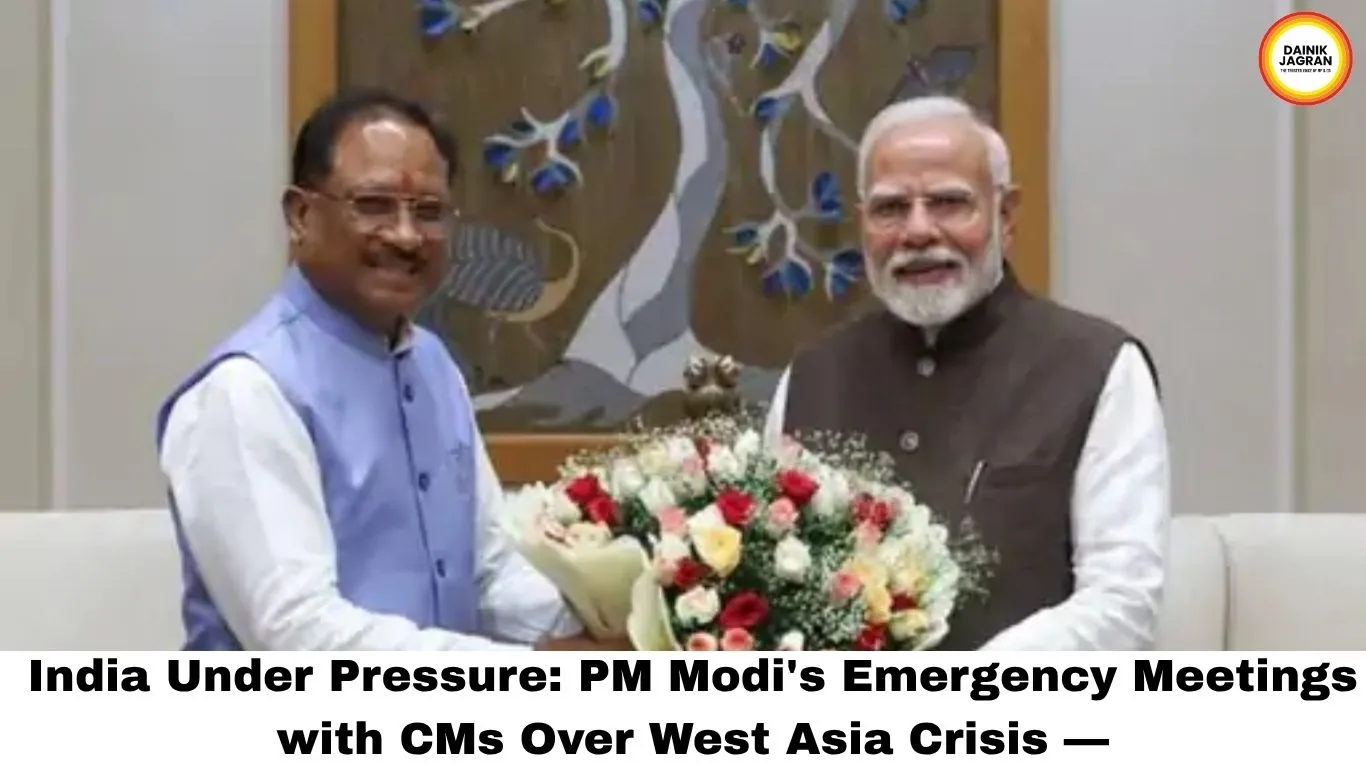
India Under Pressure: PM Modi's Emergency Meetings with CMs Over West Asia Crisis — What It Means for You
Digital Desk
PM Modi holds emergency meetings with CMs over the Iran war's impact on India. LPG shortage, fuel prices, and 1 crore Indians at risk — here's the full picture.
The West Asia crisis has landed squarely on India's doorstep — and the government is no longer treating it as a distant geopolitical problem.
Prime Minister Narendra Modi convened a virtual emergency meeting with Chief Ministers across the country to discuss the deepening impact of the Middle East conflict on India, marking a significant escalation in the domestic response to a war that began nearly a month ago. For ordinary Indians — those waiting in queues for LPG cylinders, watching fuel prices climb, or worried about relatives working in the Gulf — this meeting is the clearest signal yet that the crisis is real, it is here, and it is not going away soon.
The Scale of India's Exposure
India is not a party to this war. But it is deeply exposed to its consequences.
Nearly one crore Indians live and work in Gulf countries, and a large number of Indian crew members are employed on commercial ships operating in these waters. Their remittances sustain millions of families back home. Meanwhile, 90% of India's LPG imports pass through the Strait of Hormuz — the very waterway that Iran has now closed. The result has been predictable and painful: long queues outside fuel and LPG distribution centres have been reported across India, and the black market price for a 14.2 kg cylinder has reportedly reached ₹4,000.
This is the ground reality that no political speech can paper over.
Modi's Response: Big Picture, but Questions Remain
PM Modi addressed Parliament stating that the West Asia war has set unprecedented challenges for India, given its extensive trade relations with countries in the conflict zone and the region's critical role as a route for India's crude oil and gas needs.
The Prime Minister presented a multi-pronged strategy backed by a dedicated Inter-Ministerial Group that meets daily to monitor and resolve issues in India's import-export chain. He also highlighted that India has expanded its energy import base from 27 to 41 countries over the past 11 years, reducing dependence on any single region.
On the humanitarian front, more than 3,75,000 Indians have been safely evacuated since the war began, including over 1,000 from Iran alone — of whom over 700 were young medical students.
These are genuine achievements. But critics argue the government moved too slowly and has been diplomatically ambiguous in a crisis that demanded clarity.
The Diplomatic Tightrope — and Where India Slipped
India's foreign policy has long prided itself on "strategic autonomy." But this crisis has exposed the limits of that posture.
For decades, New Delhi cultivated parallel relationships with Israel, Iran, and the Gulf states while avoiding entanglement in their conflicts — a carefully constructed edifice that has crumbled in days. PM Modi's visit to Israel just days before the war broke out drew sharp criticism at home and abroad, giving the impression that India was seen as leaning toward one side.
At the all-party meeting, opposition leaders expressed disapproval over the government's silence on unilateral military actions against Iran, arguing that India should have taken a clearer stand on the sovereignty of a nation with which it has deep historical and economic ties.
The government's counterpoint: India quietly secured passage for four of its ships through the Strait of Hormuz — a diplomatic win, even if it fell short of a broader strategic statement.
What the Emergency CM Meeting Signals
Today's virtual meeting with Chief Ministers is significant for three reasons.
First, it acknowledges that the West Asia crisis India impact is no longer abstract — it is a ground-level emergency affecting fuel distribution, food prices, and livelihoods. PM Modi urged all states to act proactively, noting that in difficult times it is labourers and the weaker sections who are affected the most.
Second, it is a coordination exercise. States have been advised to prevent hoarding and ensure smooth distribution of essential commodities.
Third, states heading into elections will have their Chief Secretaries engage separately, reflecting both administrative sensitivity and the political tightrope the Centre is walking.
Opinion: India Needs More Than Meetings
The government deserves credit for rapid evacuation of citizens and for diversifying energy sources over the past decade — policies that are now paying dividends. The daily inter-ministerial review, the state-level coordination, and the Parliament addresses are all evidence of a government taking the crisis seriously.
But India's voice in the world is muted at a moment when it should be loudest. With nearly one crore citizens in the Gulf, billions in trade at stake, and a fuel crisis biting ordinary households, India has every right — and the moral standing — to be a leading voice for de-escalation and diplomacy in West Asia. That voice, so far, has been too cautious.
As PM Modi himself acknowledged in Parliament: the challenges ahead will test us. The emergency meetings are a start. But India needs not just a crisis management plan — it needs a foreign policy reset that matches its ambitions with its actions.
--------
🚨 Beat the News Rush – Join Now!
Get breaking alerts, hot exclusives, and game-changing stories instantly on your phone. No delays, no fluff – just the edge you need. ⚡
Tap to join:
🟢 WhatsApp Channel: Dainik Jagran MP CG
Crave more?
🅕 Facebook: Dainik Jagran MP CG English
🅧 Twitter (X): Dainik Jagran MP CG
🅘 Instagram: Dainik Jagran MP CG
Share the fire – keep your crew ahead! 🗞️🔥
India Under Pressure: PM Modi's Emergency Meetings with CMs Over West Asia Crisis — What It Means for You
Digital Desk
The West Asia crisis has landed squarely on India's doorstep — and the government is no longer treating it as a distant geopolitical problem.
Prime Minister Narendra Modi convened a virtual emergency meeting with Chief Ministers across the country to discuss the deepening impact of the Middle East conflict on India, marking a significant escalation in the domestic response to a war that began nearly a month ago. For ordinary Indians — those waiting in queues for LPG cylinders, watching fuel prices climb, or worried about relatives working in the Gulf — this meeting is the clearest signal yet that the crisis is real, it is here, and it is not going away soon.
The Scale of India's Exposure
India is not a party to this war. But it is deeply exposed to its consequences.
Nearly one crore Indians live and work in Gulf countries, and a large number of Indian crew members are employed on commercial ships operating in these waters. Their remittances sustain millions of families back home. Meanwhile, 90% of India's LPG imports pass through the Strait of Hormuz — the very waterway that Iran has now closed. The result has been predictable and painful: long queues outside fuel and LPG distribution centres have been reported across India, and the black market price for a 14.2 kg cylinder has reportedly reached ₹4,000.
This is the ground reality that no political speech can paper over.
Modi's Response: Big Picture, but Questions Remain
PM Modi addressed Parliament stating that the West Asia war has set unprecedented challenges for India, given its extensive trade relations with countries in the conflict zone and the region's critical role as a route for India's crude oil and gas needs.
The Prime Minister presented a multi-pronged strategy backed by a dedicated Inter-Ministerial Group that meets daily to monitor and resolve issues in India's import-export chain. He also highlighted that India has expanded its energy import base from 27 to 41 countries over the past 11 years, reducing dependence on any single region.
On the humanitarian front, more than 3,75,000 Indians have been safely evacuated since the war began, including over 1,000 from Iran alone — of whom over 700 were young medical students.
These are genuine achievements. But critics argue the government moved too slowly and has been diplomatically ambiguous in a crisis that demanded clarity.
The Diplomatic Tightrope — and Where India Slipped
India's foreign policy has long prided itself on "strategic autonomy." But this crisis has exposed the limits of that posture.
For decades, New Delhi cultivated parallel relationships with Israel, Iran, and the Gulf states while avoiding entanglement in their conflicts — a carefully constructed edifice that has crumbled in days. PM Modi's visit to Israel just days before the war broke out drew sharp criticism at home and abroad, giving the impression that India was seen as leaning toward one side.
At the all-party meeting, opposition leaders expressed disapproval over the government's silence on unilateral military actions against Iran, arguing that India should have taken a clearer stand on the sovereignty of a nation with which it has deep historical and economic ties.
The government's counterpoint: India quietly secured passage for four of its ships through the Strait of Hormuz — a diplomatic win, even if it fell short of a broader strategic statement.
What the Emergency CM Meeting Signals
Today's virtual meeting with Chief Ministers is significant for three reasons.
First, it acknowledges that the West Asia crisis India impact is no longer abstract — it is a ground-level emergency affecting fuel distribution, food prices, and livelihoods. PM Modi urged all states to act proactively, noting that in difficult times it is labourers and the weaker sections who are affected the most.
Second, it is a coordination exercise. States have been advised to prevent hoarding and ensure smooth distribution of essential commodities.
Third, states heading into elections will have their Chief Secretaries engage separately, reflecting both administrative sensitivity and the political tightrope the Centre is walking.
Opinion: India Needs More Than Meetings
The government deserves credit for rapid evacuation of citizens and for diversifying energy sources over the past decade — policies that are now paying dividends. The daily inter-ministerial review, the state-level coordination, and the Parliament addresses are all evidence of a government taking the crisis seriously.
But India's voice in the world is muted at a moment when it should be loudest. With nearly one crore citizens in the Gulf, billions in trade at stake, and a fuel crisis biting ordinary households, India has every right — and the moral standing — to be a leading voice for de-escalation and diplomacy in West Asia. That voice, so far, has been too cautious.
As PM Modi himself acknowledged in Parliament: the challenges ahead will test us. The emergency meetings are a start. But India needs not just a crisis management plan — it needs a foreign policy reset that matches its ambitions with its actions.


