


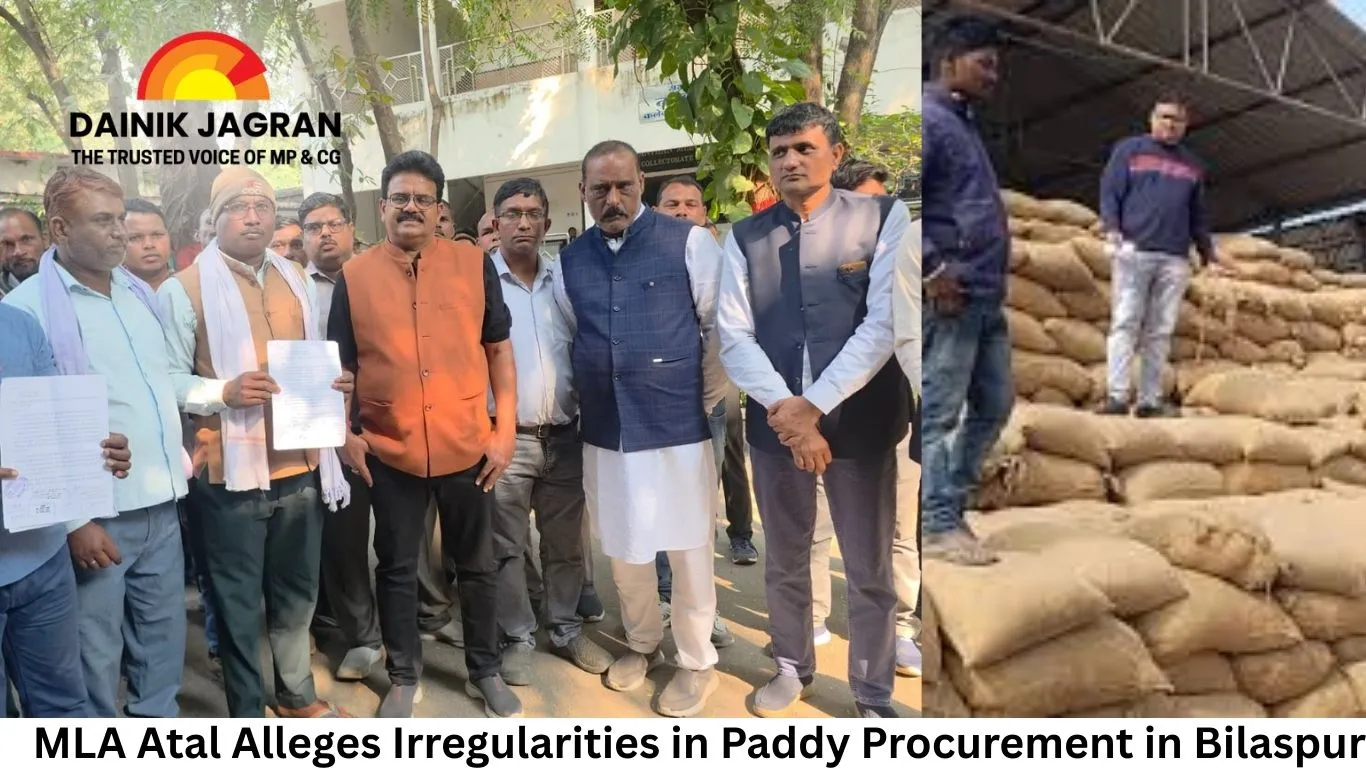
MLA Atal Alleges Irregularities in Paddy Procurement in Bilaspur; Farmers Face Distress
Digital Desk
Shrivastava alleged that, despite state government directives to procure 21 quintals per farmer, only 14 quintals are being recorded in several centers. He also highlighted that procurement has not yet started at the Dar-Sagar center in the Kota region, forcing farmers to travel long distances to sell their produce.
“The situation has created economic, physical, and mental hardships for farmers. Many refuse to sell their paddy at Belghahna mandi due to the mismanagement at local centers,” the MLA said. He urged the collector to intervene immediately and ensure proper procurement at Dar-Sagar, which covers six gram panchayats and 15 villages.
Shrivastava also pointed out the logistical burden on farmers, who are being forced to travel nearly 20 kilometers to Belghahna mandi, which already handles procurement for 25 villages and over 1.25 lakh quintals of paddy annually. The MLA further accused middlemen of colluding with officials to conduct illegal purchases.
In response, the district administration conducted raids at two locations, seizing paddy worth ₹2.13 lakh. Joint action by the revenue, food, and mandi departments recovered a total of 172 sacks, weighing approximately 69 quintals. Of these, 112 sacks were seized from a trader in Gataura, Masturi, and 60 sacks from Ashok Kumar Kashyap in Salka, Beltara.
So far, 25 cases related to illegal collection and transportation of paddy have been registered in the district, with a total of 813 quintals of paddy valued at around ₹25 lakh confiscated.
This crackdown reflects ongoing efforts to curb malpractices and ensure farmers receive fair compensation for their produce.




.jpg)




