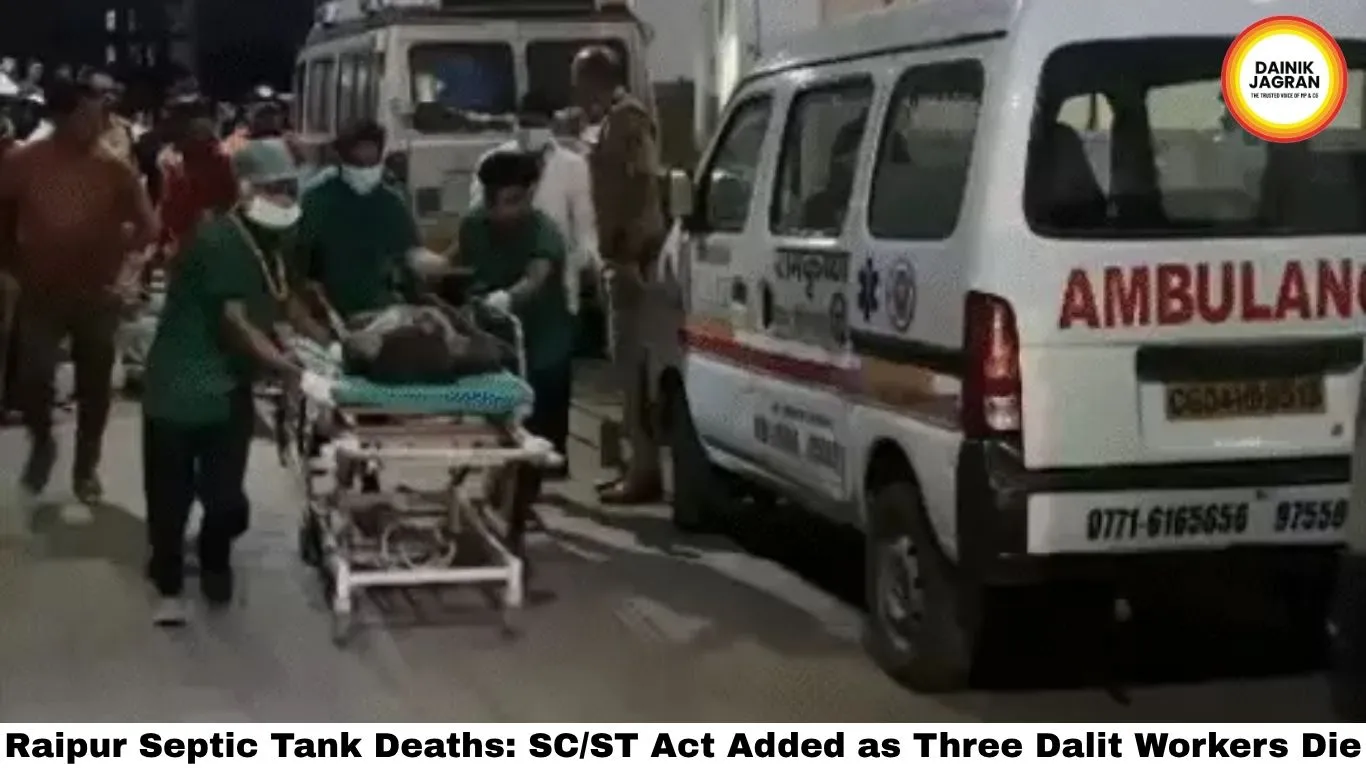
Raipur Septic Tank Deaths: SC/ST Act Added as Three Dalit Workers Die in Ramkrishna Hospital Tragedy

Digital Desk

Raipur Septic Tank Deaths: SC/ST Act Added as Three Dalit Workers Die in Ramkrishna Hospital Tragedy

Three Dalit sanitation workers died cleaning a septic tank at Raipur's Ramkrishna Care Hospital. SC/ST Act now added to FIR. Here's the full story.

Raipur Septic Tank Deaths: SC/ST Act Added as Three Dalit Workers Die in Ramkrishna Hospital Tragedy

Three young men went to work at one of Raipur's biggest private hospitals. They never came back. Now the case has a new charge — and a very old wound.


What Happened on the Night of March 17

At around 8 PM on Tuesday, March 17, 2026, three sanitation workers entered a nearly 20-foot-deep septic tank at Ramkrishna Care Hospital in Pachpedi Naka, Raipur — one of the largest and most prestigious private hospitals in Chhattisgarh.

None of them were wearing safety equipment. None of them had oxygen masks. None of them had been given protective gear of any kind.

The first worker descended into the tank on the contractor's orders and immediately lost consciousness from toxic gas exposure. The second went in to look for him — and collapsed too. The third followed — and fell the same way. A fourth worker, tied to a rope, also lost consciousness but was pulled out in time and survived.

The three who did not make it out were Anmol Manjhi, 25, Govind Sendre, 35, and Satyam Kumar, 22 — all from Simran City colony in Raipur. All three were from marginalised Dalit communities. All three were cleaning a tank inside a hospital worth crores, without a single piece of safety equipment.


The SC/ST Act Addition — And Why It Matters

In the latest development, police have added charges under the Scheduled Castes and Scheduled Tribes (Prevention of Atrocities) Act to the FIR already registered against contractor Kishan Soni.

This is significant. The SC/ST Act addition transforms this from a standard negligence case into a case that directly addresses the caste dimension of manual scavenging — the documented, undeniable reality that it is overwhelmingly Dalit workers who are sent into septic tanks, sewers, and drains without safety gear, while upper-caste supervisors and hospital administrators watch from a safe distance.

The FIR under the SC/ST Act means that if convicted, those responsible face far stricter sentencing than under ordinary negligence provisions — and cannot easily get anticipatory bail.


The Hospital's Response

Hospital Director Dr Sandeep Dave announced a compensation package of Rs 30 lakh each for the families of the three deceased workers. The hospital also committed to paying Rs 20,000 per month for the children's education and providing lifetime free healthcare to the affected families.

The compensation announcement, made swiftly and publicly, reflects the hospital's awareness of the severity of public outrage. Families and protesters gathered outside Ramkrishna Care Hospital demanding accountability — not just condolences.

The contractor responsible for hiring the workers and sending them into the tank without safety equipment has been named in the FIR. Whether the hospital management itself faces direct criminal liability under the Prohibition of Employment as Manual Scavengers and Their Rehabilitation Act, 2013 — given that the tank was on hospital premises — remains to be seen.


The Government's Response

Chief Minister Vishnu Deo Sai called the incident deeply painful and ordered strict action against all those responsible. He chaired an emergency meeting of the state monitoring committee on the Manual Scavengers Act and directed that sewer and septic tank cleaning work must henceforth be carried out only through the municipal corporation or registered agencies — with mandatory safety protocols enforced at every step.

The Chhattisgarh Human Rights Commission took suo-motu cognizance of the case, calling it a serious human rights violation, and issued a notice to the Raipur District Collector seeking a detailed report within a month.

The right words were said. The right orders were issued. The question — as it always is in these cases — is whether anyone will still be talking about Anmol, Govind, and Satyam six months from now.


A National Shame With Local Numbers

This is not a Raipur problem. It is an India problem wearing a Raipur face this week.

Between 2017 and 2023, at least 377 sanitation workers died cleaning sewers and septic tanks across India — with over 90% lacking proper protective equipment. In 2019 alone, 116 such deaths were recorded. Preliminary figures for 2024 show 52 deaths. Over a decade, more than 600 people have died doing work the law has banned since 2013.

A 2023 government survey under the Manual Scavengers Act found — officially — zero manual scavengers in any district in India. Three bodies in a Raipur septic tank say otherwise.


What Must Change

The addition of the SC/ST Act to this FIR is meaningful — but prosecutions under it are slow and convictions rare. What would actually prevent the next death is simple: mandatory third-party safety inspections before any confined space work, criminal liability for institution management — not just contractors — and a complete ban on human entry into septic tanks when machine alternatives exist.

Anmol Manjhi was 25. Satyam Kumar was 22. They were sent into a hole in the ground with no equipment, in a country that banned this practice thirteen years ago.

That is not an accident. It is a system

english.dainikjagranmpcg.com
24 Mar 2026 By Jiya.S

Raipur Septic Tank Deaths: SC/ST Act Added as Three Dalit Workers Die in Ramkrishna Hospital Tragedy

Digital Desk

Raipur Septic Tank Deaths: SC/ST Act Added as Three Dalit Workers Die in Ramkrishna Hospital Tragedy

Three young men went to work at one of Raipur's biggest private hospitals. They never came back. Now the case has a new charge — and a very old wound.


What Happened on the Night of March 17

At around 8 PM on Tuesday, March 17, 2026, three sanitation workers entered a nearly 20-foot-deep septic tank at Ramkrishna Care Hospital in Pachpedi Naka, Raipur — one of the largest and most prestigious private hospitals in Chhattisgarh.

None of them were wearing safety equipment. None of them had oxygen masks. None of them had been given protective gear of any kind.

The first worker descended into the tank on the contractor's orders and immediately lost consciousness from toxic gas exposure. The second went in to look for him — and collapsed too. The third followed — and fell the same way. A fourth worker, tied to a rope, also lost consciousness but was pulled out in time and survived.

The three who did not make it out were Anmol Manjhi, 25, Govind Sendre, 35, and Satyam Kumar, 22 — all from Simran City colony in Raipur. All three were from marginalised Dalit communities. All three were cleaning a tank inside a hospital worth crores, without a single piece of safety equipment.


The SC/ST Act Addition — And Why It Matters

In the latest development, police have added charges under the Scheduled Castes and Scheduled Tribes (Prevention of Atrocities) Act to the FIR already registered against contractor Kishan Soni.

This is significant. The SC/ST Act addition transforms this from a standard negligence case into a case that directly addresses the caste dimension of manual scavenging — the documented, undeniable reality that it is overwhelmingly Dalit workers who are sent into septic tanks, sewers, and drains without safety gear, while upper-caste supervisors and hospital administrators watch from a safe distance.

The FIR under the SC/ST Act means that if convicted, those responsible face far stricter sentencing than under ordinary negligence provisions — and cannot easily get anticipatory bail.


The Hospital's Response

Hospital Director Dr Sandeep Dave announced a compensation package of Rs 30 lakh each for the families of the three deceased workers. The hospital also committed to paying Rs 20,000 per month for the children's education and providing lifetime free healthcare to the affected families.

The compensation announcement, made swiftly and publicly, reflects the hospital's awareness of the severity of public outrage. Families and protesters gathered outside Ramkrishna Care Hospital demanding accountability — not just condolences.

The contractor responsible for hiring the workers and sending them into the tank without safety equipment has been named in the FIR. Whether the hospital management itself faces direct criminal liability under the Prohibition of Employment as Manual Scavengers and Their Rehabilitation Act, 2013 — given that the tank was on hospital premises — remains to be seen.


The Government's Response

Chief Minister Vishnu Deo Sai called the incident deeply painful and ordered strict action against all those responsible. He chaired an emergency meeting of the state monitoring committee on the Manual Scavengers Act and directed that sewer and septic tank cleaning work must henceforth be carried out only through the municipal corporation or registered agencies — with mandatory safety protocols enforced at every step.

The Chhattisgarh Human Rights Commission took suo-motu cognizance of the case, calling it a serious human rights violation, and issued a notice to the Raipur District Collector seeking a detailed report within a month.

The right words were said. The right orders were issued. The question — as it always is in these cases — is whether anyone will still be talking about Anmol, Govind, and Satyam six months from now.


A National Shame With Local Numbers

This is not a Raipur problem. It is an India problem wearing a Raipur face this week.

Between 2017 and 2023, at least 377 sanitation workers died cleaning sewers and septic tanks across India — with over 90% lacking proper protective equipment. In 2019 alone, 116 such deaths were recorded. Preliminary figures for 2024 show 52 deaths. Over a decade, more than 600 people have died doing work the law has banned since 2013.

A 2023 government survey under the Manual Scavengers Act found — officially — zero manual scavengers in any district in India. Three bodies in a Raipur septic tank say otherwise.


What Must Change

The addition of the SC/ST Act to this FIR is meaningful — but prosecutions under it are slow and convictions rare. What would actually prevent the next death is simple: mandatory third-party safety inspections before any confined space work, criminal liability for institution management — not just contractors — and a complete ban on human entry into septic tanks when machine alternatives exist.

Anmol Manjhi was 25. Satyam Kumar was 22. They were sent into a hole in the ground with no equipment, in a country that banned this practice thirteen years ago.

That is not an accident. It is a system

https://english.dainikjagranmpcg.com/states/chhattisgarh/raipur-septic-tank-deaths-scst-act-added-as-three-dalit/article-15900

Advertisement

Latest News