Raisen Fuel Panic: How WhatsApp Rumours — Not War — Emptied Madhya Pradesh's Petrol Pumps

Digital Desk

Raisen Fuel Panic: How WhatsApp Rumours — Not War — Emptied Madhya Pradesh's Petrol Pumps

Raisen and MP districts saw panic buying amid Iran war rumours. India has 60-day fuel reserves. Here's why misinformation is more dangerous than any oil shortage.

Raisen Fuel Panic: How WhatsApp Rumours — Not War — Emptied Madhya Pradesh's Petrol Pumps

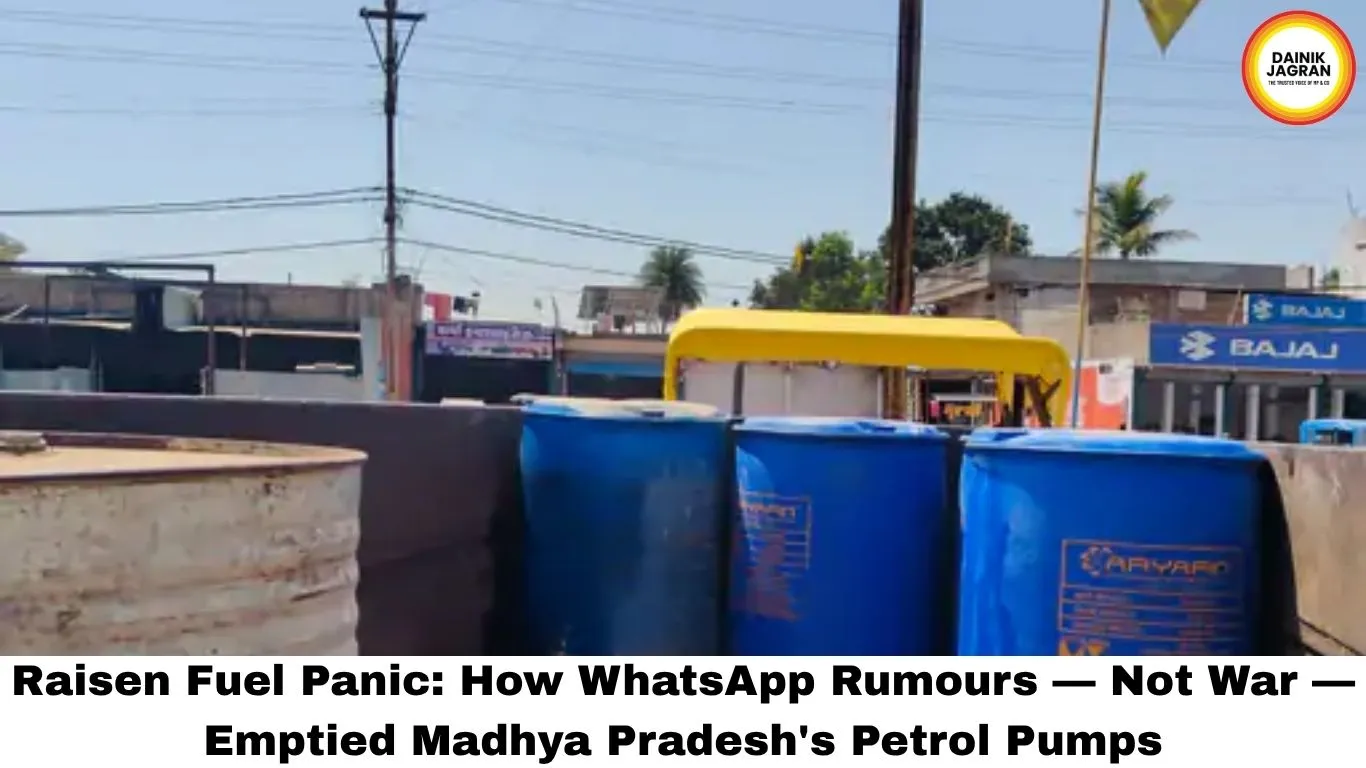
Long queues snaking out of petrol pumps. "No Stock" boards going up one after another. Residents lining up with cans, bottles, and spare tanks — desperate to stockpile fuel before it supposedly "ran out." This has been the scene across Raisen and dozens of other districts in Madhya Pradesh over the past three days. And the cause? Not a war. Not a pipeline rupture. Not a government-declared emergency. A WhatsApp message.

The great MP fuel panic of March 2026 is a textbook case of how misinformation — in a hyper-connected world — can create the very crisis it falsely predicts.


What Triggered the Rush

The chaos was set off by viral social media messages linking the ongoing US-Israel military conflict with Iran to fears of an imminent fuel shortage in India. The Strait of Hormuz — the narrow waterway through which roughly 20% of the world's oil passes — had seen disruptions, and global crude prices were climbing. That was real. What was not real was the claim that India was on the verge of running out of petrol, diesel, or LPG.

Yet the message spread fast. In Raisen, authorities were forced to impose limits on fuel sales to control the situation and prevent artificial shortages. Police personnel were deployed at pumps across multiple districts of Madhya Pradesh to maintain order. The administration also directed petrol pumps in districts like Barwani to stop dispensing fuel in gallons or drums to prevent bulk stockpiling.

Across the state, fuel consumption surged three to four times the normal rate in a single day. Nearly a dozen pumps in Bhopal ran completely dry — not because supply had failed, but because demand had been artificially inflated by fear.


The Self-Fulfilling Panic

There is a cruel irony at the heart of this story: the shortage people feared came true precisely because they feared it. When thousands of people simultaneously rush to fill their tanks "just in case," even a robust and well-stocked supply system comes under pressure. Fuel meant to last two full days was being sold out within hours at several outlets.

In Balaghat, people queued up late at night carrying bottles and cans to store fuel at home. In Ujjain, over 40,000 litres of diesel and 16,000 litres of petrol were exhausted temporarily. Dewas, Ratlam, and Shajapur reported similar scenes. In each case, the culprit was not supply failure — it was manufactured demand driven by rumour.

This is panic buying in its most destructive form: a behaviour that punishes the very community it is meant to protect.


What the Government Says — and Why It Matters

The Ministry of Petroleum and Natural Gas has been unequivocal. India currently holds approximately 60 days' worth of fuel stock — crude oil, refined petroleum products, and strategic underground reserves combined — out of a total storage capacity of 74 days. All petrol pumps across the country, numbering over one lakh outlets, are fully stocked and operating normally. There is no rationing, no emergency measure, and no actual shortage anywhere in the country.

State-run oil giants — Indian Oil Corporation, Bharat Petroleum, and Hindustan Petroleum — have all issued formal statements confirming stable supply chains and adequate inventories. Refineries are operating at full capacity. Overnight depot operations have been activated to ensure continuous distribution. The government has also extended the credit facility for petrol pump operators from one day to three days, ensuring that no pump shuts down simply due to working capital constraints.

As of March 26, petrol in Delhi was priced at ₹94.77 per litre and diesel at ₹87.67 — unchanged. In Mumbai, petrol stood at ₹103.50 and diesel at ₹90.03. The government has firmly stated that India requires none of the extreme measures being adopted by countries like Pakistan, Bangladesh, or Sri Lanka — no rationing schemes, no odd-even fuel days, no emergency closures.


India Is Not Pakistan — Context Matters

To be fair, public anxiety is not entirely irrational given the global backdrop. The US-Israel war on Iran has sent energy markets into genuine turbulence. Countries across the Global South — Pakistan, Bangladesh, Sri Lanka, Egypt — are facing severe fuel stress. Pakistan has introduced a four-day government work week and slashed fuel allowances. Bangladesh has seen pumps run dry in some districts. Egypt announced petrol price hikes of 15 to 22 percent.

These are real crises, and it is understandable that Indians — watching this unfold in real time on social media — drew parallels and worried. The Strait of Hormuz disruption is serious, and India does import significant crude from the Gulf.

But context is everything. India is the world's fourth-largest oil refiner and fifth-largest exporter of petroleum products. It imports crude from over 40 countries, maintaining a diversified supply chain specifically designed to absorb shocks of this kind. It has strategic petroleum reserves. It has secured crude procurement for the next two months. It is in a fundamentally different position from economies that import 80 to 95 percent of their energy needs from a single region.


The Real Crisis: Misinformation Infrastructure

What Raisen and the rest of Madhya Pradesh experienced this week is not a fuel crisis. It is an information crisis. A single viral message — unverified, irresponsible, and in the government's own words "deliberately spread" — was enough to overwhelm petrol pumps, disrupt traffic, and force police deployment across the state.

This should prompt serious questions. Who creates and circulates these messages? What is their motive — genuine concern, political disruption, or something more calculated? And what responsibility do social media platforms bear when their infrastructure becomes the primary vehicle for mass panic?

The lesson from Raisen is simple but urgent: in an age where a WhatsApp forward travels faster than a fuel tanker, civic literacy — the ability to pause, verify, and not react — is as critical a resource as crude oil itself.


Calm Is the First Fuel

India is not facing a fuel shortage. Raisen is not facing a fuel shortage. Madhya Pradesh is not facing a fuel shortage. What it faced this week was a crisis of collective behaviour triggered by misinformation — and the real damage was not to supply chains, but to the community's sense of calm and trust in institutions.

The queues are easing. Supply is stabilising. The administration acted swiftly. But the episode leaves behind an uncomfortable question: the next time a rumour circulates — whether about fuel, food, or something else entirely — will we be better prepared to not believe it?

Because the most dangerous shortage is not of petrol. It is of good judgment.
--------

🚨 Beat the News Rush – Join Now!

Get breaking alerts, hot exclusives, and game-changing stories instantly on your phone. No delays, no fluff – just the edge you need. ⚡

Tap to join: 

🟢 WhatsApp Channel: https://whatsapp.com/channel/0029VbAeWYG72WTxso1CFr2g

Crave more?

🅕 Facebook: English Dainik Jagran MP CG

🅧 Twitter (X): Jagran MP CG

🅘 Instagram: Dainik Jagran MP CG

Share the fire – keep your crew ahead! 🗞️🔥

english.dainikjagranmpcg.com
27 Mar 2026 By Jiya.S

Raisen Fuel Panic: How WhatsApp Rumours — Not War — Emptied Madhya Pradesh's Petrol Pumps

Digital Desk

Raisen Fuel Panic: How WhatsApp Rumours — Not War — Emptied Madhya Pradesh's Petrol Pumps

Long queues snaking out of petrol pumps. "No Stock" boards going up one after another. Residents lining up with cans, bottles, and spare tanks — desperate to stockpile fuel before it supposedly "ran out." This has been the scene across Raisen and dozens of other districts in Madhya Pradesh over the past three days. And the cause? Not a war. Not a pipeline rupture. Not a government-declared emergency. A WhatsApp message.

The great MP fuel panic of March 2026 is a textbook case of how misinformation — in a hyper-connected world — can create the very crisis it falsely predicts.


What Triggered the Rush

The chaos was set off by viral social media messages linking the ongoing US-Israel military conflict with Iran to fears of an imminent fuel shortage in India. The Strait of Hormuz — the narrow waterway through which roughly 20% of the world's oil passes — had seen disruptions, and global crude prices were climbing. That was real. What was not real was the claim that India was on the verge of running out of petrol, diesel, or LPG.

Yet the message spread fast. In Raisen, authorities were forced to impose limits on fuel sales to control the situation and prevent artificial shortages. Police personnel were deployed at pumps across multiple districts of Madhya Pradesh to maintain order. The administration also directed petrol pumps in districts like Barwani to stop dispensing fuel in gallons or drums to prevent bulk stockpiling.

Across the state, fuel consumption surged three to four times the normal rate in a single day. Nearly a dozen pumps in Bhopal ran completely dry — not because supply had failed, but because demand had been artificially inflated by fear.


The Self-Fulfilling Panic

There is a cruel irony at the heart of this story: the shortage people feared came true precisely because they feared it. When thousands of people simultaneously rush to fill their tanks "just in case," even a robust and well-stocked supply system comes under pressure. Fuel meant to last two full days was being sold out within hours at several outlets.

In Balaghat, people queued up late at night carrying bottles and cans to store fuel at home. In Ujjain, over 40,000 litres of diesel and 16,000 litres of petrol were exhausted temporarily. Dewas, Ratlam, and Shajapur reported similar scenes. In each case, the culprit was not supply failure — it was manufactured demand driven by rumour.

This is panic buying in its most destructive form: a behaviour that punishes the very community it is meant to protect.


What the Government Says — and Why It Matters

The Ministry of Petroleum and Natural Gas has been unequivocal. India currently holds approximately 60 days' worth of fuel stock — crude oil, refined petroleum products, and strategic underground reserves combined — out of a total storage capacity of 74 days. All petrol pumps across the country, numbering over one lakh outlets, are fully stocked and operating normally. There is no rationing, no emergency measure, and no actual shortage anywhere in the country.

State-run oil giants — Indian Oil Corporation, Bharat Petroleum, and Hindustan Petroleum — have all issued formal statements confirming stable supply chains and adequate inventories. Refineries are operating at full capacity. Overnight depot operations have been activated to ensure continuous distribution. The government has also extended the credit facility for petrol pump operators from one day to three days, ensuring that no pump shuts down simply due to working capital constraints.

As of March 26, petrol in Delhi was priced at ₹94.77 per litre and diesel at ₹87.67 — unchanged. In Mumbai, petrol stood at ₹103.50 and diesel at ₹90.03. The government has firmly stated that India requires none of the extreme measures being adopted by countries like Pakistan, Bangladesh, or Sri Lanka — no rationing schemes, no odd-even fuel days, no emergency closures.


India Is Not Pakistan — Context Matters

To be fair, public anxiety is not entirely irrational given the global backdrop. The US-Israel war on Iran has sent energy markets into genuine turbulence. Countries across the Global South — Pakistan, Bangladesh, Sri Lanka, Egypt — are facing severe fuel stress. Pakistan has introduced a four-day government work week and slashed fuel allowances. Bangladesh has seen pumps run dry in some districts. Egypt announced petrol price hikes of 15 to 22 percent.

These are real crises, and it is understandable that Indians — watching this unfold in real time on social media — drew parallels and worried. The Strait of Hormuz disruption is serious, and India does import significant crude from the Gulf.

But context is everything. India is the world's fourth-largest oil refiner and fifth-largest exporter of petroleum products. It imports crude from over 40 countries, maintaining a diversified supply chain specifically designed to absorb shocks of this kind. It has strategic petroleum reserves. It has secured crude procurement for the next two months. It is in a fundamentally different position from economies that import 80 to 95 percent of their energy needs from a single region.


The Real Crisis: Misinformation Infrastructure

What Raisen and the rest of Madhya Pradesh experienced this week is not a fuel crisis. It is an information crisis. A single viral message — unverified, irresponsible, and in the government's own words "deliberately spread" — was enough to overwhelm petrol pumps, disrupt traffic, and force police deployment across the state.

This should prompt serious questions. Who creates and circulates these messages? What is their motive — genuine concern, political disruption, or something more calculated? And what responsibility do social media platforms bear when their infrastructure becomes the primary vehicle for mass panic?

The lesson from Raisen is simple but urgent: in an age where a WhatsApp forward travels faster than a fuel tanker, civic literacy — the ability to pause, verify, and not react — is as critical a resource as crude oil itself.


Calm Is the First Fuel

India is not facing a fuel shortage. Raisen is not facing a fuel shortage. Madhya Pradesh is not facing a fuel shortage. What it faced this week was a crisis of collective behaviour triggered by misinformation — and the real damage was not to supply chains, but to the community's sense of calm and trust in institutions.

The queues are easing. Supply is stabilising. The administration acted swiftly. But the episode leaves behind an uncomfortable question: the next time a rumour circulates — whether about fuel, food, or something else entirely — will we be better prepared to not believe it?

Because the most dangerous shortage is not of petrol. It is of good judgment.

https://english.dainikjagranmpcg.com/states/madhya-pradesh/raisen-fuel-panic-how-whatsapp-rumours-%E2%80%94-not-war-%E2%80%94/article-16067

Advertisement

Latest News